





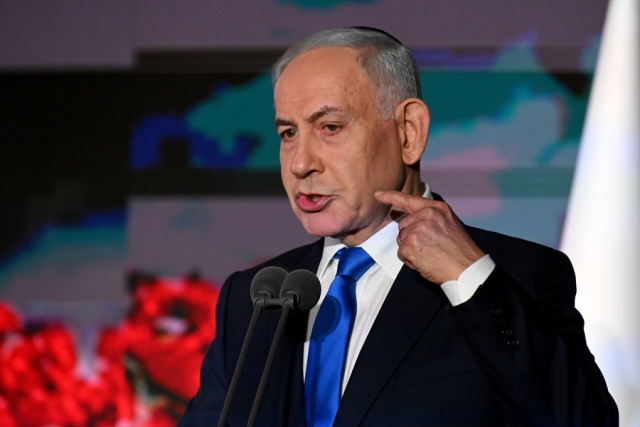
A development that could change the course of Israeli Prime Minister Benjamin Netanyahu’s long-running corruption trial came on Wednesday, when judges at the Jerusalem District Court urged prosecutors to reconsider the charges against the Israeli prime minister, expressing serious doubts about the prospects of conviction in two of the three cases against him.
The court suggested that prosecutors consider dropping the charges against Netanyahu in Case 4000, which concerns an alleged exchange of regulatory favours for favourable media coverage, and questioned whether the conduct alleged in Case 2000, which concerns Netanyahu’s discussions with Yedioth Ahronoth publisher Arnon Mozes about the possibility of more favourable coverage, constituted a criminal offence.
The judges intervened during a hearing attended for the first time by Israel’s attorney general, Gali Baharav-Miara, after the court ordered her to appear. “In our view, the public interest requires reconsideration,” presiding judge Rivka Friedman-Feldman said, speaking on behalf of fellow judges Moshe Bar-Am and Oded Shaham.
The judges clarified that their comments reflected their assessment of the evidence presented so far and did not amount to a ruling or an acquittal.
The court raised broader questions about whether the prosecution could sustain its case, going beyond the bribery charge it had previously asked prosecutors to reconsider.
Case 4000: Why the judges question the charges
Case 4000 is the most serious of the three corruption cases against Netanyahu because it includes a bribery charge.
The indictment alleges that Netanyahu advanced decisions that benefited the telecoms company Bezeq and its then controlling shareholder, Shaul Elovitch, in exchange for favourable coverage from the Walla news website, which Elovitch also controlled.
The judges identified problems with both sides of the alleged exchange. The indictment relies heavily on testimony from Shlomo Filber, the former director general of the Communications Ministry, who said Netanyahu had instructed him to act in Bezeq’s interests.
The judges questioned whether they could rely on Filber’s testimony, citing changes in his account, the way his examination unfolded and evidence that appeared to contradict his claims.
Their comments did not specifically address the testimony of Nir Hefetz, a former Netanyahu aide and another key prosecution witness in the case.
The judges also questioned the allegation that Netanyahu received an “unusually favourable response” to his requests about media coverage. They asked what objective criteria had been used to measure the alleged preferential treatment and whether the evidence established that Netanyahu knew at the time how extensive it was.
The court said those reservations also affected the breach of trust charge linked to the alleged conflict of interest. “As regards this charge, we consider the prospects of conviction low enough to warrant reconsidering the case,” the judges said.
The latest intervention went further than those in June 2023 and June 2026, when the judges asked prosecutors to reconsider the bribery charge alone. This time, they called for a broader review of the charges against Netanyahu in Case 4000. They clarified that their assessment concerned the prime minister alone. If prosecutors dropped the charges against him, the proceedings against Shaul Elovitch and his wife, Iris, would continue unless a separate decision was taken, as their criminal liability would have to be assessed separately.
Case 2000: Doubts over whether the alleged conduct constitutes a criminal offence
The judges also expressed serious reservations about Case 2000, which concerns Netanyahu’s conversations with Arnon Mozes, the publisher of Yedioth Ahronoth.
The indictment alleges that the two men discussed the possibility of more favourable coverage for Netanyahu in exchange for measures that would restrict the operations of rival newspaper Israel Hayom.
Prosecutors argue that Netanyahu continued to discuss Mozes’s proposal and that his conduct created a real possibility that he would use his powers as prime minister to advance legislation benefiting the publisher. The judges questioned whether the facts set out in the indictment and the evidence presented supported the prosecution’s legal conclusions.
The court said prosecutors should have the opportunity to present detailed legal arguments before a decision is made on how the case should proceed. The allegation that Netanyahu used the powers of his office for personal gain is also central to the case.
Case 1000: The charges that remain in focus
Case 1000 concerns expensive gifts Netanyahu allegedly received from wealthy businessmen and actions prosecutors say he took to further the interests of one of them.
The judges noted that most of the evidence had already been presented. A request to take testimony abroad from businessman James Packer is still pending.
The court suggested finding a way to complete the proceedings in the case so that it could deliver a verdict.
The judges expressed no comparable doubts about the grounds for the charges in Case 1000. They have yet to reach a verdict.
A deal to end the trial is on the table
The judges’ intervention has reopened discussion of a possible deal between the prosecution and the defence that could bring the years-long trial to an end.
Attorney General Gali Baharav-Miara defended the prosecutors’ work and said they would consider the court’s comments. She said the case could conclude either with a verdict or with an agreement that reflected the nature of the alleged conduct and offences.
Baharav-Miara reiterated that prosecutors had responded favourably to Israeli President Isaac Herzog’s initiative to open talks and said the other side had yet to reply. Netanyahu’s lawyer, Amit Hadad, called for criminal mediation to proceed and proposed a closed-door meeting with the attorney general at the courthouse to discuss a possible deal.
The possibility of seven years out of politics
One of the main obstacles to a deal is the potential political fallout from a conviction.
If Netanyahu accepted a deal involving a conviction for an offence deemed to involve “moral turpitude”, he could be required to stay out of public political life for seven years. That would have a significant bearing on his ability to remain active in Israeli politics.
Given the judges’ serious doubts about two of the three cases, it is unclear whether Netanyahu would accept a deal with such far-reaching political consequences. He has repeatedly denied wrongdoing and says he is the target of an organised campaign by police, law enforcement authorities and political rivals seeking to remove him from power.
The political implications and talks on forming a new government
The development comes at a critical point in Israeli politics, with negotiations under way to form a new government after the elections.
Likud and Gadi Eisenkot’s Yashar party are among those taking part in talks on forming a coalition government.
A deal ending Netanyahu’s trial could affect the balance of those negotiations. The judges did not link their proposals to the coalition talks.
Netanyahu was in the Knesset, Israel’s parliament, at the time of the hearing. In a speech, he discussed the evolution of democracy in the United States and the importance of the balance of power between branches of government, without directly addressing developments at the Jerusalem court.
A case that began ten years ago
Netanyahu’s legal troubles began in June 2016, when Israel’s then attorney general, Avichai Mandelblit, ordered a preliminary investigation after receiving information from the Lahav 433 police unit.
The information included a series of allegations of illegal conduct by the then prime minister.
Investigators first questioned Netanyahu in January 2017. In November 2019, Mandelblit announced his decision to bring charges in three corruption cases.
The indictment was filed in January 2020 after Netanyahu dropped his bid for parliamentary immunity. The trial began in May 2020, making Netanyahu the first serving Israeli prime minister to stand trial on criminal charges. He faced charges of fraud and breach of trust in all three cases, as well as bribery in Case 4000.
Ask me anything
Explore related questions




