





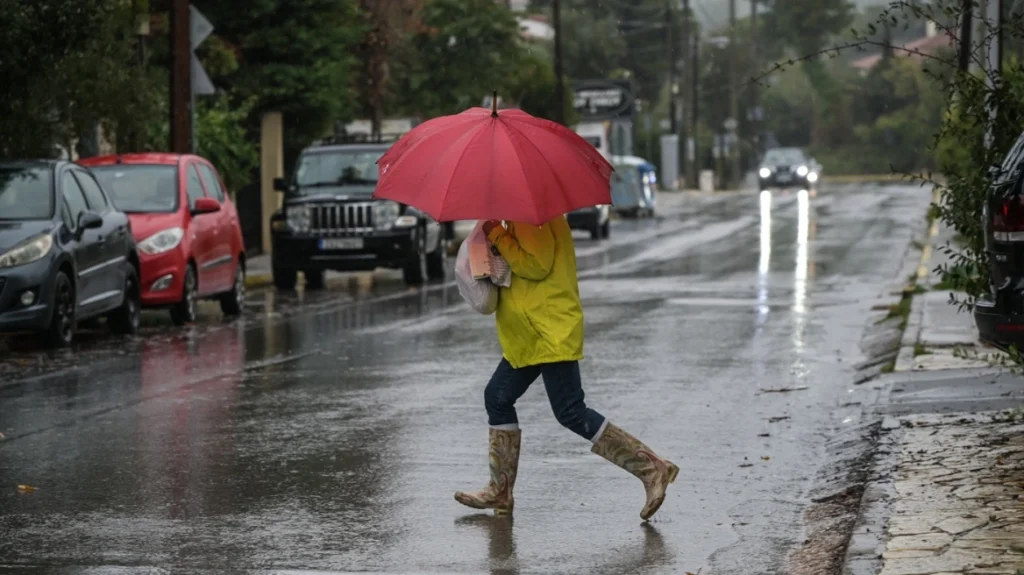
The severe weather system that began moving in from western Greece on Thursday night into Friday is now fully underway. It is progressing slowly eastwards and will affect almost the entire country over the weekend.
According to the emergency severe weather bulletin issued by the Hellenic National Meteorological Service (HNMS), today, Saturday, the Ionian Islands, Epirus and western Central Greece are under a “red” alert. Western Peloponnese has been placed under an “orange” alert, as have parts of Central Macedonia, specifically Pieria and Halkidiki, as well as eastern Thessaly, from Saturday evening onwards.
As far as Attica is concerned, rain is expected today, Saturday, mainly from the afternoon onwards. The HNMS forecast refers to isolated thunderstorms.
According to meteorologist Giorgos Tsatrafyllias, one indication of the severity of the situation is that forecasting models for the red-alert areas suggest that rainfall could amount to “the equivalent of two to three Novembers’ worth of rain by Saturday afternoon”.
Sunday will be the most difficult day
The weather is expected to deteriorate further on Sunday, when the storm front will have moved further east.
According to the HNMS, heavy rain and thunderstorms are forecast for tomorrow, Sunday, initially in Thessaly, eastern Central Greece (particularly the regional unit of Phthiotis) and Evia. Eastern and southern Peloponnese will gradually be affected as well.
In Attica in particular, large amounts of rainfall are expected, mainly in the western and northern parts of the region, from midday and throughout the afternoon.
Megara, Elefsina, Mandra, Mount Parnitha, Dionysos and Oropos are among the areas expected to receive the heaviest rainfall in Attica. Cumulative rainfall totals by the end of Sunday could locally exceed even 100 millimetres. (It should be noted that 100 millimetres of rain is equivalent to 100 litres of water per square metre.)
Significant rainfall is also forecast in central Athens, the eastern suburbs and along the coastal zone, as almost the entire region is expected to fall within the area of substantial precipitation.
The estimated cumulative rainfall totals by the end of Sunday are as follows:
- Western Attica (Megara, Elefsina, Mandra): 60–100 millimetres of rain, with the possibility of even higher amounts locally.
- Northern Attica (Mount Parnitha, Dionysos, Oropos): 70–100 millimetres, with the possibility that these figures will be exceeded in mountainous areas.
- Central Athens: 40–70 millimetres.
- Eastern Attica (Gerakas, Pallini, Rafina, Marathon): 50–80 millimetres.
- Southern suburbs and coastal zone: 40–70 millimetres.
Strong winds and falling temperatures
In addition to the rain, Sunday’s weather will be characterised by very strong northerly to northeasterly winds, reaching force 9 on the Beaufort scale and locally force 10 in the Aegean. Gusts are expected to reach up to 120 km/h in the northern Aegean and 90 km/h in Attica.
The winds are also expected to bring a drop in temperature of up to 10 degrees Celsius.
Emergency measures to protect workers during Saturday’s severe weather: What the circular provides for
The Ministry of Labour has issued a circular introducing emergency measures to protect private-sector workers in view of the extreme weather conditions expected across a large part of the country on Saturday, November 28.
The circular provides for the mandatory suspension of outdoor work, the provision of remote working arrangements and measures to facilitate employees’ arrival at and departure from work.
The text of the circular
A. Mandatory suspension of outdoor work
For employees of businesses operating in areas where extreme weather conditions are expected, according to the updated Emergency Severe Weather Bulletin (ESWB) issued by the National Meteorological Service, the suspension of work is mandatory throughout Saturday, November 28, 2026, in particular in the Region of Western Greece, the Regional Unit of the Ionian Islands and the Regional Unit of Epirus.
The measure applies to manual work carried out outdoors, such as work on technical and construction projects, building sites, shipbuilding and ship-repair zones, and the delivery and transportation of products and items using two-wheeled vehicles, scooters or roller skates (delivery services), among other activities.
It is noted that the above cases of mandatory work suspension cover all employees, regardless of their type of employment, including workers operating through digital platforms under Article 68 of Law 4808/2021.
The suspension of work does not apply to economic activities involving important and socially critical infrastructure in the fields of health, transport and public utilities (for example, healthcare facilities, water supply, electricity, air transport, ground handling, maritime, road and rail transport), provided that the necessary measures are taken to protect employees’ health and safety. These include the provision of appropriate personal protective equipment, in accordance with current legislation.
In the event of non-compliance with the obligations set out in this circular, the Labour Inspectorate will impose a fine of two thousand (€2,000) euros for each employee of the business, pursuant to Articles 23 and 24 of Law 3996/2011 (Government Gazette A’ 170).
B. Provision of remote work through teleworking arrangements
In order to protect workers in areas expected to be particularly affected, according to the updated Emergency Severe Weather Bulletin issued by the National Meteorological Service, the Ministry of Labour and Social Security recommends that private-sector businesses implement remote working wherever this is organisationally feasible.
C. Emergency measures concerning the organisation of working hours
For the purposes of implementing this circular and facilitating employees in the event that their arrival and departure times need to be changed, employers in areas expected to be particularly affected, according to the updated Emergency Severe Weather Bulletin issued by the National Meteorological Service, may refrain from registering in advance any changes to working-time arrangements in the ERGANI Information System.
Ask me anything
Explore related questions




