

×
GreekEnglish

×
  • Politics
  • Diaspora
  • World
  • Lifestyle
  • Travel
  • Culture
  • Sports
  • Cooking
Saturday
17
Jan 2026
weather symbol
Athens 11°C
  • Home
  • Politics
  • Economy
  • World
  • Diaspora
  • Lifestyle
  • Travel
  • Culture
  • Sports
  • Mediterranean Cooking
  • Weather
Contact follow Protothema:
Powered by Cloudevo
> Culture

“Dead nails” used in Roman grave to protect the living from restless dead

Ancient Romans feared the “restless dead” and would take magical precautions to protect themselves from these potentially dangerous beings

Newsroom March 16 05:01

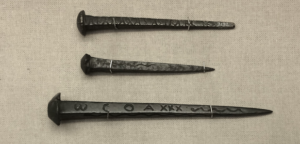
Belgian archaeologists digging at the site of the ancient Roman city of Sagalassos in southwestern Turkey recently unearthed a most unusual burial. The tomb held the cremated remains of a man who’d lived in the second century AD, and what made this burial so remarkable is that it was sealed with two dozen bricks and an additional layer of plaster. Topping everything off, more than three dozen bent nails were sprinkled around the edges of the tomb as well, presumably as magic talismans meant to keep the deceased person trapped inside.

According to the Belgian archaeologists, all these steps were taken to prevent the return of a wandering spirit, who might have the capability of rising from the grave even after cremation. In an article just published in the journal Antiquity, the study authors explained that the ancient Romans feared the “restless dead” and would take magical precautions to protect themselves from these potentially dangerous beings.

See Also:

>Related articles

Trump threatens tariffs against those who oppose U.S. plans for Greenland

CIA chief in Venezuela meets with Rodriguez

Ballistic missile strike hits pier in Ukraine

Uncontrolled Chinese rocket segment disintegrated over Texas

“The burial was closed off with not one, not two, but three different ways that can be understood as attempts to shield the living from the dead—or the other way around,” study first author  Johan Claeys , an archaeologist at Catholic University Leuven (KU Leuven) in Belgium, told Live Science .

Read more: Ancient Origins

Ask me anything

Explore related questions

#archaeology#culture#grave#roman#world
> More Culture

Follow en.protothema.gr on Google News and be the first to know all the news

See all the latest News from Greece and the World, the moment they happen, at en.protothema.gr

> Latest Stories

Mitsotakis on the Karystianou party: “There is a long distance between being the parent of a tragedy victim and being the leader of a political party”

January 17, 2026

Patras in carnival mode – This evening, the city’s official opening ceremony

January 17, 2026

Greenland as the first line ofdefense for the U.S. and NATO:

January 17, 2026

Changes at top universities: Oxford abolishes the term ‘doctores’ for inclusion reasons

January 17, 2026

Where affordable housing falls short in Greece: IOBE proposes a cap on rent increases

January 17, 2026

Weather: Noticeable drop in temperature from today – Where it will snow and at which altitudes

January 17, 2026

One dead after train–bus collision at the Port of Hamburg – see photos

January 16, 2026

President of Air Traffic Controllers: Another communications blackout possible in the near future

January 16, 2026
All News

> Lifestyle

A treat for readers: Dior, bags, and literature

The fashion house Dior starts 2026 with a dreamy new campaign

January 16, 2026

Sophie Turner’s first photo as Lara Croft released for Tomb Raider series

January 15, 2026

Vicky Chatzivasileiou: “I never gave up anything for television — It’s not my whole life”

January 15, 2026

Nikki Glaser reveals jokes cut from her Golden Globes hosting set

January 15, 2026

Next-level skylines: The towers transforming cities in 2026

January 13, 2026
Homepage
PERSONAL DATA PROTECTION POLICY COOKIES POLICY TERM OF USE
Powered by Cloudevo
Copyright © 2026 Πρώτο Θέμα



