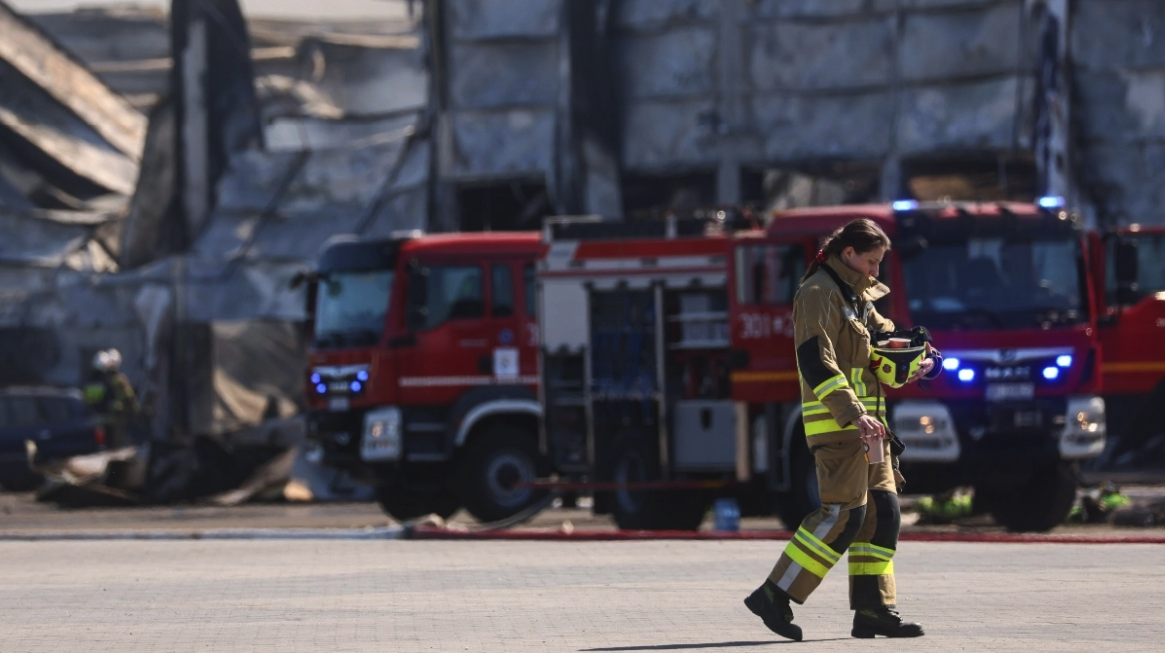
Security services in Europe are on high alert after a series of mysterious fires and attacks on infrastructure in the Baltics, Germany and the UK.
Security services have not ruled out that these actions are a potential new weapon for Russia to use to destabilise Europe.
As the British Guardian reports, the fire that broke out at IKEA in Vilnius, Lithuania this month went virtually unnoticed until Polish Prime Minister Donald Tusk did not rule out that it could be the work of a foreign saboteur.
Already, authorities have suggested that Russian involvement in an arson attack in east London, a fire that destroyed Poland’s largest shopping mall, an attempted sabotage in Bavaria and anti-Semitic graffiti in Paris have not been ruled out.
They are alarmed over concerns of sabotage
Although there is no evidence that any of the incidents are coordinated, security agencies believe they could be part of an effort by Moscow to destabilise the West, which has sided with Ukraine. Since the Cold War, foreign intelligence operations have consisted of spies and their handlers. But in the age of social media, saboteurs can be recruited, taking a reward of a few hundred euros or cryptocurrency.
The issue was also discussed at a summit of foreign and defence ministers in Brussels this week, with security officials from the Netherlands, Estonia and Lithuania warning of national vulnerabilities.
One minister, who asked not to be named, said they were deeply concerned about “sabotage, physical sabotage, organised, financed and carried out by Russian proxies”.
The attacks that cause concern
Last week, Tusk revealed that Polish authorities had arrested nine people in connection with acts of sabotage allegedly committed at the behest of Russian agencies. He said the crimes allegedly included “beatings, arson and arson attempts”, while investigators are looking into whether Russia was involved in the Warsaw shopping centre fire, an allegation the Russian embassy called a conspiracy theory.
An Ikea spokesman said investigations were continuing into the cause of the fire in Lithuania, but it was among the examples, along with an arson attempt at a paint factory in Poland, that Tusk cited in his warning of possible foreign involvement.
In April, a British man was accused of orchestrating an arson attack on two plants linked to a Ukrainian businessman at an industrial site in Leighton, east London, after allegedly being recruited by Russian intelligence services. The Crown Prosecution Service claimed he “engaged in conduct targeting businesses linked to Ukraine in order to benefit the Russian state”.
“Russia is increasingly aggressive”
On Tuesday, Estonian Defence Minister Hanno Pevkur, who is in Brussels for an EU defence summit, said the country had already been the victim of Russian sabotage.
“They have carried out similar operations in Estonia. They hired 10 people to attack the car of the interior minister and the car of a journalist. This is normal Russian behaviour.
We are sorry to say it, but we have to understand that Russia is increasingly aggressive towards European countries and NATO countries,” he said, referring to incidents in February when they smashed the windows of the cars of Interior Minister Lauri Läänemets and a journalist.
Six people were arrested shortly afterwards, including Russian nationals and dual Russian-Estonian citizens, the prosecutor said.
They are investigating sabotage
In Germany, there are also suspicions of attacks led by foreign intelligence agencies, in addition to a wave of cyberattacks in 2023 by a hacker group linked to Russian intelligence agencies.
Last month, two German-Russian nationals were arrested on suspicion of planning sabotage attacks, including on a military base in Bavaria. The main suspect is accused of planning an explosion, arson and maintaining contact with Russian intelligence services.
Investigators in France are looking into whether the graffiti painted on the Holocaust memorial in Paris last week was commissioned by Russian security services.
Last year in Paris, some people spray-painted the Star of David on buildings in and around Paris, sparking fears of a repeat of Nazi-era attempts to identify Jewish homes. Authorities later said they believed the attack may have been a “claim” by a person living abroad.
The Athens school bomb hoax
The attacks, European officials fear, add to an already proliferating campaign of misinformation.
The Guardian report recalls that on Wednesday, several schools in Attica were evacuated after a bomb call turned out to be a hoax. Police traced it to a Russian server and said the hoax was aimed at “disturbing public order”.
EU countries are following these events. Lithuania’s National Crisis Management Centre (NKVC) has warned businesses, including shopping centres and organisations supporting Ukraine, to increase their vigilance.
Vilmantas Vitkauskas, head of the NKVC, told reporters two weeks ago: “The threat level is quite high. We urge the public to remain vigilant.”
“We are vulnerable.”
The Netherlands was warned of espionage and preparation for sabotage of vital infrastructure, with the Dutch defence minister telling the Brussels summit that Russia was “trying to intimidate” NATO countries, making EU member states vulnerable.
“Yes, we are vulnerable. I think we all are. We have vital infrastructure. We have infrastructure at the bottom of the sea, we have electricity supplies, water supplies, we are vulnerable to cyber attacks. We see now in several European countries that Russia is trying to destabilise us and also to intimidate us.
“I think that’s been a way that Russia and also the Soviet Union have operated throughout recent history, really; in the 75 years of NATO I think we’ve seen it a lot,” he said.
NATO Secretary General Jens Stoltenberg also pointed to Moscow. “We’ve seen a number of arrests across the alliance and in various NATO allies of people accused of arson or sabotage.
These are, of course, ongoing legal proceedings,” he said. “But what I can say is that we have seen increased Russian intelligence activity across the alliance. As a result, we have increased our vigilance.”
Ask me anything
Explore related questions