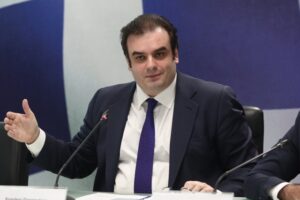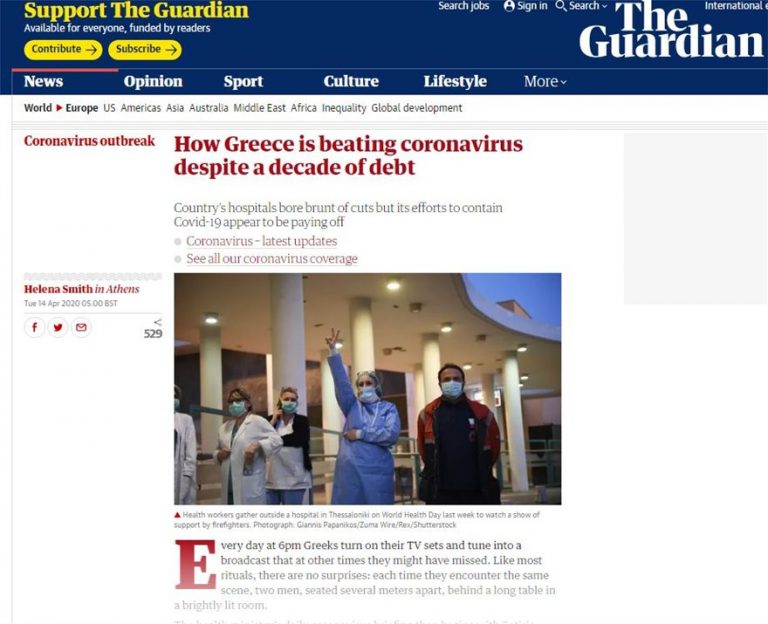
Every day at 6pm Greeks turn on their TV sets and tune into a broadcast that at other times they might have missed. Like most rituals, there are no surprises: each time they encounter the same scene, two men, seated several meters apart, behind a long table in a brightly lit room.
The health ministry’s daily coronavirus briefing then begins with Sotiris Tsiodras, a soft-spoken Harvard-trained professor of infectious diseases, delivering the latest facts and figures with the occasional emotional plea. Nikos Hardalias, the civil defence minister, invariably follows, invoking the gravity of the situation with warnings that Greeks “must stay at home”.
The bookish professor and no-nonsense former mayor are the faces who have come to be associated with the government’s drive to contain the spread of Covid-19. Their efforts at keeping the country virus-safe appear to be paying off: in a population of just over 11 million, there were, as of Monday, 2,145 confirmed cases of coronavirus and 99 fatalities, far lower than elsewhere in Europe. Italy to date has registered 20,465 deaths.
Greece, it is generally agreed, is having a better crisis than may have been expected. Tsiodras recently allowed himself to speak of “a flattening of the curve” even if authorities accept that the prospect of Orthodox Easter, on 19 April, is unlikely to be without challenge. Traditionally, Greeks flock to ancestral villages in the countryside to celebrate the biggest festival in their religious calendar.
Hellenic Chamber of Hotels presents relief proposals for after the pandemic
The country’s ability to cope with a public health emergency of such proportions was not a given. After almost a decade embroiled in debt crisis – years in which its economy contracted by 26% – Greece’s health system has far from recovered.
State hospitals bore the brunt of cuts demanded in return for rescue loans from international lenders to keep the nation afloat and in the eurozone. With the epidemic’s arrival in Europe, officials were forced to acknowledge, 18 months after the country exited its third bailout, that it had only 560 intensive care unit (ICU) beds.
It was a stark reality that left no room for mitigation strategy, or contemplating policies of achieving “herd immunity”.
Greece, like Italy, also has a large elderly population, with about a quarter of pensionable age. “There were realities, weaknesses, that we were very aware of,” said Dr Andreas Mentis who heads the Hellenic Pasteur Institute. “Before the first case was diagnosed, we had started examining people and isolating them. Incoming flights, especially from China, were monitored. Later, when others began to be repatriated from Spain, for example, we made sure they were quarantined in hotels.”
COVID-19 crisis threatens to double Turkey’s unemployed
Mentis sits on the scientific committee that advises the centre-right government on the deadly disease. What is increasingly being seen as textbook crisis management, even by political foes, has been attributed as much to prioritising science over politics as to a managerial approach that focused on what the 51-year-old prime minister, Kyriakos Mitsotakis, has described as “state-sensitivity, co-ordination, resolve and swiftness”.
Alex Patelis, Mitsotakis’ economics adviser, said: “There are problems you can solve through spin and others that require truth and transparency. It was very clear we needed experts and we needed to listen to them. That said, Greeks have been through crisis; they know what it is. I think that also enabled them to adapt and be stoic.”
From the outset the 25-strong committee pushed for the socially disruptive choice of lockdown, a devastating option for a country that had only just begun to show signs of economic rejuvenation.
Read more: The Guardian
Ask me anything
Explore related questions