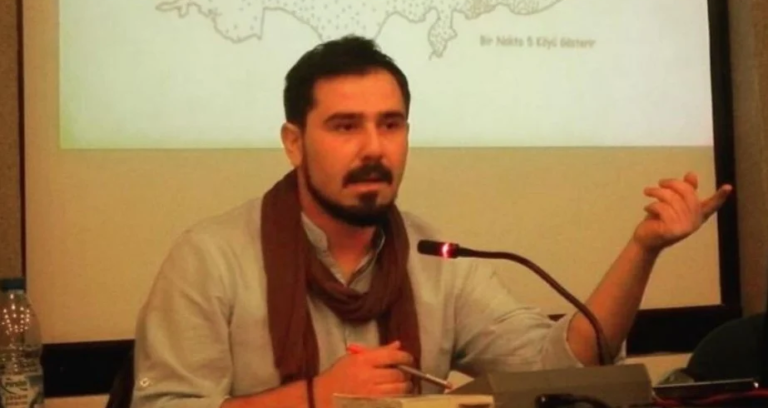
The young Turkey born researcher Mert Kaya searched for his roots and discovered that he is the great-grandson of a Pontian Greek who was left behind in the population exchange in 1923-24 and was Islamised.
His intensive study has just been published in Greek and he states that “Memory is a place for battles”.
Kaya was born and raised in Smyrna (Σμύρνα, Turkish: İzmir).
He studied Sociology at the Middle East University of Technology with a postgraduate degree in Cultural Studies and Media from Hacettepe University. His dissertation was a memorial research on the Islamisation of the Greeks of the East in 1919-1925.
The interest did not arise by chance; one day, when he was 10 years old, one of his aunts had returned from her first trip abroad, to Greece, and she was telling her brothers about her experience. When the conversation got “heavy,” the adults took the children out of the room and watched a video showing an elderly man greeting them, saying “I miss you so much.”
Over the years, and by persistently asking, Mert learned a different truth about the origins of his mother’s family: their roots were not in the Bitlis, a city in eastern Turkey inhabited mainly by Kurds, but rather from in Amasya (Ἀμάσεια) in Pontus, today’s Turkey’s southeastern Black Sea coast. They were Pontian Greeks, most of whom escaped to Greece, except for Mert Kaya’s great-grandfather Ishak, who was left behind, adopted by a Kurdish family and gradually converted to Islam and moved with them to Bitlis.
Looking for the traces of his ancestors in Greece and Turkey, Mert Kaya unraveled the thread of people who stayed behind and embraced Islam to survive. The children and grandchildren of those who experienced its events narrated the experiences of migration, residence, Islamisation, assimilation and cultural integration as they experienced them before, during and after the “population exchange”.
The oral stories that he collected became his dissertation that was published in 2019 and a few days ago was published in Greek with the title “The Islamization of the Greeks of Asia Minor in the period 1919-1925. A study of memory” by Kyriakidis publications.
He is currently a PhD candidate in the Department of Communication Sciences at Hacettepe University and works as a sociologist at the UNESCO branch in Smyrna. This is his story.
Why Athens is becoming a magnet for young expats
What is your family history? What did you know about it until you did your research?
– My parents were born in Bitlis, a city in eastern Turkey, and moved to Smyrna in the late 1970s. I grew up with Turkish and Kurdish culture. I had no idea about my Greek origin. I was educated in classical Turkish history and under pressure of ethnocentric ideology.
If you live and grow up in Smyrna, your enemy is the Greeks. They taught us that the Greeks invaded our lands and we had a war with them.
There was basically no family history. No one mentioned the past – only some happy stories from childhood and difficult living conditions, especially during winters. When I compared my mother and father’s families, I found my father more conservative. On my mother’s side, they are more open-minded and not conservative. I always feel more intimate with my mother’s side; I share and communicate more with them. Although I knew nothing about family history, I already felt closer to my mother because of their views.
Continue here: Greek City Times
Ask me anything
Explore related questions