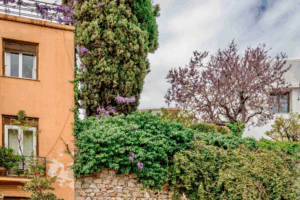
Kolonaki rises from the former royal quarter of Athens like a well-tailored jacket shrugged effortlessly over Lycabettus Hill. Its name – a nod to the lone, waist-high column still anchoring the neighborhood’s main square – is almost comically understated for a district that has long defined Athenian polish. In the late 19th century, when the capital began inching uphill from the palace gardens, diplomats and doyennes claimed these terraces of sunlight and marble for themselves, commissioning neoclassical townhouses whose iron balconies still catch the afternoon breeze.
The topography dictated an elegant choreography: slender streets curl around the hillside, stitched together by stone staircases and pavements veined with gray Pentelic marble. Early-20th-century façades, all stucco swags and Ionic pilasters, rub shoulders with sober post-war apartments – a visual dialogue that feels less like a compromise than a perfectly judged mix. In the cafés you can still overhear the low thrum of academics parsing philosophy or politicians rehearsing sound bites, a reminder that Kolonaki’s cachet has always been intellectual as much as material.
Yet the mood is anything but hushed. Perfume counters glow beneath vaulted ceilings, gallerists prop open glass doors, and dinner reservations are a competitive sport. Kolonaki today balances residential composure with a cosmopolitan energy that starts with sunrise espresso and ends, many glasses of Assyrtiko later, on a rooftop terrace facing the Acropolis lights.
Read more at Travel.gr/en
Ask me anything
Explore related questions