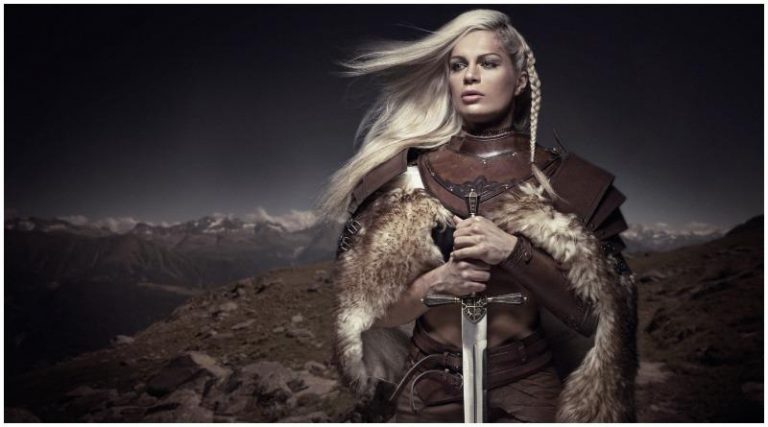
When you think of “Old English,” do you think about struggling through the Canterbury Tales or Beowulf? Old English, or Anglo-Saxon, was a language spoken by the Angles and the Saxons, the first two Germanic tribes to settle in the British Isles.
Why is it so hard, then, for modern English speakers to read Old English? In terms of grammar, sentence structure, and vocabulary, Old English is much more like Dutch and German (to which it is related) than to modern English, according to Babbel.

(Buildings in old Viking village in Iceland)
If you’re wondering how that happened, it’s because of the Norman French invasion in 1066. The influx of French rulers and nobility for the next 300 years led to a lot of French words filtering into the language we know as English. Today, almost 30% of the words in the English language come from French. Modern English is thought of as having West Germanic roots with a heavy French influence, but there is a missing piece of the language puzzle: The Vikings!
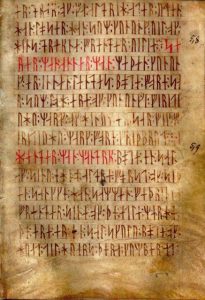
(Codex runicus, a vellum manuscript from c. 1300 containing one of the oldest and best-preserved texts of the Scanian law (Skånske lov), written entirely in runes)
“Viking” really means a seagoing expedition in Old Norse. Vikings, then, were men from Denmark and Norway who spent their summers going to sea and colonizing and/or pillaging along the way. By the 870s, the Danes had largely given up the raiding and many had settled across Northern England.
England even had Danish kings for about 30 years. The Norman invasion in 1066 put an end to Danish influence of English culture in most ways, but the Viking language persisted. There are many words in modern English that go back to those Viking settlers, according to Ancient Origins. Here are just a few of them.
WRONG: Even though you might hate to admit it, if you thought “wrong” was an entirely English word, you are mistaken. The word comes from the Old Norse “rangr,” which the Danes shifted to “vrang,” and in English eventually became “wrong.”
CAKE: These sweet baked treats get their name from the Old Norse “kaka,” which is what the Vikings used to describe a little cake.
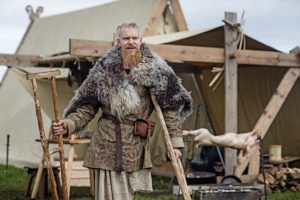
UGLY: The Danes would describe someone who they thought wasn’t at all attractive as “uggligr,” which came from the word “ugga,” which means “to fear.” “Ugly” literally comes from the idea of being scary looking – a definite advantage in a Viking warrior.
The Viking influence is also felt in our days of the week. Tuesday, Wednesday, and Friday are sometimes attributed to the gods Tyr, Odin, and Freya, although really the sources are Tiw, Wodan, and Friga, who were the Anglo-Saxon versions of the same deities. Thursday, of course, is Thor’s day. The similarity in the names here shows how closely related the groups were, even before coming to England.
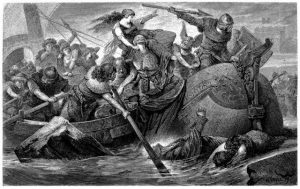
A number of the words we use relating to war and violence also have their roots in the Viking’s language, such as “gun,” which was “gunn” in Old Norse, which comes from the female name Gunnhildr and translates as war or battle. Clearly, the Norse were no strangers to headstrong women. We also get the words “club,” “slaughter,” “ransack,” and “scathe” courtesy of the Vikings. Probably one of the most well-known words in this area is “berserk,” which comes from “bersrkr,” a Viking warrior who would go into battle wearing animal skins instead of armor, and who was said to go into intense battle rages.
There are also plenty of words in English with Norse roots that refer to more civilized aspects of life, such as “husband” and “thrift” (which means prosperity in Old Norse). We have words related to society, such as “by-law” and “tidings.” There are even words that refer to the landscape around us that are still in use today, such as “dirt,” “muck,” and “mire.”
In many ways, the modern English language is more closely related to those in Scandinavia than many people think, and more closely related to their language than English is to Old English, which suggests that the Viking influence seeped its way into the language of the Anglo-Saxons, as well.

Some linguists even think that English should be reclassified as a Northern Germanic language, like the Scandinavian languages, instead of branding it as being Western Germanic, like German and Dutch. We really do still speak Viking.
Source: thevintagenews
Ask me anything
Explore related questions