





The war in Ukraine has many fronts – it’s not just about weapons on the battlefields between the Russian invaders and the Ukrainians defending their country.
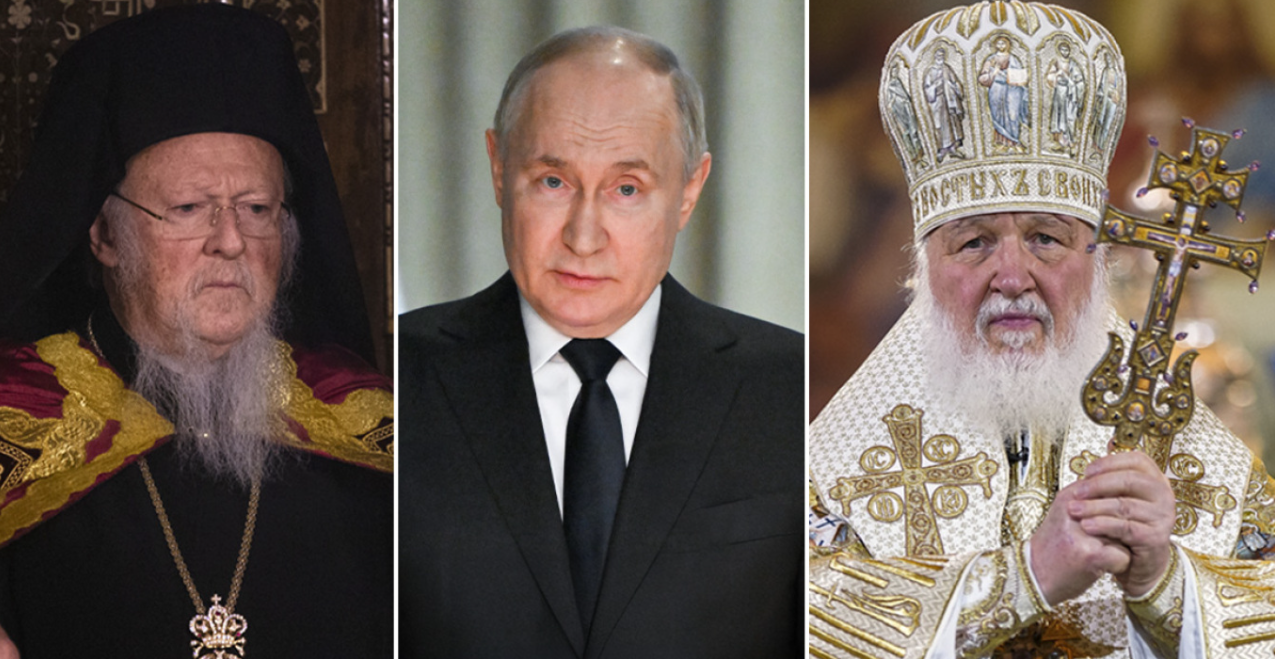
When Vladimir Putin justified the Russian invasion of Ukraine in 2022, he also referred to the rupture in relations between Constantinople and Moscow, a rupture that has almost taken on the dimensions of a schism. In doing so, he took a position in a religious and political dispute between two Orthodox Patriarchs with different philosophies and goals: Bartholomew in Constantinople and Kirill in Moscow.
The American magazine Atlantic, in an extensive article by Robert Worth, discusses this war, how it began and its course, why it extends beyond the Phanar and Moscow, and how it might end.
Greece is also a battleground
“The Russian campaign to restore its influence in the… post-Soviet space and beyond began in Greece,” wrote The Atlantic, a country with age-old religious ties to Russia and common enemies.
After 2000, Russian investments in religion in Greece (churches, trips to Russia, and the like) increased. The Russian monastery of St. Panteleimon is the most pro-Russian of the 20 on the Athos Peninsula – and the best-built thanks to money from Russian oligarchs. Putin saw it up close in 2005, whose rise after 1999 also “stepped” into the exploitation of religion.
The second step, a little later, were efforts through websites, blogs, and Facebook groups to discredit Patriarch Bartholomew as a puppet of the Turks, the Vatican, and the USA.
The battle for influence even reached the metropolises of Africa, where Russian money, as well as Instagram for reaching the faithful, try to bring parishes to Moscow’s side. Priests, as explained by an Orthodox African bishop, are susceptible to bribery because they have large families to support. The 300 euros per month given by the Russians is not an insignificant amount for these countries.
Bartholomew, absorbed in organising a Pan-Orthodox Council, did not pay attention to these attacks. However, the Russians were putting forward their demands, which ended up becoming obstacles: for example, they did not want references to human rights (which they consider tacit acceptance of homosexuality).”
Ultimately, one week before the Council began in Crete in 2016, the Russians withdrew. It was a decision that, as the article states, exposed the ruptures within Orthodoxy.
For the Phanar, it was the green light to satisfy the Ukrainians’ request for autocephaly, a request that had emerged when the country gained independence after the dissolution of the Soviet Union.
Relations between Constantinople and Moscow after the events in Crete entered a collision course. The Phanar openly took the side of the Ukrainian side, preparing for the recognition of autocephaly.
The schism that began at the Phanar
In August 2018, Patriarch Kirill of Moscow visited Constantinople after learning that Patriarch Bartholomew would recognise the Ukrainian Church as autonomous.
It was, as The Atlantic emphasised, an “existential threat” to Kirill—after all, Russian Orthodoxy had its roots in Kiev for over 1,000 years. Under the spiritual leadership of Constantinople rather than Moscow, Ukraine would drift away from Kremlin influence, sidelining Putin’s plans to expand Russia’s sphere of influence into former Soviet territories.
The decision rested solely in Bartholomew’s hands, the only one who could decide on Ukrainian autocephaly.
“The atmosphere of the meeting, beyond formalities, was not warm. When Kirill went to take a glass of water, one of his guards snatched it away and gave him a bottled water, “as if we were poisoning Patriarch Kirill,” commented Archbishop Elpidophoros of America, who was present at the meeting.
The meeting took a turn for the worse when the conversation turned to Ukraine. Bartholomew told Kirill that Ukrainians wanted ecclesiastical independence, just as they wanted political independence. Kirill indirectly referred to violent upheaval in Ukrainian politics, a suggestion that shocked his interlocutor.
Ultimately, the Russians left the Phanar after the meeting. Since then, the two patriarchs have had no communication; Bartholomew now regards Kirill as “Putin’s tool.”
The Russians left, but they didn’t forget. The ecclesiastical schism was one of the justifications Putin cited for invading Ukraine in 2022.
Two Different Patriarchs
In a sense, as The Atlantic writes, Bartholomew and Kirill represent two different images of Orthodoxy.
Bartholomew has sought to make Orthodoxy more compatible with the modern liberal world. He openly encourages believers to accept evolution and other scientific doctrines, advocates for environmental protection, and, like Pope Francis, has “quietly promoted a more tolerant attitude toward homosexuality.” However, Bartholomew’s power is limited compared to the Pope’s: He is the first among equals among the eight patriarchs.
Born in 1946, Kirill grew up in the Soviet Union when Stalin had tried to use Orthodoxy as a tool for his pursuits, all under Kremlin control. Kirill’s predecessor, Alexy, was a KGB agent in a system where nothing worked without Soviet approval
In contrast, Kirill, who has been Patriarch since 2009, fully supports the war against Ukraine and speaks—or rather, rants—about traditional values against gay parades. With the help of Russian intelligence services, he strives to enlist bishops closer to Constantinople, even through coercion and bribery. His anti-modern ideology has become a tool of soft power, eagerly consumed by conservatives in the Orthodox world and by right-wing figures in Europe, such as Hungarian Prime Minister Viktor Orbán. He even has followers in the United States!
How Will the War End?
The Patriarchs’ war has yet to produce a winner.
Losing the entire Ukrainian Orthodoxy would be a serious blow to Kirill, writes The Atlantic. They make up about one-third of the parishes claimed by the Russian Orthodox Church, a country with a much higher church attendance rate than Russia, where religiosity is not vibrant, despite Kirill’s jabs against the moral decline of the West.
For Bartholomew, the stakes are no smaller, perhaps risking the unity of Orthodoxy. He may seek to bring his Church into the future, but, as the American magazine concludes, history doesn’t always bend in the direction we desire.”
Ask me anything
Explore related questions




