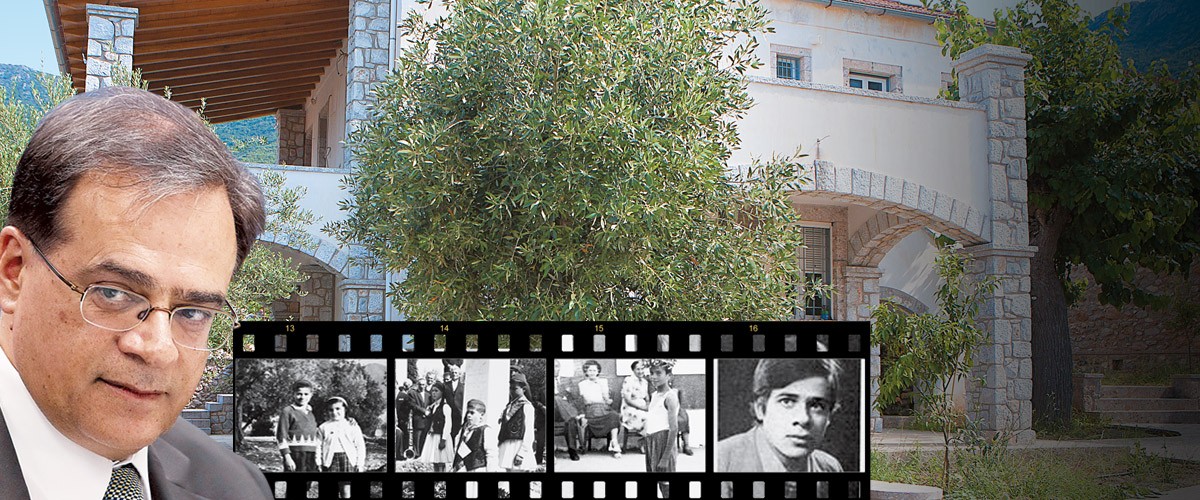
The new Greek Finance Minister Gikas Hardouvelis, who replaced Yannis Stournaras during the June 10 government reshuffle, is the US-trained economist who heads the economic team at Eurobank, the fourth largest Greek lender, and he also holds a chair in banking and financial economics.
He is known for having a soft-spoken nature and for keeping a low profile, characteristics that may stem from his early childhood years. Born in Peleta, the winter residence of those from the seaside village of Poulithra in the Peloponnese, Mr. Hardouvelis spent his childhood in the late Sixties with a lot of family warmth but not too many financial comforts.
A remarkable opportunity knocked on his door when he was handpicked for a full scholarship by Anatolia College, the American College of Thessaloniki. During his six-year tenure as a boarding student at Anatolia College he remained at the top of his class despite the hardship of having to endure student life without the support of his family.
After finishing high school he gladly accepted a full scholarship at Harvard University. His father, brimming with pride, borrowed money to buy his son a one-way ticket to the United States and it was clear that failure wasn’t an option.
As an undergraduate student he found a part-time job at the campus cafeteria to raise money to visit his family. The year after, he worked as a night watchman doing the graveyard shift. His “career” in security ended once he completed his Bachelor of Arts in Applied Mathematics and a Master of Science (1978).
From Massachussets he went to Berkley College in California with just $1,500 and another scholarship. It was while earning his Ph.D. in Economics (1983) that Mr. Hardouvelis met his wife Suzanne, a Lebanese with Armenian roots. They would later go on to have two sons, Angelos and Alexandros.
His teaching posts include being Assistant Professor at Barnard College, Columbia University (1983-1989) and Associate Professor and subsequently Full Professor at Rutgers University (1989-1993) in New Jersey.
He made the decision to return to Greece with his family in 1994 following an offer to teach at the University of Athens. He also received extensive banking experience with the Bank of Greece (1994-1995) and as Second Alternate to the Governor at the European Monetary Institute, Chief Economist at the National Bank of Greece (1996-2000). He played a critical role in the establishment of the Athens Derivatives Exchange, as an original member of its Board of Directors (1997-2000). During 2000-2004 he was Director of the Economic Office of Greek Prime Minister Costas Simitis.
Ask me anything
Explore related questions