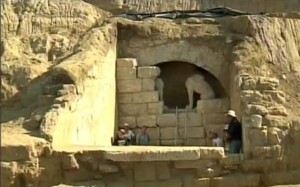
Archaeologists began work at the burial mound of ancient Amphipolis on Monday with the use of special cranes to help hold the blocks of the protective wall. Made of limestone, time has rendered the wall brittle and fragile with danger of it caving in. Archaeologists are trying to prevent this, utilizing the same techniques used at the Acropolis of Athens.
The Ministry of Culture and Sport yesterday issued an announcement that the 1.5-ton Sphinxes will not be removed from the site, adding that work at the site is in accordance with scientific deontology.
Here’s a video of work at the excavation site on Monday –
The exquisite mosaic floor
A mosaic floor with geometrical rhombus shapes is featured behind the wall right up until the door of the tomb. The design is intact, retaining the ancient colors and its original coating. Archaeologists ascertain that if the tomb had ever been looted in the past, then the robbers had not entered from this point. The main question is whether the roof of the tomb is untouched as it is possible that the overlying soil could have subsided and filled the grave.
Furthermore, there is mystery as to why the two Sphinx guardians of the tomb are headless, without wings and with traces of red paint at their feet.
Speculation: Just one tomb or a burial complex
The tomb, according to research, shows that the tomb has three chambers. This fact and the sheer size and magnificence of the outer area of the tomb, along with the Sphinx guardians and the mosaic wall, has led archaeologists to wonder if the mound may actually be a burial complex. The fact that the tomb’s entrance is at the south-east of the burial mound rather than the center is further cause for speculation.
The view that the tomb is that of Alexander the Great’s wife, Roxanne, who was executed with her son, Alexander IV, by Macedonian general Cassander who fought for control of the empire. The fact that the Lion of Amphipolis was likely located at the top of the burial mound renders this unlikely as the lion customarily honored the male form, leading pundits to ascertain that there a male figure is most likely buried at the tomb.
The form of the Sphinx on coins

Coin expert Asterios Tsintsifos has found the mysterious guardians of the burial mound at ancient Amphipolis printed on coins used at the area when it was still known as Ennea Odoi (Nine Roads). These are etched on tetradrachmas weighing 14.4 and 12.9 grams date back to the 6th century B.C. and other coins.
The area was attractive to ancient colonists because of the gold and silver reserves of Pangaion and the dense forests providing timber. “Ennea Odoi was a multinational city. Colonists from Chalkis were there from the 7th century B.C. and it was also the most populated colony of Miletus, who initiated coinage to the area. The Milesian system of measurement was followed,” he says, adding that there were also Phocaeans, Samians and Eretrians from Ioania in the region. The Macedonian element became stronger in the area after 520 B.C. but there were also settlers from Andros and Akanthos in the area. “After the Persian campagins and the final withdrawal of the Persions in 479 B.C. there was a turnaround and Ennea Odoi fell into the hands of the Athenians, who renamed it Amphipolis.” According to Thucydides it was named thus because the Strymon River flows around the city but there are also other theories.
The area was a region of Dionysian worship and the cult of the Sphinx was also prevalent in the region, however isn’t linked to the Sphinx of Thebes of the 5th century B.C. onwards. The Sphinx was also worshiped on the islands of Chios and Naxos and was closely connected to Donysian mysteries and wine. In 530 B.C. there was an increase in coin cutting with the citizens of Ennea Odoi choosing a sphinx and a cow with a calf to be despicted on their coins. This reveals that they were supporters of the god Dionysos and stockbreeders.
Even after Ennea Odoi became Amphipolis, the residents didn’t forget their heritage and continued to issue coins depicting the Sphinx from 520 B.C. until 470 B.C.
Ask me anything
Explore related questions