×
GreekEnglish

×
  • Politics
  • Diaspora
  • World
  • Lifestyle
  • Travel
  • Culture
  • Sports
  • Cooking
Monday
29
Dec 2025
weather symbol
Athens 8°C
  • Home
  • Politics
  • Economy
  • World
  • Diaspora
  • Lifestyle
  • Travel
  • Culture
  • Sports
  • Mediterranean Cooking
  • Weather
Contact follow Protothema:
Powered by Cloudevo
> technology

Inbreeding study reveals why humans don’t have sex with their relatives

Prehistoric humans developed surprisingly sophisticated social and mating networks and deliberately sought partners beyond their families

Newsroom November 9 04:07

Even 34,000 years ago, our ancestors knew having sex with their relatives was a bad idea. Analysis of ancient human remains found in Russia has revealed that even among an extremely small society, incest did not take place.

The study, led by Cambridge University and the University of Copenhagen, says prehistoric humans developed surprisingly sophisticated social and mating networks and deliberately sought partners beyond their families.

The study has led to speculation that this could partly explain why anatomically-modern humans proved more successful than other species such as Neanderthals that did not avoid inbreeding.

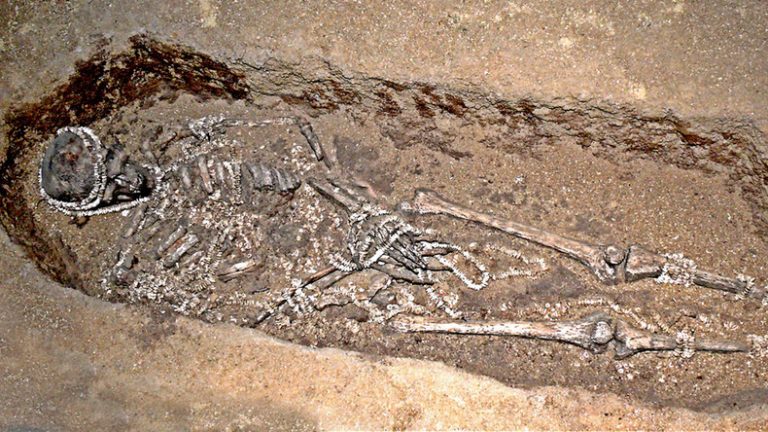
Researchers examined genetic remains of four anatomically-modern humans from Sunghir, an Upper Paleolithic site in Russia. Unusually for finds from this period, the people were found buried together.

To the researchers’ surprise, the individuals were not closely related in genetic terms. At the very most, they were second cousins. This is true even in the case of two children who were buried head-to-head in the same grave.

Objects and jewelry found buried with the remains suggest they may have developed rules, ceremonies and rituals to accompany the exchange of mates between groups which perhaps foreshadowed modern marriage ceremonies.

Professor Eske Willerslev, fellow at St John’s College, Cambridge, said in a statement: “What this means is that even people in the Upper Paleolithic, who were living in tiny groups, understood the importance of avoiding inbreeding.

“The data that we have suggest that it was being purposely avoided. This means that they must have developed a system for this purpose. If small hunter–gatherer bands were mixing at random, we would see much greater evidence of inbreeding than we have here.”

>Related articles

Olympian Anna Korakaki uploaded a new photo with a bloated belly

Konstantinos Argyros: “God willing, I will expand my family”

Research: The BBC’s “first Black Briton” from the Roman era was ultimately…white and originated from southern England

By comparison, genomic sequencing of a Neanderthal individual from the Altai Mountains who lived about 50,000 years ago indicated inbreeding was not avoided.

It led researchers to speculate that an early, systematic approach to preventing inbreeding may have helped anatomically-modern humans to thrive, compared with other hominins.

Source: rt

Ask me anything

Explore related questions

#anthropology#Cambridge University#dna#family#genetics#Inbreeding#incest#Neanderthal#science#technology#University of Copenhagen
> More technology

Follow en.protothema.gr on Google News and be the first to know all the news

See all the latest News from Greece and the World, the moment they happen, at en.protothema.gr

> Latest Stories

The final changes to Inheritance Law 80 years later: What does the bill of the Minister of Justice provide for? What does the Justice Department’s proposal stipulate?

December 29, 2025

Analysis of the meeting between Trump and Zelensky: Why “95 percent” progress doesn’t bring an end to the war

December 29, 2025

Farmers close today and detours, travelers took up to 12 hours for the route Thessaloniki-Athens

December 29, 2025

Trump–Zelensky meeting – U.S. President said he is optimistic, no deadlines set

December 28, 2025

Pierrakakis: New model of sustainable development for Greece after the Recovery Fund

December 28, 2025

Nicole Kidman spent her first Christmas after divorcing Keith Urban in Australia with their daughters

December 28, 2025

Traffic delays in Bralo, Martino, and Kastro due to road blockades

December 28, 2025

Electricity tariffs: How December 2025 closes and what to expect in January 2026

December 28, 2025
All News

> World

Analysis of the meeting between Trump and Zelensky: Why “95 percent” progress doesn’t bring an end to the war

The Mar-a-Lago meeting redefined the peace narrative without answering the critical questions of the war - Territory, energy and legitimacy remain the real thorns in the side of any agreement

December 29, 2025

Trump–Zelensky meeting – U.S. President said he is optimistic, no deadlines set

December 28, 2025

Google prepares a new era for email: Users will be able to change their Gmail address

December 28, 2025

One year of Donald Trump’s presidency: Developments during the first 365 days

December 28, 2025

Glasgow hospital launches investigation after wrong body cremated

December 27, 2025
Homepage
PERSONAL DATA PROTECTION POLICY COOKIES POLICY TERM OF USE
Powered by Cloudevo
Copyright © 2025 Πρώτο Θέμα