





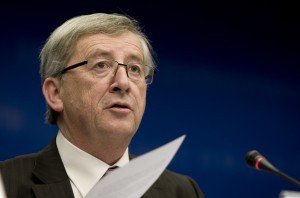
The former head of the Eurogroup and European center-right candidate for the office of President of the European Commission Jean-Claude Juncker, was revealing in his statements of the measures that Greece was asked to implement in the recent years.
Recently, during the congress of the European People’s Party in Dublin, which endorsed his candidacy for the office of the President of the European Commission, stated that during the rough years of the crisis, he tried to prevent a catastrophe, through humble means. “I tried to mainly support those who suffered through the crisis”, he explained in an interview with Deutsche Welle. “To remain on the subject of Greece: We see that those who suffered most were poor Greeks while others simply pretended to be suffering. If we had implemented the reforms carried out in Greece, in Germany and France, there would be a rebellion in northern Europe. So, I think that Northern Europeans should be more moderate in the expression of their views”, was his message, which caused a stir through its sincerity.
At the same time, in response to the co-chairs of the Green Party Daniel Cohn-Bendit who wondered: “If Juncker is so hurt by this consistency, what did he do when he was president of the Eurogroup?”, he answered: “In principle we made certain to keep the unity of the Eurozone strong. As you know, I was always against kicking Greece out of the Eurozone. I did everything I could while trying to behave with respect and friendly feelings towards Greece, which others did not. I always reacted, though I did not publicize it, to behaviours which would have negative consequences for Greece. Mr. Cohn-Bendit was never in the Eurogroup, but I was…”.
In addition, Jean-Claude Juncker once again opposed, as he argues, a policy which focuses exclusively on austerity, ignoring the developmental dimension. “What I asked is to regard fiscal discipline and policies of development and growth as two sides of the same coin”, underlined Juncker. And to close the gap between Northern and Southern Europe, because I cannot stand to see Europe divided in two categories, meaning the “virtuous” North and the “sinners” of the South. I dislike these stereotypes. What we need in Europe is to fill out the trenches which separate us, and not create new ones”.
Oscillations were caused, however, by Juncker’s policy on Eurobonds. By 2010, he seemed to be in conflict with the German chancellor on this issue. At a recent conference of the German Christian Democrats in view of elections, he stated he was opposed, like Angela Merkel, to the “communitarization of debt through eurobonds”. As he explains to Deutsche Welle: “Years ago I had stated that I am for Eurobonds, but I had also stated that specific requirements had to be met for eurobonds to be meaningful. That is: to achieve greater tax harmonization, to establish a more robust European co-responsibility in the drafting of national budgets and better coordination of economic policy. It is not likely that we will be able to do all this in the next five years, so I am of the opinion that we cannot have eurobonds within that period, because the terms have not been met”.
Ask me anything
Explore related questions




