






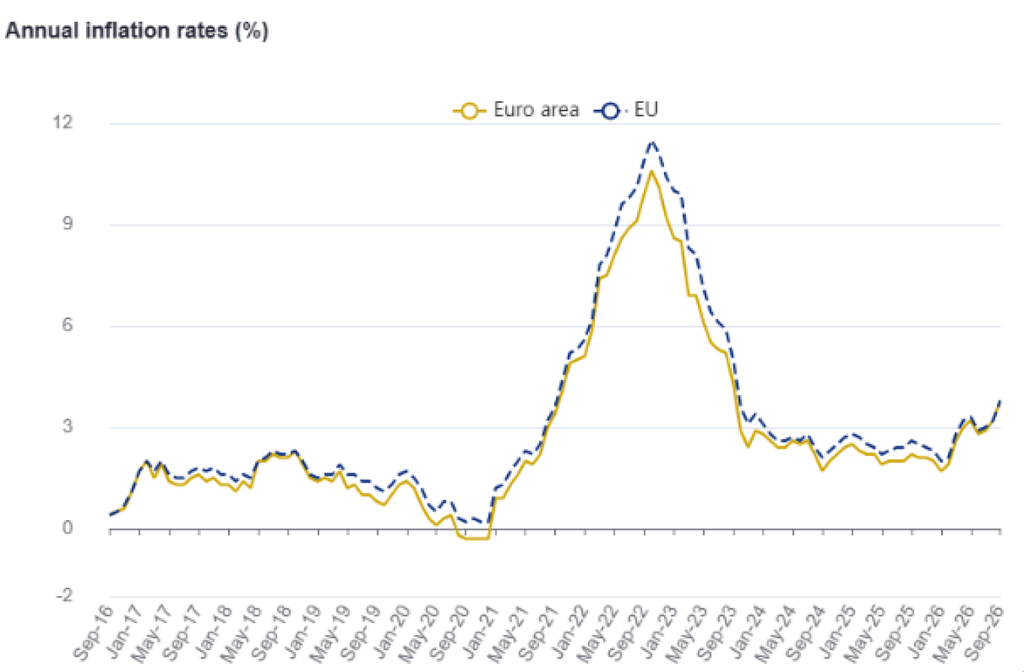
Annual inflation in the eurozone accelerated to 3.8% in September 2026, up from 3.2% in August, according to final figures released by Eurostat, confirming its preliminary estimate. A year earlier, in September 2025, inflation stood at 2.2%.
A similar increase was recorded across the European Union, where annual inflation reached 3.8% in September, compared with 3.2% in August and 2.6% in the same month last year.
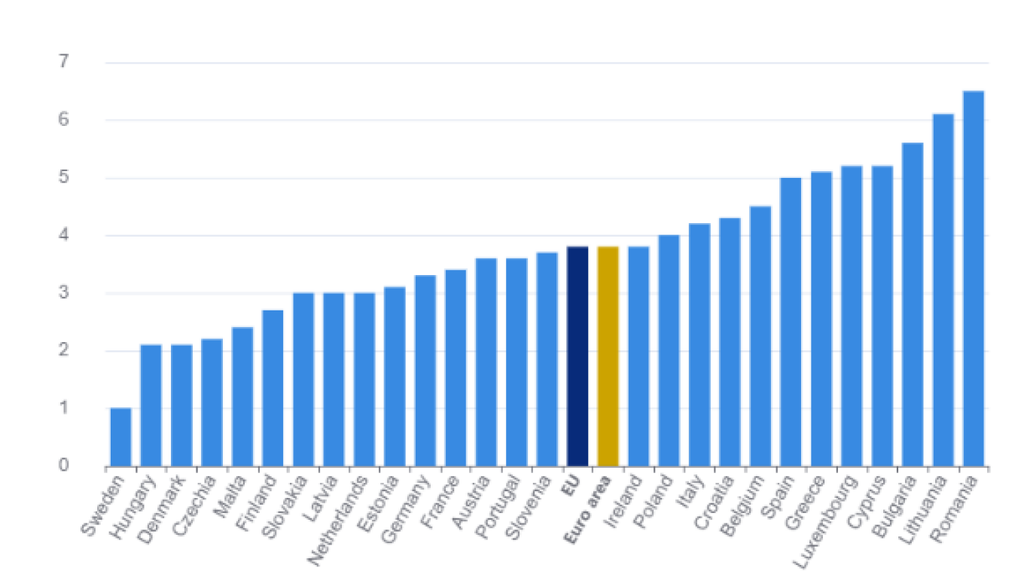
In Greece, annual inflation was confirmed at 5.1%, significantly above the eurozone average. Consumer prices rose by 1.9% on a monthly basis, slightly exceeding the preliminary estimate of 1.8%, according to the European statistical agency.
Countries with the Highest and Lowest Inflation Rates
According to Eurostat, the lowest annual inflation rates were recorded in Sweden (1%), Hungary (2.1%), and Denmark (2.1%).
At the other end of the spectrum, the highest rates were registered in Romania (6.5%), Lithuania (6.1%), and Bulgaria (5.6%).
Compared with August 2026, annual inflation declined in just one EU member state, remained unchanged in three, and increased in 23, highlighting the widespread intensification of inflationary pressures across the bloc.
Energy Remains the Biggest Driver of Inflation
Energy was the largest contributor to annual inflation in the eurozone in September, accounting for 1.71 percentage points of the overall rate.
Services followed, contributing 1.52 percentage points, while non-energy industrial goods added 0.29 percentage points.
The category of food, alcohol, and tobacco contributed a further 0.25 percentage points, according to Eurostat’s final figures.
The data underline the renewed inflationary pressures facing European economies, with Greece recording a rate 1.3 percentage points higher than the eurozone average.
Ask me anything
Explore related questions




