





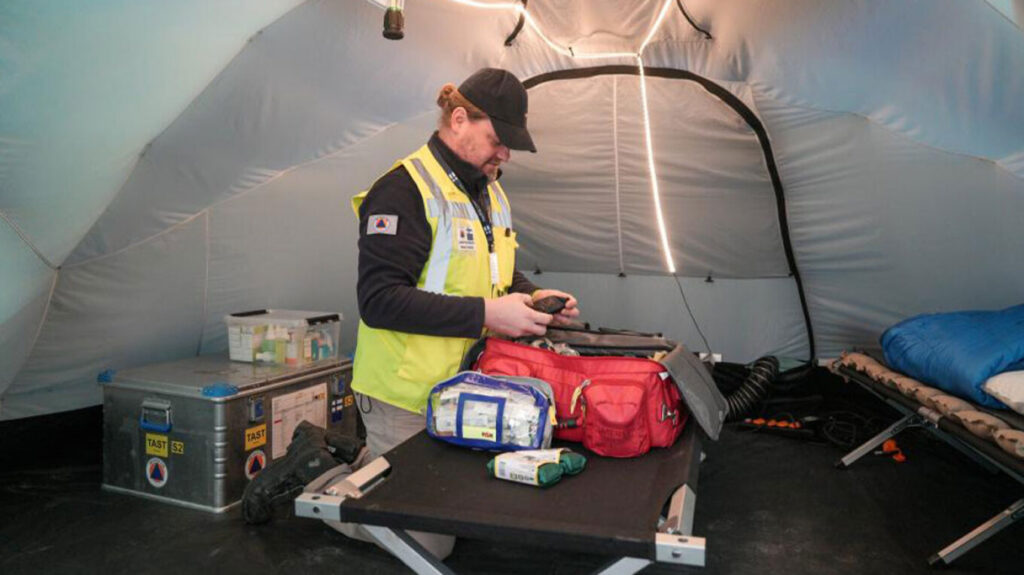
The European Commission unveiled new emergency preparedness guidelines on Tuesday, 3 November, aimed at helping Europeans remain self-sufficient during the first 72 hours of a crisis or disaster, while emergency services and public authorities mobilise assistance.
The guidance, presented by European Commissioner for Equality, Preparedness and Crisis Management Hadja Lahbib at the European Civil Protection Forum in Brussels, forms part of broader efforts to strengthen Europe’s ability to respond to increasingly frequent and complex emergencies.
The measures range from preparing emergency bags containing essential supplies to teaching children how to respond to disasters and ensuring that people with disabilities are included in emergency planning.
The Commission also announced plans to establish an annual EU Preparedness Day, with the first event proposed for 23 October 2027.
Preparing for the first 72 hours of a crisis
At the centre of the new guidance is the principle that citizens should be able to meet their basic needs for at least three days following an emergency, particularly when essential services have been disrupted or public assistance has not yet arrived.
The Commission is encouraging national authorities to help households understand what supplies they should keep available and how to prepare an emergency bag that can be quickly collected if evacuation becomes necessary.
The aim is to strengthen individual and household resilience during the critical initial period of a disaster, reducing immediate dependence on emergency services while authorities organise their response.
The guidelines are non-binding, meaning they do not impose a legal requirement on European households to maintain 72 hours of emergency supplies.
Four priorities for emergency preparedness
The Commission’s new guidelines address four areas considered essential to improving public preparedness across the European Union.
72-hour self-sufficiency: Citizens should have the knowledge and essential supplies necessary to meet their basic needs during the first three days of an emergency. Authorities are encouraged to promote household preparedness, including emergency supplies and ready-to-use evacuation bags.
Preparedness education: Emergency preparedness should be incorporated into early childhood and primary school education. Teachers would receive appropriate training to help children develop practical safety skills through activities suited to their age, without generating unnecessary fear or anxiety.
Inclusive preparedness for people with disabilities: Emergency plans should take account of the specific requirements of people with disabilities. The Commission is encouraging authorities to involve them directly in preparedness planning and ensure that emergency information, assistance and protective measures are accessible.
Communication of risks and threats: Public authorities should improve how they communicate potential dangers and emergency instructions. The objective is to ensure that citizens receive timely, reliable and accessible information before, during and after emergencies.
Taken together, the measures are intended to establish a stronger culture of preparedness throughout Europe, enabling individuals and communities to anticipate crises and respond more effectively.
EU Preparedness Day planned for October 2027
Alongside the new guidance, the Commission proposed establishing an annual EU Preparedness Day on 23 October, beginning in 2027.
The initiative would encourage citizens, communities and public authorities to take a more active role in preparing for emergencies, while recognising the work of civil protection organisations and emergency responders.
The proposed date commemorates the establishment of the EU Civil Protection Mechanism on 23 October 2001.
Over the past 25 years, the mechanism has helped coordinate emergency assistance between European countries and supported disaster response operations beyond the EU.
The initiative also reflects recommendations made by the European Citizens’ Panel on Preparedness, which brought together 150 citizens from across the EU between March and May 2026.
Among its proposals was the introduction of an annual EU Preparedness Week to increase public awareness and participation.
The Commission intends to work with the European Parliament, the Council of the European Union, the European Economic and Social Committee and the European Committee of the Regions on a joint declaration supporting the initiative.
Keeping civil protection systems operational during disasters
The new measures extend beyond individual preparedness to address the ability of national civil protection authorities to continue functioning during major emergencies.
A recently adopted Commission recommendation on operational continuity and stress-testing seeks to strengthen the resilience of national contact points operating within the EU Civil Protection Mechanism.
These contact points play a central role in coordinating requests for assistance and facilitating international emergency responses.
The recommendation encourages participating countries to develop operational continuity plans and regularly test their emergency arrangements.
The objective is to ensure that national coordination structures remain operational around the clock, even when a crisis disrupts communications, infrastructure or other essential services.
The latest initiatives form part of the EU Preparedness Union Strategy, adopted in March 2025, which seeks to improve Europe’s capacity to anticipate, prevent and respond to natural disasters, health emergencies, security threats and other major disruptions.
The strategy reflects growing concern that crises affecting energy supplies, transport networks, communications, public health and security can rapidly spread across borders and sectors.
By combining practical household preparedness with stronger emergency coordination systems, the Commission aims to improve Europe’s capacity to withstand disruptions and respond to future crises.
Ask me anything
Explore related questions




