





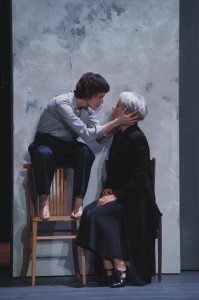
Directed by Mark Paquin, the modern version of a classic drama transforms Antigone into a fragile, but unruly and headstrong woman, a “demystified” figure, a human, which speaks to the audience with “great simplicity and beauty, and a heartbreaking voice like a cello” as Le Figaro newspaper put it.
The sets are by Gerard Didier, simple, with clean lines, defined by a wall with three monumental doors, a wall which towards the end of the show will move to reveal to the public the protagonists in their daily lives, familiar, to remind us that what we watch still happens every day where there is oppression, that people die every day for their beliefs, that they risk their lives, that they do not compromise.
Written in the heart of German occupation, Anouilh’s Antigone is a project that has been presented on stages around the world countless of times, has sparked heated debate and controversy and has been studied and analyzed as only a few works of the world’s repertoire, have.
Ask me anything
Explore related questions




