





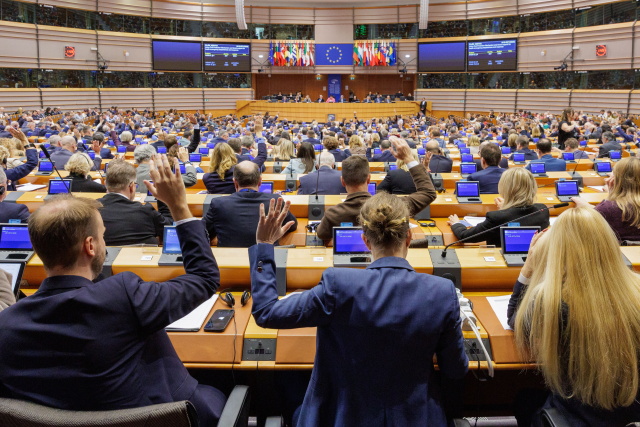
European Commissioner for the Mediterranean Dubravka Šuica described the Turkey-Libya memorandum as “null and void”, reaffirming the EU’s full solidarity with Greece and Cyprus during Tuesday’s debate in the European Parliament’s plenary session in Strasbourg.
“The memorandum on the delimitation of maritime zones signed between Turkey and Libya in 2019 is incompatible with the law of the sea. It infringes the sovereign rights of third states, is null and void and cannot produce legal effects for third states,” the commissioner said.
Šuica said the issue was part of a broader effort to uphold international law, maintain stability in the eastern Mediterranean and respect the sovereign rights of member states. Turning to EU–Turkey relations and Turkey’s accession process, she stressed that the EU assesses its relations with candidate countries on the basis of both their domestic reforms and their conduct on the international stage.
“We are closely monitoring any action or statement that could create new tensions in the region or undermine efforts to de-escalate,” she said, adding that the EU seeks a constructive working relationship with Turkey based on mutual respect, commitment to international law and good neighbourly relations.
The Türkiye–Libya maritime memorandum violates the International Law of the Sea and infringes on EU countries’ sovereign rights, notably Greece’s. The EU has declared it null and void. We also condemn it! At our initiative, the European Parliament’s resolution this week will take a clear stand against it and reaffirm EU’s solidarity with Greece.
— S&D Group (@TheProgressives) November 24, 2026
On Libya, Šuica stressed that the country’s political transition must not be undermined by agreements that deepen divisions, create legal uncertainty or infringe the rights of third states, such as the agreement with Turkey.
She reiterated the EU’s commitment to Libya’s unity, sovereignty, territorial integrity and stability, noting that the country’s stability is closely linked to that of the Eastern Mediterranean.
“Unilateral actions that disregard the rights of others are unacceptable. The EU will continue to stand firmly behind Greece and Cyprus and raise the issue in its relations with Turkey,” the commissioner concluded.
Speaking on behalf of the Irish presidency of the Council of the EU, Irish Minister of State Charlie McConalogue stressed that the Turkey-Libya memorandum was “not a technical dispute, but a matter of principle”. Reiterating the Council’s full solidarity with Greece and Cyprus, he said the sovereign rights of all member states must be respected and that maritime zones must be delimited through dialogue and good-faith negotiations, in full compliance with international law, rather than through unilateral actions that disregard the rights of other states.
The Irish minister said that although the EU has a strategic interest in a stable and cooperative relationship with Turkey, de-escalation must be sustained and credible and must include respect for the rights of EU member states. He placed particular emphasis on the Council’s readiness to respond to actions that infringe those rights.
“The EU will continue to act in unity. The Council will continue to monitor developments in the eastern Mediterranean closely and is ready to respond to actions that undermine the sovereignty, sovereign rights or jurisdiction of member states or violate international law,” he said. “In defending these principles, we are defending not only the rights of Greece and Cyprus, but also the very credibility of the international legal order,” the Council representative concluded.
Speaking for the European People’s Party (EPP), New Democracy MEP Manolis Kefalogiannis described the Turkey-Libya memorandum as illegal and contrary to the law of the sea, calling it an attempt to impose a fait accompli in the eastern Mediterranean. Kefalogiannis recalled the international condemnation of the memorandum and referred to Article 3 of the United Nations Convention on the Law of the Sea, which enshrines every state’s right to set the breadth of its territorial waters at up to 12 nautical miles. He also condemned Turkey’s continued threat of war against Greece (casus belli) and its “Blue Homeland” doctrine. “Challenging the sovereign rights of an EU member state is a challenge to the EU itself as a whole,” he said, expressing the view that the resolution due to be put to a vote on Thursday would be “a resounding response to Turkey and its aggression”.
Speaking for the Socialists and Democrats (S&D) group, PASOK MEP Yannis Maniatis called for a decisive European response after what he described as the recent ratification of the Turkey-Libya memorandum by Libya’s House of Representatives. Maniatis described the condemnation of the memorandum by the presidents of the European Council and the European Commission as a useful first step.
“We must now move from words to action,” he said, stressing that protecting the sovereignty and sovereign rights of member states is both a national responsibility and a “shared European responsibility”. He said the Socialists and Democrats’ draft resolution calls for the renewal and expansion of the EU’s existing sanctions framework for the eastern Mediterranean so that it also covers illegal activities based on the Turkey-Libya memorandum.
It also calls for respect for international law to be a substantive condition for any future EU cooperation with Libya or Turkey, and for the EU to protect the Great Sea Interconnector, the project to link the electricity grids of Greece and Cyprus. “The EU is a unique experiment in peace. It must, however, have the strength to defend its principles and protect all its member states equally,” Maniatis concluded.
Ask me anything
Explore related questions




