





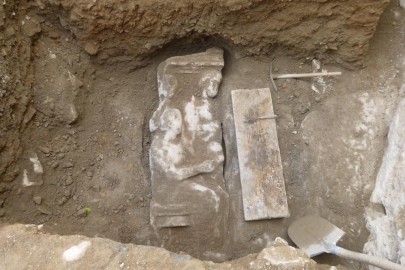
The German Archaeological Institute’s excavation team discovered a grave stele from Attica while digging at the ancient Kerameikos cemetery. The stele dates from the classical period and depicts a relief of a seated woman and a girl on the first level and another woman with a bearded man on the second level. There is an illegible inscription, possibly the name “Demostratos.”
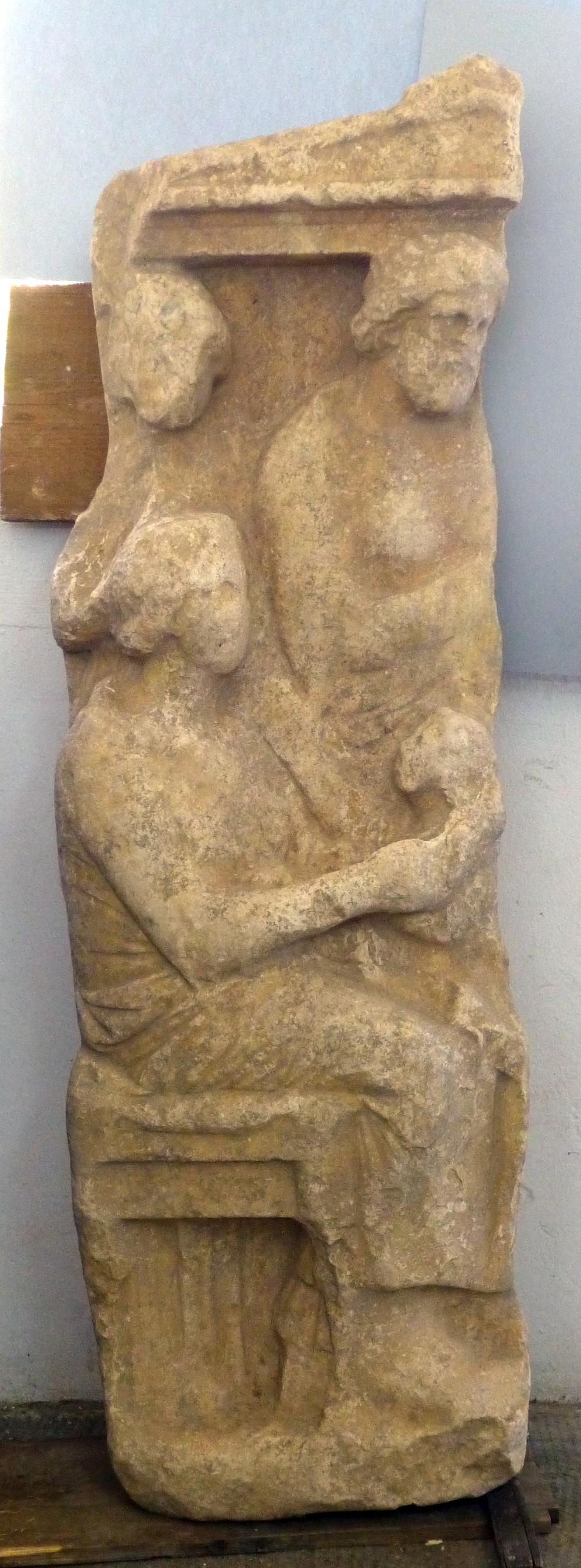
According to archaeologists, the shape as well as the type and style of the stele indicate that it is from the third quarter of the 4th century BC. The stele is believed to have originally been placed along the road in front of the Sacred Gate of the ancient cemetery and was removed and used as building material at a later unknown time. The fragment was later used to cover the sewerage network under Iera Odos Street during the construction of the Athens’ water supply system.
The grave stele was found as a result of digs that began in February after the Central Archaeological Council agreed to excavations at a small part of the area near Ermou Street. The excavation is expected to reveal the continuation of Iera Odos and will be joined with the rest of the ancient site before it is open to the public following a proposal made by the German Institute.

Work is to be completed by the end of 2014. Following this, the archaeological team will research the stratigraphy of the slope and build a retaining wall for the area that isn’t supported under Melidoni and Ermou sts.
Kerameikos (according to Archaeologist T. Iliopoulos on the Odysseus Site)
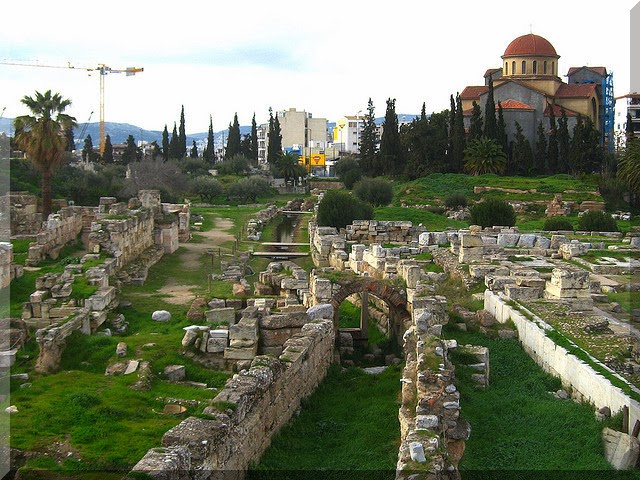
The archaeological site of Kerameikos comprises part of the Themistoclean Wall, the Dipylon Gate and Sacret Gate, the Pompeion, the burial enclosure and the Stele of Hegeso, the Demoxion Sema and other well-known monuments. The entrance of the approximately 11-acre site is located on Ermou Street.
Two important roads, the road leading to Plato’s Academy and the Sacred Way, connected Athens to Eleusis, began at the Dipylon and Sacred Gate (Iera Pyli) respectively. The Sacred Gate was the starting point for the procession of the Eleusinian Mysteries, and the Dipylon the starting point of the Panathenaic procession, which moved along the Panathenaic Way towards the Acropolis. The preparations for the Panathenaic procession took place inside the Pompeion, a large building with peristyle court, located directly behind the wall, next to the Dipylon. The building dates from the end of the fifth century BC.
In the Classical period (fifth-fourth centuries BC) the streets were lined with cemeteries and funerary monuments, mostly of families and often decorated with reliefs. Some of the best-known funerary monuments are the Tomb of Dexileo, the Stele of Hegeso (c. 400 BC), the Relief of Demetria and Pamphile, and the marble bull from the funerary enclosure of Dionysios of Kollytos (c. 345 BC).
Outside the Dipylon, along the street leading to Plato’s Academy, lay the Demosion Sema, or Public Cemetery, the burial place of Athenian notables and war heroes. This is where Pericles delivered his famous Funeral Oration for those who died during the first year of the Peloponnesian War (430 BC).
Ask me anything
Explore related questions




