





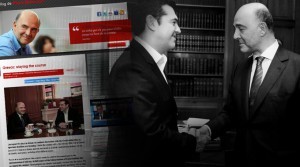
By Pierre Moscovici, European Commissioner for Economic and Financial Affairs, Taxation and Customs
I just spent two days in Athens to continue discussions with the Greek authorities, as important deadlines are looming. I know the country well – this was my fifth visit in Greece since 2012! I went as a friend, and was welcomed as a friend. And between friends, we can talk frankly and openly, including about difficult issues.
We are at a crucial phase: the country needs to confirm its commitment to the implementation of reforms, in full respect of the Memorandum of Understanding that was signed this summer. Great progress has already been made: we must stay the course. We must not lose sight of the goal, and we have move ahead methodically and firmly: this is what is expected by the members of the euro area, before releasing a first tranche of EUR2 billion for the country.
I am reasonably optimistic because of the current climate of cooperation and trust. This government is now, and since the European Council agreement in July, one with which we have been able to work best since the beginning of the crisis in 2010. Challenges remain, but the will to move forward together is shared. And it should be noted that Greece has made real progress in the implementation of reforms. The country now also bravely faces a refugee crisis, and we support Greece in addressing this challenge.
This dynamic, of cooperation and momentum, must be kept up: progress on measures is the prerequisite for disbursement of the funds expected by Athens. We must equally maintain the momentum for a conclusion of the first review of the third financial assistance program by the end of 2015. That is the message I delivered to my interlocutors during my visit in Athens, in discussions with Prime Minister Alexis Tsipras, the Minister of Finance Euclid Tsakalatos, or the Minister of Labor and Social Welfare, Giorgos Katrougalos.
Staying the course, means first and foremost insisting and following through on implementation: the way forward will be easier with creditors if this precondition is met.It is in the interest of all: of Greece, which needs to modernize its structures and intends to continue the debate on its debt; and Member States, which want a strong, sustainable Greece in the euro area.
Discussions, difficult decisions are still ahead in the coming days and weeks. I did not hide this reality from my interlocutors, but instead spoke about these challenges.
Several measures are in the process of being adopted, related to key structural reforms and fiscal consolidation. This goes in the right direction; but the first set of measures now has to be completed. We need to see progress particularly in regards to the issue of household insolvency. The most vulnerable must be helped and protected, without being complacent with those who are considered ‘strategic defaulters’ and thus try to escape their responsibilities.
A second wave of measures will have to be approved in the coming days and voted on in November. Keeping this timetable would allow institutions to quickly review and endorse those decisions, allowing Member States to unlock the tranche of aid expected. I hope that the Eurogroup of 9 November could give a signal to that effect – that is our goal.
After that, the first review of the program will be launched and I hope it will be concluded by the end of the year.
In parallel, crucial work continues on the recapitalisation of banks: it is imperative that this process be finalised by the end of the year. The challenge is to protect depositors, stabilize the Greek banking system and restore market confidence, for a subsequent gradual lifting of capital controls to take place.
The Juncker Commission stands by Greece in support, throughout the duration of this process. Ultimately, it is for the country to create the conditions for discussions to progress in due course, on the sustainability of its debt, as promised by the members of the euro area. This was also the objective of my visit to Athens: not only to exchange views and prepare the ground on the eve of an important Eurogroup – as contact with the authorities has remained constant since the summer – but to also to prepare the ground for the future and be forward looking.
The forecasts that are going to be published today by the Commission predict a return to growth for the country in the 2nd half of 2016. They show that our core goal remains the same: we want a strong Greece in the area euro, with a revival of employment, a strengthening of social cohesion, and a Greece that regains its economic stability and sustainability.
The country controls its own destiny. We are there to help it succeed.
Ask me anything
Explore related questions




