





Imagine you took all sunlight that hits our planet at any given moment, and focussed it on one (unfortunate) piece of Earth the size of a thumbnail. Now times that blistering intensity by 100, and you’re beginning to understand the insanity of the world’s most powerful X-ray laser.
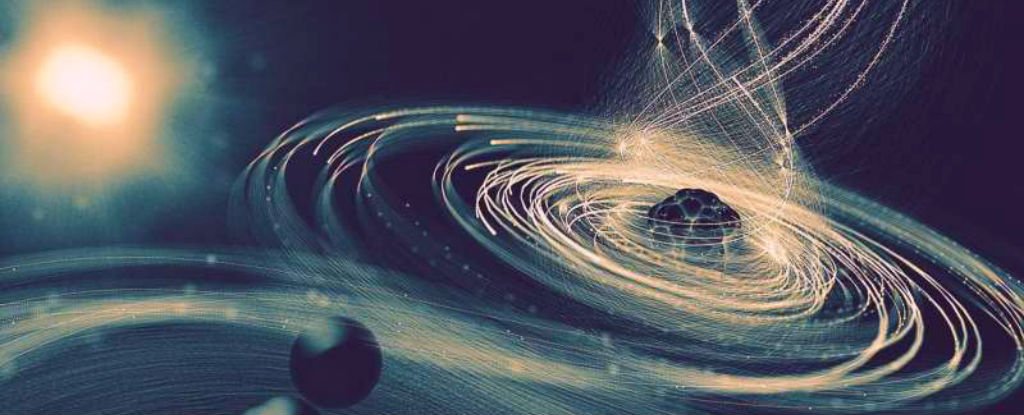
In a surprise result, scientists have focussed the full intensity of this laser onto a single molecule, and the aftermath has given rise to a phenomenon no one’s ever seen before – a molecular ‘black hole’, which consumes anything in its path.
“We certainly weren’t expecting this from previous measurements,” one of the team, Sebastien Boutet from the US Department of Energy’s SLAC National Accelerator Laboratory, told Mashable.
Training laser beams in on unsuspecting molecules is nothing new – in past experiments, physicists have used lower-intensity lasers to blast small iodomethane molecules and strip away the electrons encircling their single iodine atom.
But when Boutet and his team focussed an ultra-intense X-ray laser pulse from SLAC’s Linac Coherent Light Source onto similar molecules, it gave rise to a hungry void, which started pulling in electrons from the rest of the molecule like a microscopic black hole – before promptly blowing up.
“[It] generated a lot of charge inside the atom, and it sucks in everything around it,” one of the researchers, Daniel Rolles from Kansas State University, told Douglas Main at Newsweek.
“It doesn’t seem to stop.”
The whole thing was over in less than 30 femtoseconds – millionths of a billionth of a second. The researchers’ molecule was stripped of more than 50 electrons, which was far more than expected, based on what less intense beams have done before.
The team first experimented with single xenon atoms, using special mirrors to focus the X-ray beam to an area just over 100 nanometres in diameter – 1,000 times smaller than the width of a human hair.
The X-ray blast stripped the xenon atoms of their electrons, creating what’s known as a ‘hollow atom’. But this state didn’t last long – electrons from the outer parts of the atom started cascading down to fill the void, only to be kicked back out by another laser beam.
All that ended up remaining in these atoms were the most tightly bonded electrons.
That behaviour recalls what researchers have observed in previous experiments using lower-energy laser beams, but things got weird when they watched what happened to iodine atoms inside larger iodomethane molecules.
The iodine atom, stripped of its electrons, started tearing electrons from its neighbouring carbon and hydrogen atoms, pulling them in like a black hole would swallow up matter that ventures too close to its event horizon.
Each time the atom would pull in the stolen electrons, the laser beam would blast them away again, and the atom ended up losing 54 electrons – more than the 53 it had started with before being obliterated.
The team repeated the process using an even larger iodobenzene molecule, and a similar phenomenon occurred.
“This is not something physicists have seen before,” Main reports for Newsweek.
“In total, the X-ray lasered away 54 of the molecule’s 62 electrons, giving it a charge 54 times what it would be in an unexcited state. This is the most extreme charge, or level of ionisation, ever achieved using light, according to the researchers.”
The team says more experiments are needed to figure out exactly what’s going on here, because they suspect that the larger iodobenzene molecule might have sucked in and lost even more than the 54 shed by the iodomethane molecule.
“We think the effect was even more important in the larger molecule than in the smaller one, but we don’t know how to quantify it yet,” one of the researchers, Artem Rudenko from Kansas State University, said in a press statement.
“We estimate that more than 60 electrons were kicked out, but we don’t actually know where it stopped, because we could not detect all the fragments that flew off as the molecule fell apart to see how many electrons were missing. This is one of the open questions we need to study.”
Ask me anything
Explore related questions




