





In the annals of aerial warfare, the names of Greece and Mexico don’t usually appear very often.
Yet Greece and Mexico were the first to use aircraft to bomb ships, a breakthrough that led to the Pearl Harbor raid—and to today’s aircraft armed with ship-killer missiles.
While the first reported incident of aircraft bombing ships was long thought to have happened during the Mexican Revolution, it turns out that the Greeks, who pioneered so much else in Western civilization, can also lay claim to that honor.
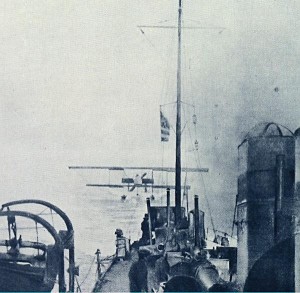
It happened during the First Balkan War of 1912–13, that warm-up act for World War I that saw the fading Ottoman Empire defeated by a coalition of Bulgaria, Greece and Serbia. On February 6, 1913, a French-made Maurice Farman two-seat aircraft, equipped with floats to convert it into a seaplane, took off into the morning sky. It belonged to the Royal Hellenic Navy, and aboard were the pilot, Greek army 1st Lt. Michael Moutoussis, and the observer, navy Ensign Aristidis Moraitinis.
Their mission was to reconnoiter Turkish fleet dispositions at Nagara Point in the Dardanelles. Circling over the target at 1,350 feet, they observed Turkish ships and shore installations. Then on their last orbit, Moraitinis dropped four grenades over the aircraft’s side.
A Turkish military report recorded that three of the grenades fell into the sea, and the fourth left a six-inch hole in the ground. “Apparently, no damage or casualties were inflicted, and the report did not identify any of the Turkish ships in the area, since none were hit,” according to writer Jon Guttman. “Turkish personnel subjected the Farman to rifle fire, turning the incident into a genuine air-sea engagement—albeit an extremely minor one—and reported that ‘the aircraft was hit and landed on the sea after 40 minutes of flying in the air.’”
In fact, the Farman hadn’t been hit. But engine failure forced it to land in the Aegean, where the crew was rescued.
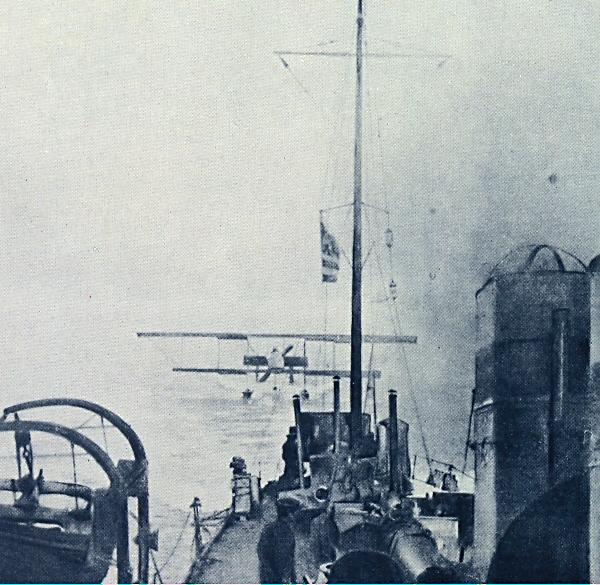
(Historic photo: Farman MF.7 of Moutoussis, Moraitinis collected by the destroyer Velos, after their reconnaissance operation over the Dardanelles, 24th January 1913)
Almost four months later, and half a world away, came the next air attack. In 1913, Mexico was being torn apart by the Mexican Revolution, in which various factions vied for control of the country. Victoriano Huerta had taken control of the government—which itself had to come to power through a coup. Opposing these Federales were the Constitutionalist factions.
In January 1913, Constitutionalist officers visited California to check out what was available in military aviation. They stopped by aircraft manufacturer Glenn L. Martin, and ended up hiring Didier Masson, a Frenchman working as one of the company’s instructor-pilots.
“The officials offered Masson $300 a month base pay, plus $50 for each reconnaissance flight and $250 for each bombing run he made, if he would join the revolutionary forces,” according to writer David Grover. The base pay alone was what a U.S. Army colonel made at the time.
The rebels also bought a Martin pusher biplane (its propeller mounted in the tail) for Masson to fly. Fitted with a bombardier’s seat and a primitive bombsight, the plane was nicknamed Sonora, after the Mexican state where it was stationed.
“No aviation ordnance of any type existed in North America at that time, so homemade bombs were created for the attacks,” Grover writes. “The bombs were 18-inch-long pieces of 3-inch pipe, filled with sticks of 40-percent dynamite, among which rivets were distributed for shrapnel. A push-type detonator was rigged to the bottom through a pipe nipple, and a crude fin was mounted on the top to ensure that the bombs would fall in an upright position.”
Some sources say it was on May 10, 1913, and others say May 29, but either way, Masson and Sonora flew a bombing mission against the Federalist cruiser General Guerrero, lying off Guaymas.
Accounts again differ as to how many bombs were dropped, from what altitude, and whether the warship fired back. In any event, neither aircraft nor ship was damaged.
It was an inauspicious start to the contest between aircraft and ships that became the fundamental factor in twentieth-century naval warfare. But thirty years later, those newfangled flying machines would have the last laugh at Pearl Harbor and Leyte Gulf.
Ask me anything
Explore related questions




