The Falklands War is often perceived, from the British perspective, as a victory that confirmed the British imperial status in the post-WWII world. It won the Conservative Party government a second term in Government for it was indeed a clear and decisive British victory.
On the other side, the Argentinian public deemed the war unnecessary as well; it was forced upon them by the ruling military junta. The conflict which started on 2nd of April 1982, lasted for 74 days and claimed the lives of 649 Argentinians military personnel, 255 British military personnel, and 3 Falklands civilians. It proved to be a stand-off between the British recapturing lost territory and a dictatorship with expansionist tendencies.
Argentina had for long wanted to claim the Falklands (or the Las Malvinas, as the Argentinians called it), South Georgia and the South Sandwich Islands, which had all been under British rule since 1833 and populated by British settlers who were loyal to the crown.
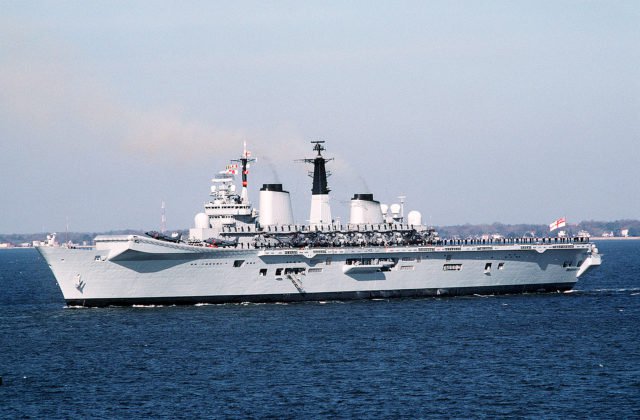
(The HMS Invincible, pictured here in 1990, which took part in the conflic)
In Argentina, a military junta under the name National Reorganization Process was the government in the period of 1976-1983 and ruled with an iron hand, dealing with political with imprisonment and execution. The man behind the junta, who was the main advocate of the attack, was Admiral Jorge Anaya. He estimated that the British would not pursue a military conflict, but would rather choose a diplomatic solution, in which the Argentinians could further promote the idea of sovereignty over the archipelago.
The campaign was designed and executed in the midst of devastating economic stagnation in Argentina, which provoked civil unrest. To divert the civilian attention from the fall of living standard and the inflation climb of 600%, a military government did what it does best – mobilize the population towards a general nationalistic sentiment for the islands, several hundred kilometres from the Argentinian coast, that were under British colonial rule.
They called it the illegal usurpation of Las Malvinas. The preparations for war included a power shift in the military junta, from its initial leader, General Roberto Viola, to General Leopoldo Galtieri, on whose behalf Admiral Anaya organised the Argentinian Navy to participate in the attack.

(The Argentinian Submarine ARA Santa Fe, which was crippled during the conflict and scuttled by the British)
Before the invasion took place, the Argentinan junta helped CIA suppress the communist elements in Nicaragua by funding the Nicaraguan counter rebels, or the Contras. This is why the Argentinians had reasons to believe that the US would keep a neutral stance if an invasion were to take place.
Also, Admiral Anaya relied on the fact that the US objected the use of force by the British during the Suez crisis in 1956. On top of that, in 1981, Britain accepted the independence of it former colony, Rhodesia, which was an example of how Britain was slowly renouncing its colonial past.
Argentinians were mainly influenced by the events of Indian annexation of the island of Goa, in 1961. The annexation was condemned by the international community but was later accepted as an irreversible act.
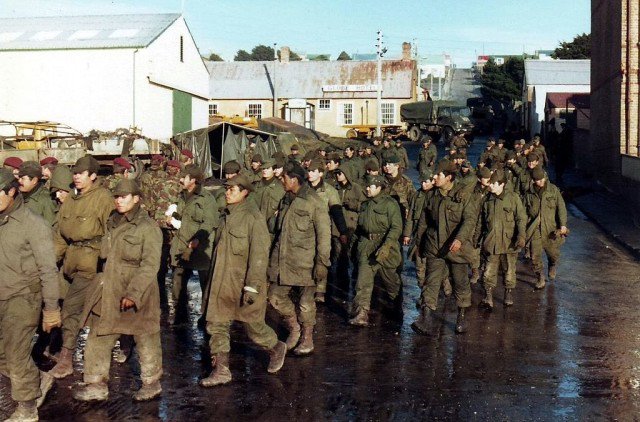
(Argentine POWs at Port Stanley)
On March 19th, 1982, the Argentinians launched an invasion of the South Georgia and the South Sandwich Islands, 165 kilometres from the coast of Patagonia. Following the initial invasion, they started to disembark on the shores of the Falklands Islands on April 2nd.
Concerning the occupation of South Georgia and the South Sandwich Islands, the British deployed two submarines, but it wasn’t until the invasion of the Falklands that they had taken the matter seriously.
The war was never officially declared although both sides did declare the Islands areas a war zone and officially recognized that a state of war existed between them. Hostilities were limited almost exclusively to the territories under dispute and the area in the South Atlantic where they lay.
Argentina’s original intention was to mount a quick, symbolic occupation, followed rapidly by withdrawal, leaving only a small garrison to support the new military governor. This strategy was based on the Argentinean assumption that the British would not respond militarily.

(Royal Navy Sea Harrier)
Argentinian assault units were indeed withdrawn to the mainland in the days following the invasion, but strong popular support and the rapid British reaction forced the Junta to change their plans and reinforce the islands since they could not afford to lose the islands once the British came out to fight.
When the conflict broke out, the UN called for peace talks, the immediate end to the hostilities and urged both parties to resolve the conflict diplomatically. The US feared that Argentina would ask the Soviet Union for help, and so they stood firmly on the side of the British.
On the South American mainland, Chile actively helped Great Britain with intelligence support. The support was evident, and Argentina was forced to keep some of its best trained and best-equipped mountain troops on the Chilean border to counter the possible military intervention by the neighboring British ally. The intervention never took place, but the Argentinians were on high alert throughout the war.
British forces landed on the islands, after which a war for aerial domination commenced. Several intense dogfights occurred during the war. The British were using Harriers as their main combat airplane while Argentina used Mirage III fighter jets, which were purchased from France several years before the war.
The Mirage was not good enough for the Argentinian air force to successfully engage the far more nimble RAF fighters. Other than the Mirage, Argentine Air Force used American A-4 Skyhawks, Israeli Daggers, the Israeli version of the Mirage fighter, and English Electric Canberras.
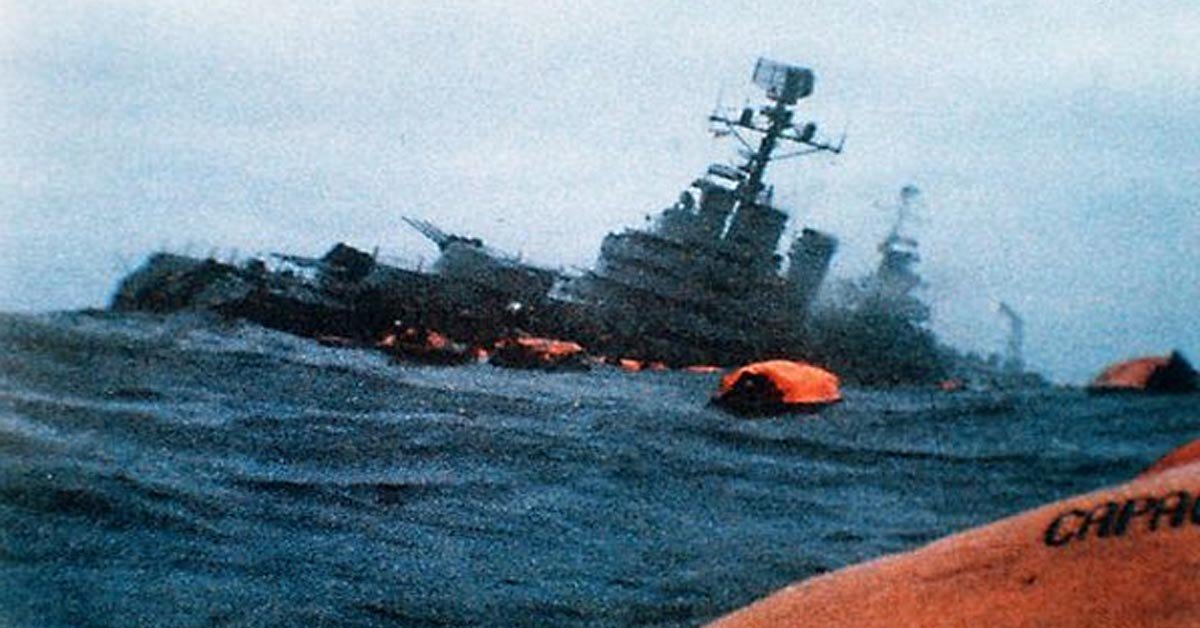
The most significant naval incident of the war was the sinking of the ARA Belgrano, an Argentinean WWII-era light cruiser, by the nuclear-powered submarine HMS Conqueror on May 2nd, 1982. 323 men aboard the ARA Belgrano lost their lives.
The retaliation for this loss occurred two days after, when a British Type 42 Destroyer, HMS Sheffield, was bombed by a naval air strike. The British lost 20 men with another 24 others severely injured.
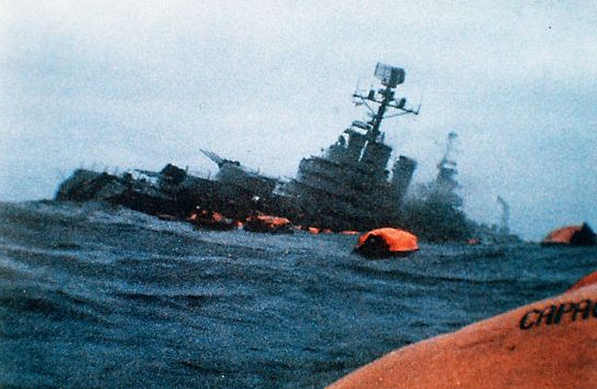
(ARA Belgrano sinking on May 2nd, 1982)
After the British victory on land, their terms for the Argentinian surrender proved to be much harsher than originally expected by the Junta, but Argentina accepted them on 14th of June 1982. Argentinean troops withdrew from the islands, leaving them in British hands.
The relations between the two countries were strained for a while, until their official normalization in 1989. Argentina continues to debate the sovereignty of the Falklands to this day. In 2013, a referendum was held on the Falkland Islands, after which the majority stated that they wish to stay under the British crown.
The Falklands conflict remains the largest air-naval combat operation between modern forces since the end of the Second World War.
Ask me anything
Explore related questions