





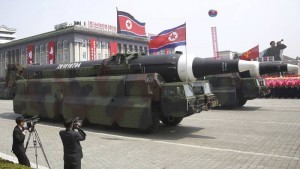
North Korea’s dramatic leap forward in ballistic missile capability has its origins far beyond the Korean peninsula, experts believe: in Russian technology that may have been acquired from a factory near Ukraine’s restive east, although the timing for any transfers is not clear.
Military analysts and western intelligence agencies have been scrambling to explain Pyongyang’s string of successful long-range test firings, which have escalated tensions and triggered a war of words with Washington.
North Korea’s Hwasong-14 missile, tested for the first time, twice, last month, is unlike anything that has preceded it in the hermit state’s ballistic arsenal: its purported range makes it capable of striking the continental US.
A series of provocative missile tests has already shown the US territory of Guam, home to a military base, to be credibly within range of Pyongyang’s latest rockets.
Such advances stand against a patchy record. The dictatorship’s previous efforts to develop its own Musudan rocket into a viable long-range ICBM — including a number of tests last year — have almost all failed.
The “astounding strides” that Pyongyang has made can only be explained by assuming the country gained access to foreign technology, a new comprehensive analysis of North Korea’s missile-test footage and data concludes.
“The Hwasong 12 and 14 are powered by a [liquid propellant engine] imported from an established missile power,” said Michael Elleman, senior fellow for missile defence at the International Institute for Strategic Studies, a think-tank, in a report published on Monday.
Mr Elleman said the North Koreans were almost certainly using a modified version of the RD-250 — a Russian-designed missile engine that is only available from two sites: the Energomash concern in Russia and the KB Yuzhnoye design bureau and its closely linked Yuzhmash rocket factory in Ukraine.
The RD-250 engines being used by North Korea also appear to have been skilfully modified, said Mr Ellemen — indicating that foreign engineers had been purposefully engaged in developing the engines for sale to the North Koreans.
Mr Ellemen’s report points to the Yuzhnoye facility in Ukraine as the likeliest source. The war between Ukraine and Russian-backed proxies in the restive east, close to the factory, has crippled the business, making its site, and employees, a potentially easy target to exploit.
“A small team of disgruntled employees or underpaid guards at any one of the storage sites, and with access to the [engines], could be enticed to steal a few dozen engines by one of the many illicit arms dealers, criminal networks, or transnational smugglers operating in the former Soviet Union,” the IISS report says. “The engines (less than two metres tall and one metre wide) can be flown or, more likely, transported by train through Russia to North Korea.”
Yuzhmash, the company which produces the rockets designed by Yuzhnoye, denied the claim. “Missiles and missile components for military use have not been produced since independence,” the company said on Monday. The company has focused on building booster technology for commercial satellite launches since 1991, it said.
Another scientific paper, published on Friday in the Bulletin of the Atomic Scientists, also notes that the RD-250 — or the variant RD-251 — is the probable basis for the tests. It was likely to have been manufactured by NPO Energomash, in Russia, and the paper said the rocket motor is “associated” with rocket and space launch vehicles in Ukraine.
However, it is more conservative about the possible timing for any transfers, saying it “probably” obtained the motor in vast shipments that took place in the late 1980s and early 1990s.
“The presence of RD-250/1 rocket components in a new North Korean rocket raises new and potentially ominous questions about the variety and extent to which Soviet rocket motors might have been obtained by North Korea during the collapse of the Soviet Union,” say the authors, Theodore Postol and Markus Schiller.
Mr Elleman believes transfer in the 1990s to have been unlikely, however, and suggests that North Korea only acquired the modified R-250 engines in 2016.
The authors of both papers also told the FT that North Korea was likely to have a store of several of these adapted engines, with estimates ranging from 10 or so at the low end to upwards of 40 at the upper end.
A senior Ukrainian official steadfastly denied Ukraine was the source of North Korea’s newly acquired technology, instead pointing the finger at Russia. There was no immediate response from Moscow to the allegations.
North Korea has a long history of targeting the former states of the Soviet Union for technology to augment its missile programme. Illicit networks established by Pyongyang funnelled Scud technology from Russia in the 1980s and 1990s, which formed the backbone of its existing ballistics programme.
More recently, in 2012, two North Korean nationals were convicted in Ukraine of trying to procure hardware from Yuzhnoye.
The Hwasong programme is still in development, Mr Elleman’s report notes, and Pyongyang’s capability to strike the continental US easily is still a point of contention. According to the Bulletin of the Atomic Scientists, the two Hwasong-14 prototypes tested in July are unlikely to pose a significant nuclear threat — yet. Both were tested using lightweight warheads, which significantly flattered their ranges.
“Even if North Korea is now capable of fabricating a relatively lightweight, miniaturised atomic bomb that can survive the extreme re-entry environments of long-range rocket delivery, it will, with certainty, not be able to deliver such an atomic bomb to the Lower 48 states of the US with the rocket tested on July 3 and July 28,” a report published in the bulletin said on Friday.
It is not clear what further technological advances Pyongyang may have gained access to — particularly a more powerful, two-chamber, version of the RD-250 engine — and whether they will overturn such limitations.
Ask me anything
Explore related questions




