






Astronomers have edged closer to solving the mystery of distant cosmic radio bursts — which some believe are from an advanced extraterrestrial civilization.
A new report shows the intensity of the strange pulses called fast radio bursts (FRBs) have become more extreme — meaning the blasts emit more energy in a single millisecond than our sun does all day. These are bursts of light are one billion times brighter than anything seen before.
Experts now believe they are coming from a mysterious object three billion light-years away.
International astronomers have spotted a few dozen FRBs — and as many as 10,000 may occur daily — but only one has repeated sporadically, known as FRB 121102, allowing it to be studied.
Researchers reported in the journal Nature that it appeared to come from an extreme environment that was “among the most highly magnetised regions of space ever observed”.
Similar environments are known to exist around massive blackholes, but that may not be the only answer.
The radio bursts from FRB 121102 could also originate from a young neutron star inside a powerful nebula, or a supernova remnant, said the report.
“This is exotic. If we had one of these on the other side of our own galaxy — the Milky Way — it would disrupt radio here on Earth, and we’d notice, as it would saturate the signal levels on our smartphones,” said Shami Chatterjee, senior research associate in astronomy at Cornell University.
“Whatever is happening there is scary. We would not want to be there.”
These radio bursts were first discovered in 2007, so small even steps toward understanding their source offers big excitement for astronomers.
“We’re directly probing the local environment of a source in a galaxy billions of light-years away,” Emily Petroff of ASTRON, the Netherlands Institute for Radio Astronomy, told National Geographic.
“It’s like the power to zoom in at a billion times magnification on an extreme object somewhere else in the universe.”
The source of FRB 121102 and its environment are unique, indicating “a new type of object not seen previously,” said the report.
The huge pulse of radio waves — more than 500 times greater any other fast radio burst observed to date — come from three billion light years away and pass through a veil of magnetised plasma.
FRB 121102 was discovered in 2014 by Laura Spitler, a postdoctoral researcher who now works for the Max Planck Institute for Radio Astronomy in Bonn, Germany.
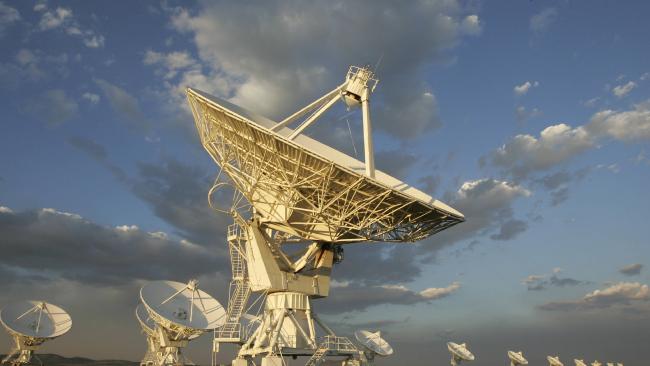
The mysterious burst lasted three one-thousandths of a second. The latest data came from telescopes at the Arecibo Observatory in Puerto Rico and Green Bank Observatory in West Virginia.
“It’s remote sensing from three billion light years away,” said James Cordes, professor of astronomy at Cornell University.
“These new measurements allow us to be much more specific about the immediate surroundings of the source.”
Until recently, many experts speculated that FRBs are produced by cataclysmic events such as stars exploding into supernovas, or neutron stars collapsing into blackholes.
While it is possible that these one-off scenarios also produce such bursts, all of them are inconsistent with multiple pulses such as those generated by FRB 121102.
Observation of FRBs could be used to better understand other celestial mysteries, according to researchers said.
The wavelengths traverse so much of the universe and cover extraordinary amounts of cosmological time. Because high frequency wavelengths arrive before low frequency wavelengths, the dispersion can give insight into the type of matter they encountered on their journey through space.
It could even be used to one day test Einstein’s theory of relativity.
“This phenomenon is so well-tuned to explore the universe,” Sarah Burke-Spolaor, an astronomer at West Virginia University and co-author of the new study told The Washington Post.
“This detection has really broken open the gates of a new realm of science and discovery,” she added.
Source: news.com.au
Ask me anything
Explore related questions




