





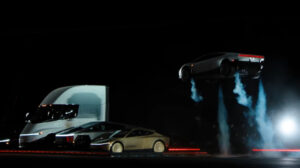
Tesla presented an electric supercar capable of lifting off the ground, performing aerial rotations, driving upside down and accelerating from 0 to 60 mph (96.6 km/h) in just 0.81 seconds. Elon Musk promised that the new Roadster would redefine what a car can do.
The presentation took place at SpaceX’s Rocket Development and Test Facility in McGregor, Texas, where the new two-seat electric vehicle underwent a series of extraordinary demonstrations more reminiscent of Hollywood stunts than a conventional car launch.
Turns out the future does have flying cars https://t.co/6fexPp6SXI
— Elon Musk (@elonmusk) October 16, 2026
The Roadster drove upside down on a specially designed track, carried out controlled flights, performed aerial rotations and landed using its thrusters before demonstrating its remarkable acceleration capabilities.
According to Tesla, the vehicle reached 60 mph from a standstill in just 0.81 seconds, beating Musk’s previously announced target of less than one second. However, the figure was reported by Tesla during its presentation and has not been independently verified. Musk also claimed that the production version would be even faster.
Our design language has evolved since the last reveal: from S3XY to Cybertruck, Cybercab & Optimus Roadster is inspired by the SR-71 & F-35 https://t.co/CV7trDTS66
— Tesla (@Tesla) October 16, 2026
Ten thrusters and 250 kilograms of compressed air
The Roadster’s most significant technological innovation comes from Tesla’s collaboration with Musk’s aerospace company, SpaceX.
Engineers from both companies developed a propulsion system using compressed air rather than conventional rocket fuel, allowing the car to perform maneuvers previously considered impossible for a road vehicle.
My first time seeing the next-gen Tesla Roadster! 👀 https://t.co/HePksE44AA
— Teslaconomics (@Teslaconomics) October 16, 2026
The Roadster is equipped with 10 propulsion nozzles supplied by two extremely high-pressure tanks with a combined capacity of 600 liters. According to Tesla Vice President of Vehicle Engineering Lars Moravy, the tanks contain approximately 250 kilograms of highly compressed air.
The four rear thrusters generate a combined thrust exceeding 80 kilonewtons (kN), with air expelled at supersonic speeds.
The system is not designed solely for acceleration. Thrusters positioned at different points around the vehicle can control its pitch and orientation while airborne, allowing it to perform controlled rotations.
“The car has attitude-control thrusters and main thrusters at the rear. It can essentially fly like a rocket, perform rotations and execute incredible acrobatic maneuvers,” Musk explained.
🤯 RECORD BREAKING SPEEDS: Tesla’s new Roadster just accelerated from 0 to 60 mph in just 0.81 seconds. https://t.co/2yibhLkbHM
— Breaking911 (@Breaking911) October 16, 2026
Another notable feature is that the tanks can be refilled using an onboard air-compression system, eliminating the need for special propellant refueling.
“You don’t need any special fuel. The car can literally refill its own air tanks and perform these maneuvers whenever you want,” Musk said.
The Tesla Roadster would leave your favorite sports car in the dust https://t.co/HxqRipibPU
— Teslaconomics (@Teslaconomics) October 16, 2026
Flying over a Tesla truck and performing aerial flips
One of the most spectacular moments of the presentation was the demonstration of the Roadster’s flying capabilities.
Initially, the vehicle climbed onto a specially constructed track and drove upside down, remaining attached to the surface thanks to a suction system installed beneath its body.
It then left the track, performed an aerial rotation and landed safely on the ground.
An even more demanding demonstration followed, with the Roadster jumping over a Tesla Semi truck and other Tesla vehicles while executing an aerial maneuver.
Musk himself appeared impressed.
“I’ve seen a lot of things, but I’ve never seen anything like this,” he said.
Notably, nobody was behind the wheel during the airborne demonstrations. For safety reasons, the Roadster performed its maneuvers autonomously.
Instead of a driver, the seat was occupied by a Starman mannequin, similar to the one placed inside the original Tesla Roadster launched into space aboard a SpaceX rocket.
“Just to be clear, that’s not a real person,” Moravy explained.
Musk joked that the vehicle had been operated autonomously during the demonstration “to make sure we don’t kill anyone.”
Acceleration beyond the limits of conventional cars
The acceleration test was equally remarkable.
Before it began, Musk explained that the main objective was to achieve a time of less than one second for the sprint from 0 to 60 mph.
The initial reading caused confusion when the timing system displayed an unrealistic result of 0.17 seconds.
“I think we broke the system. We didn’t do it in 0.17 seconds,” Moravy commented.
“If we did it in 0.1 seconds, we’d probably destroy the human inside,” Musk replied.
The final announced result was 0.81 seconds for the 0–60 mph sprint, with Musk insisting that the figure could be improved further.
“As you increase power and reduce mass, you get greater acceleration. The production car will be even better,” he said.
Moravy also claimed that the new Roadster would be capable of covering half a mile (804.7 meters) in the time other cars require to complete a quarter-mile (402.3 meters), illustrating the potential advantage of its propulsion system over longer acceleration distances.
For now, however, no comprehensive independent tests have been published to verify all of Tesla’s performance claims.
How the Roadster can drive upside down and corner at more than 2g
Beyond its thrusters, the new Tesla Roadster incorporates an advanced aerodynamic suction system using powerful fans beneath the vehicle.
The fans create negative pressure, pulling the car toward the road surface and dramatically increasing grip.
Unlike conventional aerodynamic components, which become more effective as speed increases, this technology can operate even at very low speeds.
Tesla claims the system can generate enough suction to keep the car attached to a surface even when it is upside down.
“The suction system can generate force equivalent to up to 2g, allowing the car to drive upside down,” Moravy explained.
Under racing conditions, Tesla says the technology will enable the Roadster to achieve lateral acceleration exceeding 2g while cornering, significantly surpassing the usual grip limitations of conventional tires.
“You can corner in a way that almost seems to violate the laws of physics because the car is so firmly attached to the ground. In acceleration and cornering, it will break every track record that has ever existed,” Musk claimed.
The system has two distinct operating modes.
At low speeds, it generates powerful suction to maximize grip. At higher speeds, airflow beneath the vehicle is modified through specially designed openings at the front and rear.
The Roadster also features an active rear spoiler that automatically adjusts its angle to balance aerodynamic downforce and drag reduction.
Out of this world https://t.co/NB281vv9dd
— Tesla (@Tesla) October 16, 2026
Top speed exceeds 370 km/h, but Musk wants more
The Roadster’s top speed was another subject of discussion during the unveiling.
Moravy said the electric supercar could exceed 370 km/h (230 mph), adding that engineers hoped to achieve even higher speeds.
Musk was considerably more ambitious, claiming the car would be “definitely much faster.”
Asked about his ultimate target, he said he would like the Roadster to exceed half the speed of sound.
That would correspond to approximately 610 km/h (379 mph), depending on atmospheric conditions.
However, this remains an extremely ambitious aspiration rather than a demonstrated capability.
Out of this world https://t.co/NB281vv9dd
— Tesla (@Tesla) October 16, 2026
Design inspired by the SR-71 Blackbird spy plane
The new Roadster’s design draws inspiration from aerospace engineering, particularly the American SR-71 Blackbird high-speed reconnaissance aircraft.
Tesla’s chief designer, Franz von Holzhausen, explained that the engineering and design teams wanted to create a vehicle with clean lines, low weight and an aerodynamic silhouette while accommodating its propulsion and suction systems.
The new Roadster is a two-seater, with seats integrated into the chassis structure to reduce weight.
It also features steer-by-wire technology, eliminating the conventional mechanical connection between the steering wheel and the wheels, alongside electronically controlled braking and acceleration systems.
The steering wheel has Tesla’s distinctive yoke design, while major components of the propulsion and aerodynamic systems are concentrated at the rear of the vehicle.
Von Holzhausen explained that the design needed to combine aesthetic appeal with the practical requirement of adjusting the car’s aerodynamic behavior.
“We wanted to create a beautiful car, but also one that could generate incredibly high levels of downforce,” he said.
The inside of the Tesla Roadster makes you feel like you’re in a spaceship https://t.co/XlaP0ckJ4p
— Teslaconomics (@Teslaconomics) October 16, 2026
The last Tesla designed for human drivers?
Musk also made an interesting statement about the Roadster’s future role within Tesla.
As the company increasingly focuses on autonomous driving and robotic vehicles, he presented the Roadster as a machine designed primarily for the pleasure of driving.
“In the long term, this will be the only manually driven car Tesla makes,” Musk said.
“And if you’re only going to have one car driven by a human, you might as well push it to the limits and far beyond,” he added.
The remarks highlight the philosophy behind the new Roadster, which has not been conceived as another mass-market electric car but as a technological showcase for Tesla and SpaceX.
Questions remain over whether it will be road legal
Despite the spectacular capabilities demonstrated, significant questions remain about the legality and safety of the Roadster’s unconventional systems.
Tesla has clarified that the thruster-assisted functions will be optional and may not be offered in every market.
According to the company’s British website, the model will be available exclusively in left-hand-drive configuration.
Musk acknowledged that it remains uncertain whether the car’s extraordinary capabilities will be legally permitted in every country.
Roadster and a rocket have shared a ride before https://t.co/fSjkkrvzqx
— Tesla (@Tesla) October 16, 2026
“This will be a real car that drives on roads. I’m not sure it will necessarily be legal in every jurisdiction, but there will be such a car that someone can actually buy,” he said.
He also admitted that the Roadster’s design does not necessarily prioritize maximum safety.
“This isn’t necessarily a car designed with safety as the number-one priority, but it turns the fun dial up to 11 out of 10,” Musk remarked.
Production planned for 2028 after nearly a decade of delays
The presentation marks another major milestone for a vehicle that has already experienced an exceptionally long development process.
Tesla originally unveiled the next-generation Roadster in November 2017, presenting it as a four-seat model and announcing that deliveries would begin in 2020.
That timetable was repeatedly postponed as Tesla prioritized the production of other models and the development of new technologies.
During the latest unveiling, Musk announced that production of the new Roadster is now scheduled to begin in 2028, approximately 11 years after its initial reveal.
The event also coincided with the 20th anniversary of the original Tesla Roadster’s unveiling, the vehicle that represented the company’s first major step into the electric car industry.
Moravy reflected on the significance of the original model for Tesla’s development.
“To be honest, the Roadster is why I came to Tesla. We had a plan to build an electric car that would prove we could then make more affordable electric vehicles. That’s how we got to the Model S, followed by the Model 3 and Model Y,” he said.
He also recalled the previous collaboration between Tesla and SpaceX, when Musk’s personal Roadster was launched into space aboard a SpaceX rocket.
This time, however, the ambition is reversed: to bring rocket technology into a car that private individuals can purchase.
Real life, baby https://t.co/3QEqn18wig
— Tesla (@Tesla) October 16, 2026
How much will the new Tesla Roadster cost?
Despite the unveiling, Tesla has yet to announce the Roadster’s final selling price.
According to information on the company’s US reservation website, customers wishing to place an order must make an initial $5,000 payment by credit card, followed by a further $45,000 bank transfer within ten days.
The combined $50,000 payment is a reservation deposit, not the vehicle’s final purchase price.
Questions also remain about the battery capacity, driving range and charging speed, as complete technical specifications for the production model were not released during the presentation.
Musk left open the possibility of further spectacular demonstrations, even mentioning a potential attempt to jump across the Snake River Canyon in the United States, recalling the historic stunt attempted by legendary daredevil Evel Knievel.
He admitted that he did not know whether such a feat would be possible but commented: “Let’s give it another try.”
Closing the presentation, Tesla’s chief executive delivered a line that summed up the philosophy behind the new Roadster:
“Where we’re going, we don’t need tires.”
The next-generation Roadster is undoubtedly one of the most unusual technological projects in the automotive industry.
However, Tesla’s real challenge will be transforming the spectacular prototype into a production vehicle whose performance, safety and capabilities live up to Elon Musk’s promises.
Ask me anything
Explore related questions




