×
GreekEnglish

×
  • Politics
  • Diaspora
  • World
  • Lifestyle
  • Travel
  • Culture
  • Sports
  • Cooking
Sunday
25
Jan 2026
weather symbol
Athens 13°C
  • Home
  • Politics
  • Economy
  • World
  • Diaspora
  • Lifestyle
  • Travel
  • Culture
  • Sports
  • Mediterranean Cooking
  • Weather
Contact follow Protothema:
Powered by Cloudevo
> Culture

Intriguing new theory might explain the fate of Easter Island’s civilization

However, researchers aren't ready to rewrite history just yet

Newsroom August 16 03:09

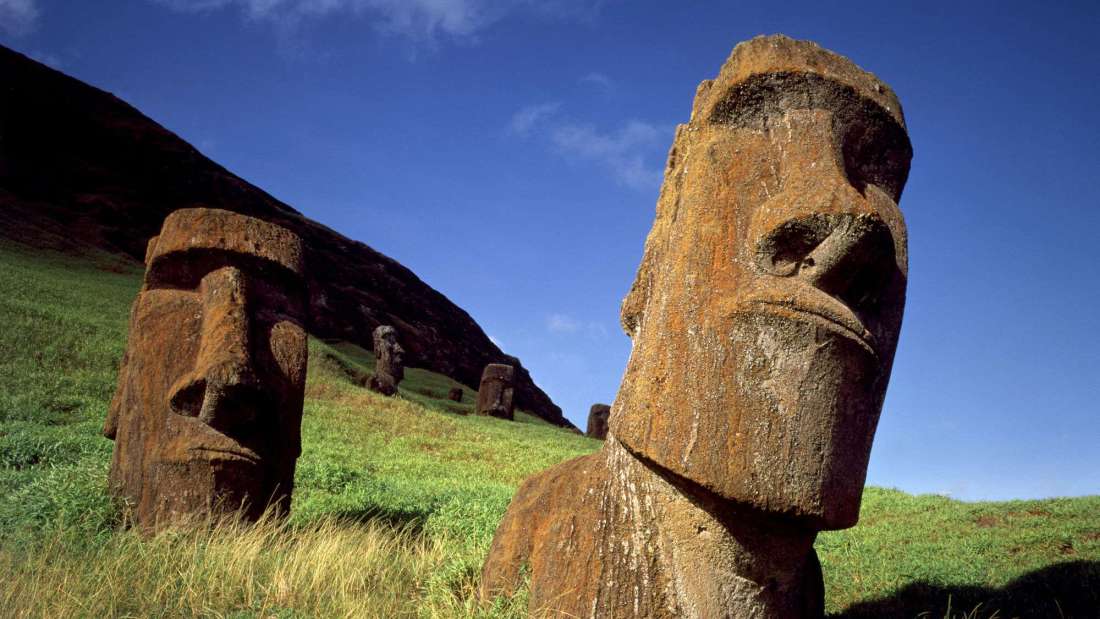
Standing up to 33 feet high and weighing 81 tons, the huge moai statues of Easter Island (Rapa Nui) are the most recognizable artifacts of a thriving civilization that peaked at the middle of the last millennium. For hundreds of years, Polynesian peoples lived on the small island 2300 miles west of Chile and developed a complex culture. By the 1700s, when Europeans first arrived, much of the society was decimated.

For years, scientists thought they knew why—but fresh archaeological evidence has provided an alternative theory.

The Journal of Pacific Archaeology published a paper this week contradicting the commonly held belief that, in the 1600s, Rapa Nui’s inhabitants descended into a Lord of the Flies–like era of infighting and violence as a result of dwindling resources. According to new research, the island’s population may not have devolved into barbarism. Instead, they were collaborating on toolmaking.

University of Queensland archaeologist Dale Simpson, Jr. theorized that the raw materials used in the carving tools would reveal clues about the dynamics of the community. He and his colleagues collected 17 tools found near the moai, including axe-like toki. Using a mass spectrometer to analyze the chemical composition of the tools and samples from stone quarries on the island, Simpson and his colleagues found that most of the toki came from a single quarry.

Simpson believes this is evidence that Rapa Nui’s people had not fallen into violent conflict, but were instead sharing resources—or at least allowing one another access to a favorite quarry for tool production. If the islanders were split into factions, it’s unlikely that whoever was controlling the quarry would permit rivals to make use of it.

If accurate, it would join other recent theories that are drawing a revised picture of Rapa Nui’s civilization. Explorers once described a surplus of spear-like objects presumably used for combat, but modern researchers examining the tools (called mata’a) in 2015 found that their surfaces were too blunt to pierce skin and were probably used for tilling soil.

>Related articles

The Shackled Men of Phaleron: This is what the space that will host the major archaeological find will look like – Photos

The dirty side of Pompeii: baths filled with sweat and urine, according to a new study

The old Acropolis Museum reopens, revealing the hidden life of the sacred rock

While Simpson’s take on the newly discovered carving tools is an intriguing theory, researchers aren’t ready to rewrite history just yet. Other scholars, including study co-author Jo Anne Van Tilburg, point out that raw materials for the tools could have been seized by force or some form of coercion.

More research will be needed to see if Simpson’s new theory holds up. If it does, it would present a new wrinkle in the storied history of Rapa Nui.

Source: mentalfloss

Ask me anything

Explore related questions
#archaeology#art#civilization#culture#Easter islands#history#theory
> More Culture

Follow en.protothema.gr on Google News and be the first to know all the news

See all the latest News from Greece and the World, the moment they happen, at en.protothema.gr

> Latest Stories

ICE agents shot and killed a protester in Minneapolis (videos)

January 24, 2026

“The Discombobulator”: Trump’s revelation about the secret weapon the U.S. used during the capture of Maduro in Venezuela

January 24, 2026

New videos show the moment a female employee was struck outside the Vrilissia Hellenic Post (ELTA) office after a dispute over a parcel

January 24, 2026

“Blackout” in the Athens FIR: What really happened on January 4

January 24, 2026

Minimum wage for 2026 enters consultation, target set at €950 by 2027

January 24, 2026

War in Ukraine: Diplomacy in Abu Dhabi, Bombardments in Kyiv and Kharkiv

January 24, 2026

Sydney McLaughlin, world’s best athlete, announces pregnancy: “I created a human with the love of my life”

January 24, 2026

The Shackled Men of Phaleron: This is what the space that will host the major archaeological find will look like – Photos

January 24, 2026
All News

> Politics

Greece–Türkiye: Cautious diplomacy ahead of the Cooperation Council

Athens and Ankara regulate the details of the conference before February 18, with the aim - despite the unfavourable climate - to keep the channels of communication open, but also to avoid major crises between the two countries.

January 23, 2026

Mitsotakis to Euronews after the EU Summit: Transatlantic relations are complex, Trump’s comments on de-escalation were positive (video)

January 23, 2026

Mitsotakis’ delicate balancing act after the crisis of trust in Euro-American relations

January 23, 2026

Metron Analysis: from 12.9% to 16%, the lead of ND in one month, 50% for Karstianos’ popularity

January 22, 2026

Mitsotakis: ‘Yes to 13 Countries Joining the Peace Council — but Only for Gaza’

January 22, 2026
Homepage
PERSONAL DATA PROTECTION POLICY COOKIES POLICY TERM OF USE
Powered by Cloudevo
Copyright © 2026 Πρώτο Θέμα