×
GreekEnglish

×
  • Politics
  • Diaspora
  • World
  • Lifestyle
  • Travel
  • Culture
  • Sports
  • Cooking
Sunday
08
Mar 2026
weather symbol
Athens 13°C
  • Home
  • Politics
  • Economy
  • World
  • Diaspora
  • Lifestyle
  • Travel
  • Culture
  • Sports
  • Mediterranean Cooking
  • Weather
Contact follow Protothema:
Powered by Cloudevo
> World

The cooperation between the Israeli and Hellenic Air Forces continues to grow (photos)

"The Greeks helped us with everything we needed, from sharing combat doctrines & flight tactics"

Newsroom December 5 06:58

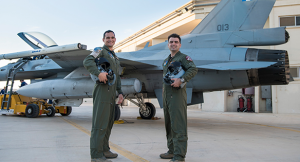
The cooperation between the Israeli and Hellenic Air Forces continues to grow: mutual exercises in both countries, simulated dogfights and side-by-side helicopter sorties. Just several weeks ago, IAF “Sufa” (F-16I) fighter jet squadrons returned from a combined training in Greece alongside the Hellenic Air Force. “We are very happy about the cooperation with the Hellenic Air Force”, said Maj. Y’, a pilot at the 201st (“One”) Squadron which operates the “Sufa” aircraft.
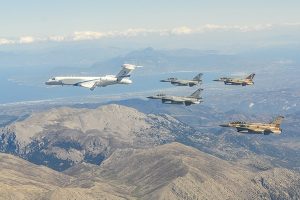
The IAF placed an emphasis on the content of the exercise early on in order to utilize the challenging Greek topography as best as they could. “It was an interesting experience”, said Maj. Y’. “The Greeks were attentive and helped us improve the quality of the exercise”.

Advantages & Opportunities

The cooperation with the Hellenic Air Force has various advantages, one of which is the geographical distance between the two countries. “The distance allows us to drill long flights similar to those we fly during operational activity”, emphasized Maj. I’, Head of the IAF’s Europe & Asia International Affairs Branch. “The exercise in Greece provided us with the opportunity to fly over expansive terrain, and the tall mountains helped simulate the operational theatre”.
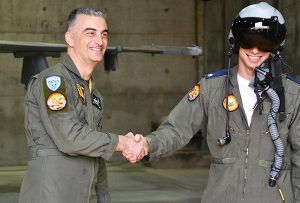
An additional advantage in the joint exercise is that Greece is a member of NATO (North Atlantic Treaty Organization) and that its air force operates according to NATO combat doctrines. These doctrines are different from the ones utilized by the IAF, which provides an opening for mutual learning. “The difference between the air forces is seen in the mode of training: NATO members fly with a large amount of formations in the sky, while the IAF aims for smaller four-aircraft formations”.

The Foundations of Success

>Related articles

Message from Mitsotakis for International Women’s Day: Zero tolerance for gender-based violence, creating opportunities at work

George Prokopiou: His ships defy the missiles in the Strait of Hormuz, as Onassis & Niarchos once did, writes the Wall Street Journal

So, who is actually in charge in Iran after Khamenei’s death? Pezeshkian apologized to the neighbors, but the attacks continued

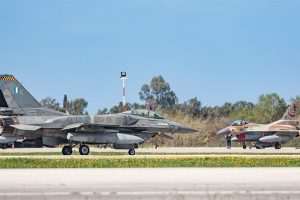
Another difference between the air forces exists in the field of exercise management: in the IAF, the exercise is managed by a central control station; in the Hellenic Air Force, a mission commander is at the head of the exercise. As part of the combined exercise, Greek fighter jets arrived at the exercise from various airbases across the country. However, in the IAF, all the aircraft flew in from the same airbase after being briefed together. “We are very focused in our training”, explained Maj. Y’. “We get down to the finest details whenever a four-aircraft formation takes off on a sortie – we believe that each aircrew member has to be as professional as possible in the cockpit in order to achieve the best results possible”.
Read more HERE

Ask me anything

Explore related questions

#aircrafts#airforces#diplomacy#Eastern Mediterranean#exercises#F-16s#greece#helicopters#Hellenic Airforce (HAF)#Iniohos#israel#Israeli Air Force (IAF)#NATO#photos#politics#world
> More World

Follow en.protothema.gr on Google News and be the first to know all the news

See all the latest News from Greece and the World, the moment they happen, at en.protothema.gr

> Latest Stories

Message from Mitsotakis for International Women’s Day: Zero tolerance for gender-based violence, creating opportunities at work

March 8, 2026

George Prokopiou: His ships defy the missiles in the Strait of Hormuz, as Onassis & Niarchos once did, writes the Wall Street Journal

March 8, 2026

So, who is actually in charge in Iran after Khamenei’s death? Pezeshkian apologized to the neighbors, but the attacks continued

March 8, 2026

Israel strikes Tehran’s oil facilities and Lebanon – “Consensus reached on the new Supreme Leader,” say Iranian media (videos) (Update)

March 8, 2026

Trump: Maybe there won’t be any Iranian leader left alive to say “we surrender” (video)

March 8, 2026

Magnitude 5.3 earthquake hits Ioannina

March 8, 2026

Alarm in the Strait of Hormuz upgraded to “Extreme Risk” – Sailors killed and escalation of attacks on shipping

March 7, 2026

The US sent supersonic B-1 bombers to Britain, a move that may signal the “major strike”

March 7, 2026
All News

> Economy

George Prokopiou: His ships defy the missiles in the Strait of Hormuz, as Onassis & Niarchos once did, writes the Wall Street Journal

In a feature on the Greek shipowner, the Wall Street Journal describes one of the boldest moves of his career, as his ships are among the very few sailing through the Strait of Hormuz

March 8, 2026

Oil: Explosive weekly surge of 35% in US crude and 28% in Brent amid crisis in the Strait of Hormuz

March 6, 2026

Strait of Hormuz: How China, India and Russia are shaping the new energy equation and oil prices

March 6, 2026

International Energy Agency on the war in the Middle East: ‘There is too much oil on the market’

March 6, 2026

Yannis Kotzias: Oil stocks for temporary crises are usually sufficient for about 60-90 days of consumption

March 6, 2026
Homepage
PERSONAL DATA PROTECTION POLICY COOKIES POLICY TERM OF USE
Powered by Cloudevo
Copyright © 2026 Πρώτο Θέμα