





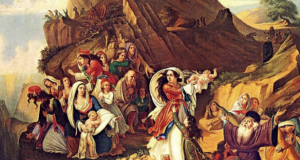
The Dance of Zalongo is considered to be a monumental act of bravery and defiance against the Ottoman rulers by the women of Epirus, and stands as one of the most colorful pages in Greece’s history.
By the end of 1803, Epirus ruler Ali Pasha wanted to finish once and for all with the Souliotes; the rebel people of Souli who were creating problems for him and the Sultan. His army besieged Souli and forced them to sign a treaty on December 12. The basic condition of the agreement; which was not observed, was for the Souliotes, along with women and children to evacuate their villages, and they would not be harmed. On December 16, the people of Souli; divided into three phalanxes, left their ancestral land behind.
Two days later, the third phalanx, heading south, was attacked in Zalongo by a large body of Turkish-Albanian soldiers. During the violent fight that followed, a group of Souliotes was trapped by the enemy. Among them there were about 60 women, some of them pregnant.
In order to avoid capture, enslavement and humiliation, the women threw their children off a steep cliff and then they held hands and started singing and dancing, with the steps leading to the cliff where they jumped to their death one by one. The incident soon became known across Europe, with the Dance of Zalongo becoming a symbol of heroism and self-sacrifice over the years.
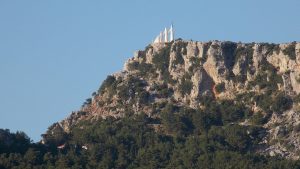
(The rocks of Zalongo where the Souliote women threw themselves off in 1803. The monument on the top was unveiled in 1961)
A concrete testimony of the Zalongos Dance comes from Ali Pasha’s officer, Suleiman Aga, an eyewitness of the incident. He told it to the Islamic mercenary Ibrahim Mansour Efendi, who wrote it in his book, which was published in Paris in 1828 as his memoirs of Ali Pasha’s Court.
According to this testimony, women “held hands and started a dance, which was driven by an unusual heroism, with the fear of death emphasizing its rhythm … At the end, exhausted, the women make a permeating and long cry with its echoes extinguished in the depths of a terrifying cliff where they all fall together with their children.”
Prussian diplomat and traveler Jacob Bardoldi (1779 – 1825), is the first to record the event between 1803 and 1804. Fighter of the Greek War of Independence and memoirist Christophoros Perrevos (1773 – 1863), is the first Greek writer who referred to the Dance of Zalongos in the second edition of the “History of Souli and Parga” (1815).
In 1888, scholar and historian Pericles Zerlentis (1852-1925), expressed doubts about the Dance of Zalongos, following on-the-spot research, without questioning the fact of the Souli women self-sacrifice.
Many years later, philologist Alexis Politis, a professor at the University of Crete, claimed in an article in “The Politis” (2005), that the song that allegedly accompanied the women’s dance, the well-known “Farewell Poor World”, was mentioned for the first time in 1908.
Despite the fact that some historians doubt whether there was an actual dance and song, the self-sacrifice of the Souli women in order not to fall in the hands of the Ottomans is indisputable.
Source: Philip Chrysopoulos/greekreporter
Ask me anything
Explore related questions




