

×
GreekEnglish

×
  • Politics
  • Diaspora
  • World
  • Lifestyle
  • Travel
  • Culture
  • Sports
  • Cooking
Sunday
28
Jun 2026
weather symbol
Athens 30°C
  • Home
  • Politics
  • Economy
  • World
  • Diaspora
  • Lifestyle
  • Travel
  • Culture
  • Sports
  • Mediterranean Cooking
  • Weather
Contact follow Protothema:
Powered by Cloudevo
> World

On faraway planet, it’s cloudy with a chance of liquid iron rain…

This ferocious heat vaporizes metals present in the planet

Newsroom March 12 02:12

Δείτε περισσότερα άρθρα μας στα αποτελέσματα αναζήτησης

Add Protothema.gr on Google

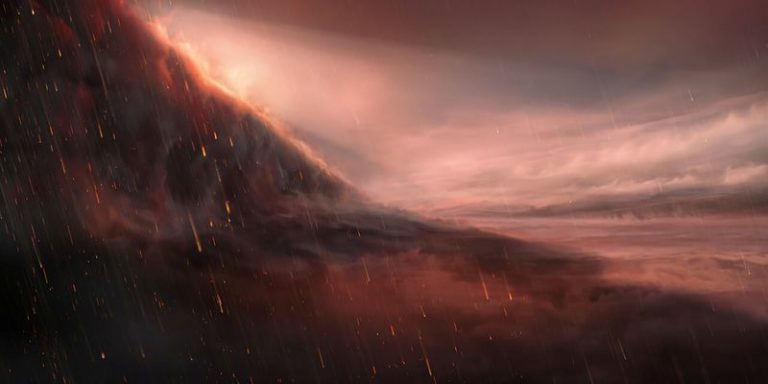
Scientists have detected an exotic planet in another solar system where the weather forecast is always dire – a 100 percent chance of the most outrageous rain imaginable, with droplets of scaldingly hot liquid iron.

The researchers said on Wednesday they used the planet-hunting ESPRESSO instrument on the European Southern Observatory’s Very Large Telescope in Chile to observe a planet called WASP-76b located about 640 light years from Earth. It is nearly twice the size of Jupiter, our solar system’s largest planet.

Planets discovered outside our solar system are called exoplanets, and WASP-76b is one of the most extreme in terms of climate and chemistry. It is a member of a family of exoplanets spotted in recent years called “ultra-hot” gas giants.

Also Read:

NASA discovers three new exoplanets

Exoplanets could be habitable, scientist says

>Related articles

New U.S. strikes target Iran again, hitting Sirik near the Strait of Hormuz

Dozens of Ukrainian drones headed for Moscow intercepted, city mayor says

Oil prices plunge 10% for the week as Hormuz traffic resumes; Brent settles at $71.99

It resides outstandingly close to its parent star, which is almost twice as big as the sun. WASP-76b orbits at only three times the radius of that star, much closer than our solar system’s innermost planet Mercury orbits the sun. The same side of WASP-76b always faces its star, much as the same side of our moon always faces Earth.

WASP-76b receives 4,000 times the solar radiation that Earth gets from the sun, and its “dayside” is baked, broiled and barbecued, reaching 4,350 degrees Fahrenheit (2,400 degrees Celsius). This ferocious heat vaporizes metals present in the planet, with strong winds then carrying iron vapour to the planet’s cooler night side where it condenses into liquid iron droplets.

Read more: Reuters

Ask me anything

Explore related questions

#exoplanets#iron#metals#rain#science#space#space exploration#technology#weather#world
> More World

Follow en.protothema.gr on Google News and be the first to know all the news

See all the latest News from Greece and the World, the moment they happen, at en.protothema.gr

> Latest Stories

University entrance score estimates for 247 departments: Engineering schools expected to rise, declines seen elsewhere

June 28, 2026

Arrests made following fatal shooting range tragedy in Malevizi; Investigators examine authenticity of victim’s signature

June 28, 2026

Fire breaks out at Hotel in Omonia, guests being rescued

June 28, 2026

New U.S. strikes target Iran again, hitting Sirik near the Strait of Hormuz

June 28, 2026

Dozens of Ukrainian drones headed for Moscow intercepted, city mayor says

June 28, 2026

Climate change ‘undoubtedly responsible’ for the severity of Western Europe’s heatwave, scientists say

June 28, 2026

Hope amid the ruins in Venezuela: Newborn rescued alive 32 hours after earthquake, watch the video

June 27, 2026

Greek Defence Industry: A last major opportunity and the open challenge of the 25% local participation rule

June 27, 2026
All News

> Greece

In reverence, the emotional deposition in Jerusalem, see photos & video

The Holy Temple of the Resurrection opened after many days due to the war between Israel and Iran

April 10, 2026

In the final stretch for the accreditation of joint master’s degrees: Aiming for their launch in the coming academic year

April 10, 2026

Schedule for Epitaph Procession today (10/4)

April 10, 2026

Perfect weather for Easter excursions, according to Tsatrafyllia’s forecast

April 10, 2026

Easter in Greece: The customs that continue in Greek tradition – From Nafpaktos to Corfu

April 10, 2026
Homepage
PERSONAL DATA PROTECTION POLICY COOKIES POLICY TERM OF USE
Powered by Cloudevo
Copyright © 2026 Πρώτο Θέμα



