×
GreekEnglish

×
  • Politics
  • Diaspora
  • World
  • Lifestyle
  • Travel
  • Culture
  • Sports
  • Cooking
Tuesday
03
Feb 2026
weather symbol
Athens 14°C
  • Home
  • Politics
  • Economy
  • World
  • Diaspora
  • Lifestyle
  • Travel
  • Culture
  • Sports
  • Mediterranean Cooking
  • Weather
Contact follow Protothema:
Powered by Cloudevo
> Culture

Final resting place of up to 65 British kings revealed as discovery sheds light on King Arthur era

Most of the tombs appear to date from the fifth and sixth centuries, a time when Britain was a patchwork quilt of dozens of small kingdoms

Newsroom March 16 10:00

Archaeologists have discovered what are likely to be the long-lost tombs of up to 65 British Kings and other senior royals from the era associated with the legend of King Arthur.

The discovery is a major breakthrough in archaeologists’ and historians’ understanding of the nature of Dark Age society. As investigations continue, it may also shed crucial new light on the currently often poorly understood political geography of post-Roman Britain.

Prior to the new research, only one final resting place of an indigenous British monarch from that time was known, along with half a dozen other potentially royal graves.

But now, at least 20 probable royal burial complexes (each containing up to five graves) have been tentatively identified – with a further 11 potentially royal burial complexes under consideration.
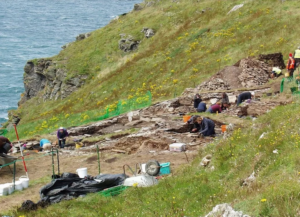
Most of them appear to date from the fifth and sixth centuries – a time when Britain was a patchwork quilt of dozens of small kingdoms.

In what is now the east and south of England, a whole series of these tiny states were ruled by Anglo-Saxon kings of fully or partially Germanic origin.

These mainly or partly continental-originating dynasties had acquired their lands and positions through conquest, marriage or alliances in the decades following the collapse of Roman rule in Britain in around 410 AD.

See Also:

140-year-old rusty batteries offer huge breakthrough for energy storage

But in the west and the north, where initially there was virtually no Anglo-Saxon penetration, the post-Roman royal dynasties that emerged were mainly Celtic ones (i.e., of indigenous British or Irish-originating dynastic origin).

But, until now, virtually nothing was known about where those Dark Age British Celtic monarchs were buried. Although archaeologists had found nine Anglo-Saxon royal graves, only one definite indigenous British royal burial site had ever been identified.

>Related articles

Unidentified drone crashes at military base in northern Poland

Kiev thanks Elon Musk for blocking Starlink in Russia

Musk also irritated with Nolan after reports that “Helen of Troy” will be black in “The Odyssey” – Online backlash over the director’s woke choice

But now new research, by a leading expert on that period, Professor Ken Dark of the University of Reading and Spain’s University of Navarra, has succeeded in tentatively pushing that Dark Age Celtic British royal graves tally dramatically up – to between 55 and 65.

The new discoveries are in Wales, Cornwall, Devon and Somerset. The newly published research suggests that they are royal final resting places because they have very unusual designs that are quite different and clearly much more high status than the thousands of other Dark Age British graves. Indeed some key examples are associated with high status probably royal Celtic locations – and have similarities with Irish royal tombs.

Read more: Independent

Ask me anything

Explore related questions

#archaeology#culture#discovery#England#history#King Arthur#king's#UK#world
> More Culture

Follow en.protothema.gr on Google News and be the first to know all the news

See all the latest News from Greece and the World, the moment they happen, at en.protothema.gr

> Latest Stories

Clintons agree to testify in Epstein investigation to avoid contempt vote

February 3, 2026

Weather: Thunderstorms, mud showers, and southerly winds are coming

February 3, 2026

Eleni Foureira: ‘I would like to collaborate with Anna Vissi’

February 3, 2026

Edi Rama: ‘We sent him to Harvard as a member of the Greek minority,’ and he mocks the Greeks

February 3, 2026

Fake power company workers and stolen data: Inside Greece’s expanding scam networks

February 3, 2026

Key takeaways from Mitsotakis interview: Alliances, pressure on PASOK, and voters’ dilemmas

February 3, 2026

The day the music died: The plane crash that took three great talents

February 3, 2026

48-hour taxi strike begins today in Athens and Thessaloniki

February 3, 2026
All News

> Culture

The day the music died: The plane crash that took three great talents

Buddy Holly, Ritchie Valens, and J.P. “The Big Bopper” Richardson — a fatal decision to fly in a single-engine plane, 67 years ago today, robbed music of three extraordinary artists

February 3, 2026

“DESSERT”: Painting Exhibition by Nikos Siskos at Sianti Gallery

February 2, 2026

Musk also irritated with Nolan after reports that “Helen of Troy” will be black in “The Odyssey” – Online backlash over the director’s woke choice

February 2, 2026

Music gala “Hope and Love” at the Athens Concert Hall

February 2, 2026

Ion Dragoumis: The unknown notebooks on the Macedonian struggle and his passions

February 2, 2026
Homepage
PERSONAL DATA PROTECTION POLICY COOKIES POLICY TERM OF USE
Powered by Cloudevo
Copyright © 2026 Πρώτο Θέμα