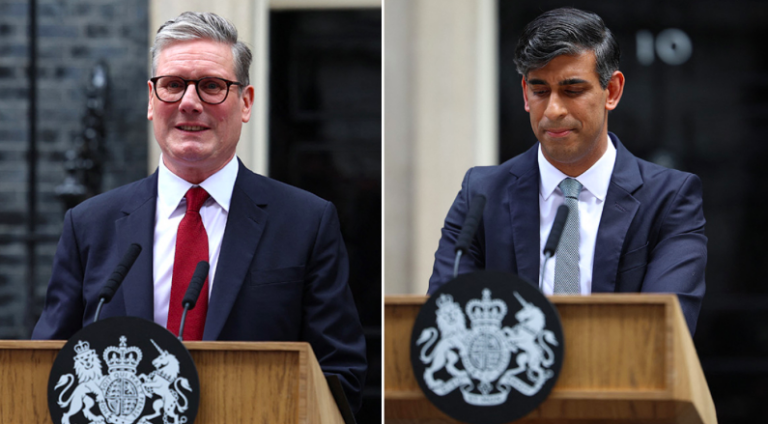
With “change” as his banner and his country’s “great reboot” as his priority, new British Prime Minister Keir Starmer received the mandate to form a government yesterday. He highlighted the changes he achieved within the Labour Party as a model for the broader transformations he aims to implement in Britain.
Starmer’s fresh team consists of new-generation executives and many women, signaling a shift in approach. The election marked a significant defeat for the Conservatives, who lost power after 14 years and experienced a severe existential crisis.
Starmer emphasized stability and moderation as the pillars of his policy, promising cheap energy, new infrastructure, and numerous new jobs. A highlight of his administration is the appointment of Rachel Reeves as Chancellor of the Exchequer, making her the first woman in British history to hold the position. “I’m under no illusions about the challenges we face,” Reeves commented, acknowledging the long road ahead.
Other key appointments include David Lammy as Foreign Secretary, John Healy as Defense Secretary, and Yvette Cooper as Home Secretary.
Vote of Disapproval
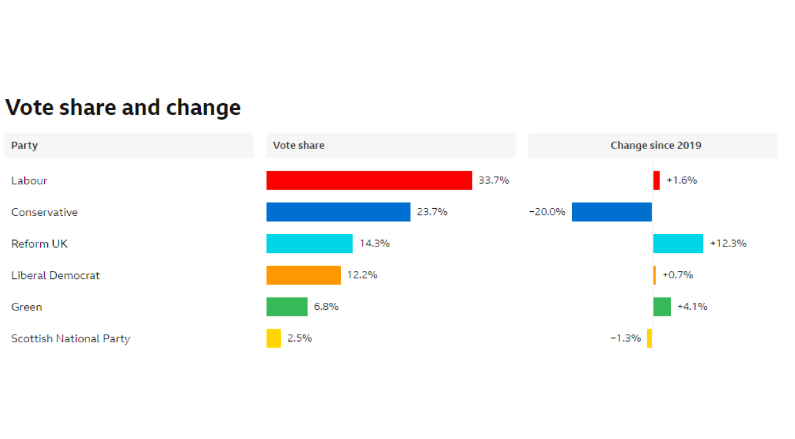
In terms of absolute numbers, Labour’s victory was not a result of their surge, but rather the collapse of the Conservatives, who lost more seats than Labour gained. Labour saw a modest gain of 1.6% compared to 2019, while the Conservatives lost 20%.
Seat Distribution:
- Labour: 412 seats, 211 more than the last election
- Conservatives: 120 seats, losing 250 seats compared to the last election
- Liberal Democrats: 71 seats (their best electoral performance in history)
- Scottish National Party: 9 seats
- Sinn Fein: 7 seats
- Independents: 6 seats
- DUP: 5 seats
- Reform Party: 4 seats
- Greens: 4 seats
- Plaid Cymru: 4 seats
- Socialist Labour Party: 2 seats
- Alliance Party, Ulster Unionist Party, and Traditional Unionist Voice Party: 1 seat each
Conservative Party’s Downfall
Despite Labour’s programmatic renewal and leadership overhaul, their return to power was significantly aided by the electoral collapse of the Conservative party. The Conservatives’ loss of 250 seats allowed Labour to quickly surpass the 326-seat threshold needed to form a majority government.
Outgoing British Prime Minister Rishi Sunak faced significant internal criticism, with at least 11 of his former ministers rejected by the electorate. Former defense secretary Grant Shapps admitted that “we have exhausted the patience of traditional Conservative voters with our endless political soap opera of infighting and division.” He emphasized that voters reject divided parties.
The internal strife within the Conservatives, compounded by a chaotic six-week pre-election period, led to former Prime Minister Liz Truss losing her re-election bid by 630 votes. The Conservatives’ image was tarnished by a record number of scandals and resignations over the past five years, resulting in only 33% of the party’s candidates being re-elected. The party now faces deep internal turmoil.
Insecurity and Managerial Weakness
In the fine print of the fresh election results, valuable seats lost by the Conservatives benefited Farage’s Reform Party, which finished second in 103 out of 650 constituencies, capturing 35% of the vote, according to Euronews. Due to the structural weaknesses of Britain’s electoral system, Labour secured a significant number of seats but did not garner a large enough share of the overall vote, making their majority rather fragile, analysts suggest.
Ask me anything
Explore related questions