





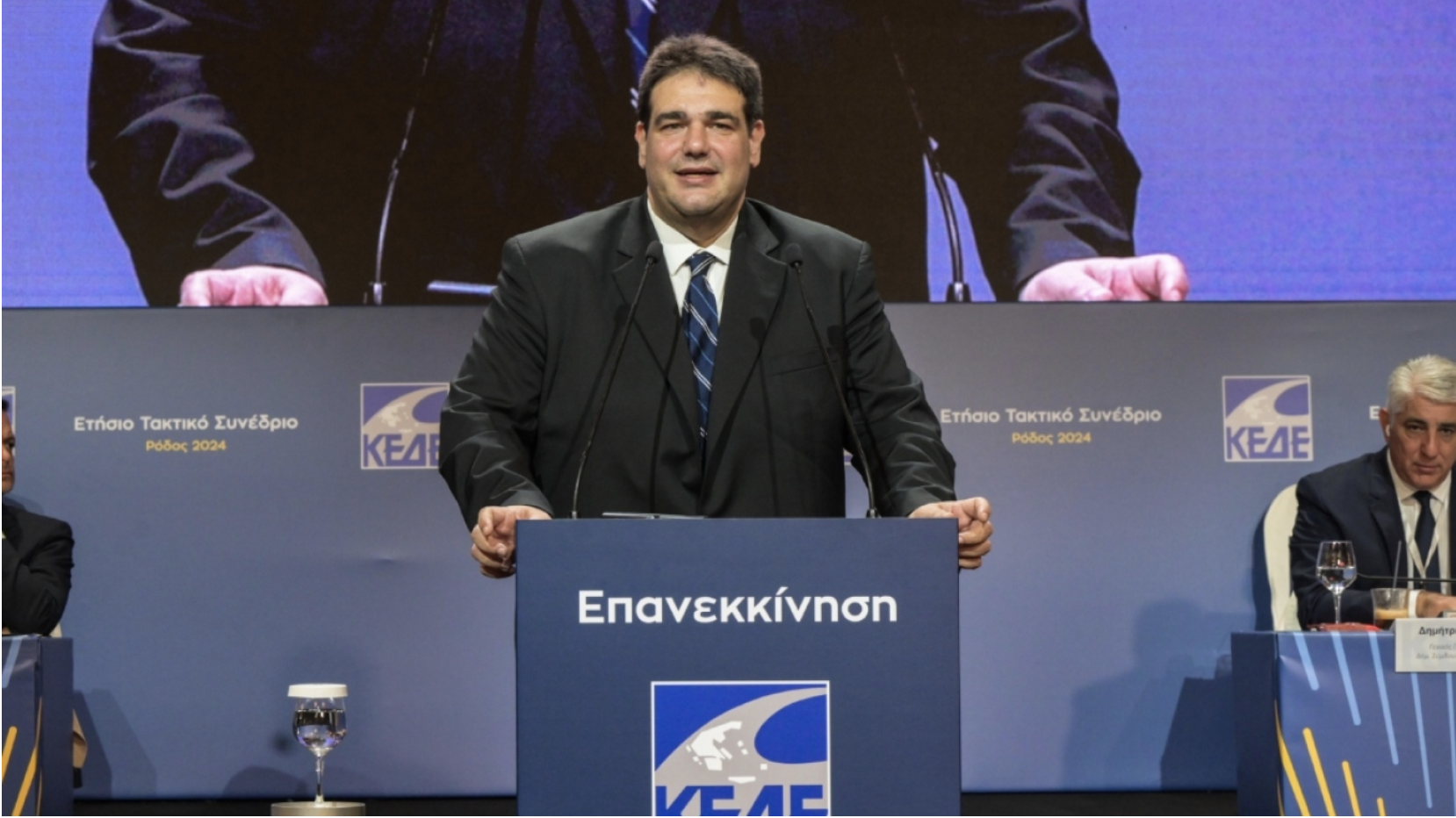
Local elections for municipalities and regions will be consistently held on the last Sunday of November. The reforms, introduced by Minister Thodoris Livanios at the KEDE (Central Union of Greek Municipalities) conference in Rhodes, are intended to modernize local government.
At the annual KEDE conference, under the auspices of President Katerina Sakellaropoulou, Minister Thodoris Livanios outlined the main axes of a comprehensive local government reform. The Ministry’s proposed changes address both the election system for municipal and regional authorities as well as issues of governance, supervision, financial management, the official status of elected representatives, and the roles and responsibilities of local government.
In a statement, Minister Livanios said: “Today we presented specific proposals for local government reform, marking the dynamic direction the government seeks for municipalities and regions. These changes will be more than just paper reforms; they aim to equip local authorities with practical tools to address inefficiencies and mature as organizations, ultimately benefiting all citizens.”
Key Proposed Reforms for the New Unified Local Government Code
A. Changes to the Election Process for Local Authorities
- Single-Round Elections for Municipal and Regional Authorities
Local authorities will be elected in a single round. Voters can select a second-choice combination on the same ballot. If no combination secures 50% + 1 of the valid votes from first preferences, the two combinations with the most votes advance to a second counting phase. In this phase, second-choice votes from ballots of other combinations that did not advance are added to the counts of the two leading combinations. The winning combination will be the one that either (a) secures 50% + 1 in the initial count or (b) achieves the highest count in the second phase.This change is designed to address low voter turnout in a second round and eliminate the significant cost of a two-round election system. - Optional Electronic Voting for Municipal and Regional Elections
After the successful introduction of absentee voting in the 2024 European Parliament elections, the Ministry announced plans to allow electronic voting for local elections. Voters who wish to vote electronically can do so, while traditional in-person voting will remain available. - Early Elections Option within the First Three Years of the Five-Year Term
This option will be available if four-fifths of council members, along with the mayor or regional governor, agree. The measure aims to prevent administrative paralysis caused by cases of councilors’ resignations or changes in political allegiance. - Additional Candidates without Preferential Voting
Each combination will be able to designate additional candidates without preferential voting, up to the following limits:- 1 additional candidate in councils with up to 19 members
- 2 additional candidates in councils with 25-39 members
- 3 additional candidates in councils with 43 members
- Youth Participation Quota
To boost youth involvement in local governance, a quota for candidates up to 30 years old is being introduced. - Abolishment of the Transfer Option for Elected Civil Servants
Election to office should be seen as a public service, not as a way to transfer jobs, which has often weakened public services through excessive staff reassignments. - Reduction in the Number of Candidates to a Maximum of 50% Beyond Required Positions (Down from 150%)
By lowering the cap, a combination seeking office in a 31-member council will now be allowed a maximum of 47 candidates instead of up to 78 under the current system. - Unified Election of Municipal Councils Instead of by District
Fifteen years after the implementation of the “Kallikratis” reform and the merging of “Kapodistrian” municipalities, the need for distinct electoral districts has been deemed unnecessary. - Single Nomination Fee Based on Population
The amount required for a nomination fee will be scaled according to the population size of each municipality or region. - Election Date Set for the Last Sunday in November
This change shortens the time between election day and the start of duties for newly elected officials, reducing the potential for a power vacuum.
B. Changes in Governance, Legal Status of Elected Officials, Supervision, Responsibilities, and Financial Management
- Mandatory Public Consultation: All regulatory acts must go through a public consultation phase before being submitted to the municipal or regional council.
- Exclusive Electronic Local Referendums: Referendums on local issues will be conducted exclusively electronically.
- Appointment of a Service Secretary in Municipalities with Over 200,000 Residents: For more efficient administration in large municipalities.
- Increased Salaries for Mayors and Vice-Mayors: Mayors of municipalities with over 20,000 residents must suspend professional activities, taking a full-time leave for the duration of their term.
- Random Distribution for Legal Compliance Checks: All actions subject to legality checks will be randomly assigned to a Compliance Auditor outside the area’s jurisdiction. Seven Compliance Auditors will coordinate under a General Compliance Supervisor for local government oversight.
- Accelerated Decision-Making for Legality Checks: The timeframe for decisions on legal compliance checks will be reduced to 10 days.
- Maintaining Municipal Fees for Service Funding: A new Local Development Fee will replace the Municipal Tax and Real Estate Property Fee, with municipalities having the freedom to adjust rates for various needs.
- Restoring the Court of Audit’s Preemptive Control for Payments over €15,000: Aims to ensure proper use of public funds.
- Establishing a Municipal Revenue Management Center: Managed by KEDE, this center will collect all confirmed debts owed to municipalities and enable electronic payments, directly crediting municipalities.
- Redistribution of Responsibilities Among Local and Regional Authorities, Decentralized Administrations, and Central Government: Redistribution will consider (1) the local, regional, or national nature of responsibilities, (2) efficiency in serving citizens, and (3) policy-based jurisdiction presumption.
A committee, including local government representatives, judicial authorities, academics, and officials from both local government and the Ministry of the Interior, has been established to draft the new Unified Local Government Code. This committee met for the first time on Monday, November 4, aiming to complete this task as quickly as possible. The Ministry of the Interior also established a Drafting and Implementation Unit to assist in this process.
This comprehensive local government reform effort represents a commitment by the Ministry to enhance municipal and regional administration, aiming to create a more dynamic, efficient, and accessible local governance system for Greece.
Ask me anything
Explore related questions




