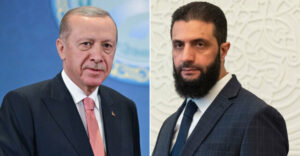
Just 22 days after the overthrow of Assad’s regime by the armed jihadist organization HTS and its allied armed groups, and while the international community is calling for and suggesting a structured and cohesive transition process, Syria’s de facto ruler, Al-Joulani, has revealed his intentions.
The transition process, as he explained to Al-Arabiya, will be lengthy. It will take at least three years to draft a new constitution and at least four years to hold elections. Therefore, until then, Syria will fall under one-man rule.
Despite the systematic and largely effective efforts of the former HTS warlord, with a background in Al-Qaeda, to present a modern face to reassure the international community and Syrian citizens alike, it is evident that many things are being done without being said, and others are being said without being done. Ultimately, the “fine words” will be judged by actions.
A Cabinet Without Reconciliation Intentions
For now, Al-Joulani, who seems to be closely guided in all his steps by his powerful patrons in Turkey, has shown no signs of seeking to form an inclusive, unifying, and reconciliatory government. Such a government would undertake the difficult tasks of achieving peace in the country, reconstructing it, and initiating the transition process with a new constitution and elections to establish a representative and democratically legitimized government.
Moreover, one must not confuse the fact that while the vast majority of the Syrian people welcomed Assad’s overthrow with joy and enthusiasm, the group that accomplished it and rushed to seize the Presidential Palace and the “levers” of power lacks significant popular support. On the contrary, it is a minority in Syria’s political scene.
However, the law of the strong now prevails in the country. And the strong one is Al-Joulani, who hurried to appoint a cabinet composed of warlords from his organization or other Islamic groups, avoiding any reconciliatory gestures toward other Syrian opposition figures or representatives of religious and ethnic minorities. This move would have given the impression of forming a National Salvation Government.
The public denunciation by opposition leader Hadi Al-Bahra that he has not received any invitation for consultation from Al-Joulani is telling.
Turkey and Al-Joulani Seek to Legitimize De Facto Power in Damascus
Turkey and Al-Joulani aim to enforce the legitimacy of this de facto power in Damascus, which is backed by the military might of the groups that collaborated to establish it. The need for a credible interlocutor in the country would compel the international community, the UN, the EU, and the Arab world to recognize this peculiar emergency military regime as the country’s legitimate interim government.
This is happening without even basic guarantees or evidence that Al-Joulani’s military government will facilitate Syria’s transition. There is no assurance that the transitional period, following international recognition, will not be used systematically to eliminate all potential opponents or political forces that could threaten its power in future elections.
International aid should not be managed by such a military authority that would use it to consolidate its power. Nor can a flood of infrastructure aid be unleashed, only for it to be funneled uncontrollably into Turkish companies already beginning to “invade” Syria.
What Ankara Seeks with Al-Joulani’s Legitimization
Erdogan and Al-Joulani’s major gamble is to impose this de facto military government as a legitimate “interim” government. This is a model proven to be dangerous in Libya, where since 2015, a “temporary” government recognized by the UN in Tripoli has persistently thwarted election efforts and effectively remained in power.
This model serves Ankara well. With Al-Joulani’s signature alone, Turkey could gain access to Syria’s natural resources, undertake reconstruction (with international funds), and even be invited for an official military presence in the country, mirroring its actions in Libya.
Such a government, with even minimal international legitimacy, could claim the right to sign international agreements, such as the proposed Turko-Syrian Memorandum on maritime zone delineation. This agreement has already been previewed by Ankara.
Although such an agreement may not be Al-Joulani’s immediate priority, it is not a decision he will defer indefinitely, given the uncertainty surrounding Syria’s future developments.
Al-Joulani’s Objectives
With Erdogan’s support—who is already lobbying for lifting sanctions against Syria under the pretext that it is the only way for the country to emerge from isolation and economic devastation—Al-Joulani seeks to lift these restrictions. Notably, Syria’s de facto ruler has appointed Mayassa Sabrina as Central Bank president. Sabrina is not only the first woman in this role but was also the Bank’s vice president until Assad’s fall.
A major issue is the disbandment of armed groups operating in the country. Al-Joulani claims his organization will disband. However, HTS has already transformed into the government’s military force. This is the entity he calls upon all armed groups in Syria to join. Many of these groups have fought to the death against Al-Qaeda, ISIS, and HTS itself, making it evident that former mortal enemies are unlikely to accept disarmament or subjugation to the “National” Army made up of HTS members.
Notably, HTS’s deputy leader, Abu Hassan, now heads the Ministry of Defense, and 20 senior officer positions in the new army have been filled by warlords from the organization or allied Islamic groups. Among them are four former warlords from Albania, Turkey, Jordan, Tajikistan, and Egypt, pointing to the “international” jihadist network that has operated on Syria’s blood-soaked battlefield in recent years.
On the other hand, the Kurds are highly unlikely to lay down their arms, especially when Turkey has already amassed troops on the border, ready for “cleansing operations” in the autonomous Kurdish region.
Greece Must Engage in the Process
Greece, for reasons tied to international legality, regional stability, and its own interests, must actively engage in this process within the framework of the EU and as a non-permanent member of the UN Security Council as of January 1. Greece must prevent the potential legitimization of the military power currently controlling Damascus until there are clear and concrete guarantees for a democratic transition, inclusive of all Syrians, regardless of religion or ethnicity.
The consolidation of Damascus’s military government under the blessings of Erdogan and Allah would be a tragic mistake for Syria and the entire region.
Ask me anything
Explore related questions