





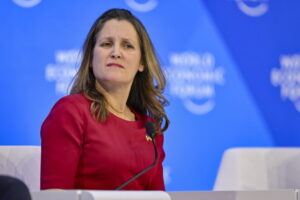
Chrystia Freeland, a former journalist turned politician who rose to prominence as Deputy Prime Minister in Justin Trudeau’s administration, has announced her candidacy for the leadership of Canada’s Liberal Party. If successful, she will also vie for the position of Prime Minister in the 2025 national election.
In a statement on Friday, Freeland declared: “I’m running to fight for Canada.”
If Freeland wins the leadership race, set to be decided on March 9, she will become the second Canadian to ascend from Deputy Prime Minister to Prime Minister, following Jean Chrétien. She would also make history as Canada’s second female Prime Minister.
A Controversial Career Move
Freeland played a pivotal role in sparking a political crisis in Canada when she resigned as Minister of Finance after disagreements with Trudeau over handling the impending threat of U.S. tariffs.
As noted by The Guardian, Freeland’s candidacy raises questions about how her strained relationship with the Trump administration might influence her campaign. During her tenure, former U.S. President Donald Trump publicly criticized her, stating: “Freeland’s behavior has been completely toxic and not at all conducive to making deals that are good for the very unhappy citizens of Canada. We won’t miss her!!!”
With the U.S. presidential election approaching, analysts are debating whether her history of tense interactions with Trump could help or hinder her campaign in Canada, where national unity and resilience in the face of U.S. trade threats have been rallying points across the political spectrum.
Who Is Chrystia Freeland?
Born in a small village in Alberta, Freeland, 56, has Ukrainian heritage—a connection that has made her an outspoken supporter of Kyiv following Russia’s invasion of Ukraine.
She studied at Harvard and Oxford before embarking on a journalism career that took her around the globe, focusing on the collapse of the Soviet Union. Her reporting led to her being banned from Russia. Freeland held senior roles at The Globe and Mail, The Financial Times, and Thomson Reuters.
In 2013, then newly elected Liberal leader Justin Trudeau persuaded Freeland to leave journalism and enter politics. She won a seat in Toronto and quickly became one of Trudeau’s most trusted allies.
Freeland has held several high-profile positions in Trudeau’s government, including Minister of Foreign Affairs and Minister of Finance. She also served as Deputy Prime Minister and Minister of Intergovernmental Affairs, cementing her reputation as a key figure in Canadian politics.
As she embarks on this next chapter, Freeland’s campaign will likely focus on her extensive experience and her vision for Canada’s future, setting the stage for what promises to be a highly competitive race.
Ask me anything
Explore related questions




