

The evolution, through time, of the ancient city of Philippines and the daily life of its inhabitants are highlighted in an impressive way, on the occasion of the works carried out in the last year at the archaeological site for the installation of the fire safety network. These works have brought to the surface small and large “secrets” of the ancient city, confirming the scientific archaeological studies that have been going on for many decades about the splendid buildings that adorned it and the justifiably great fame it acquired after its foundation (in 356 BC) by the King of Macedonia Philip.
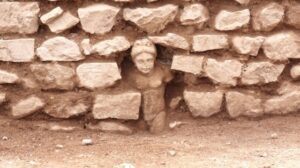
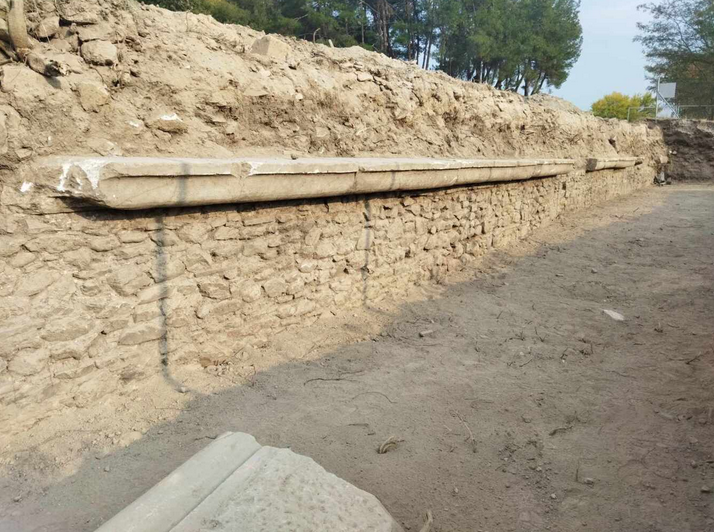
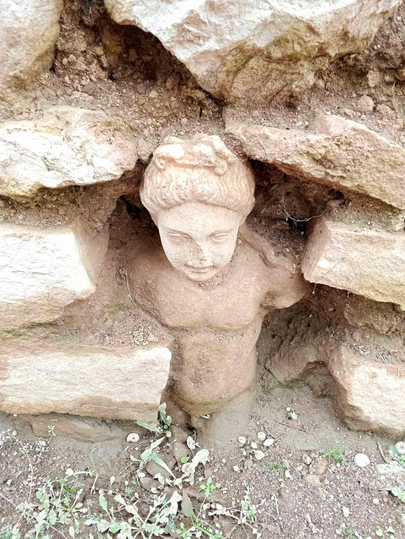
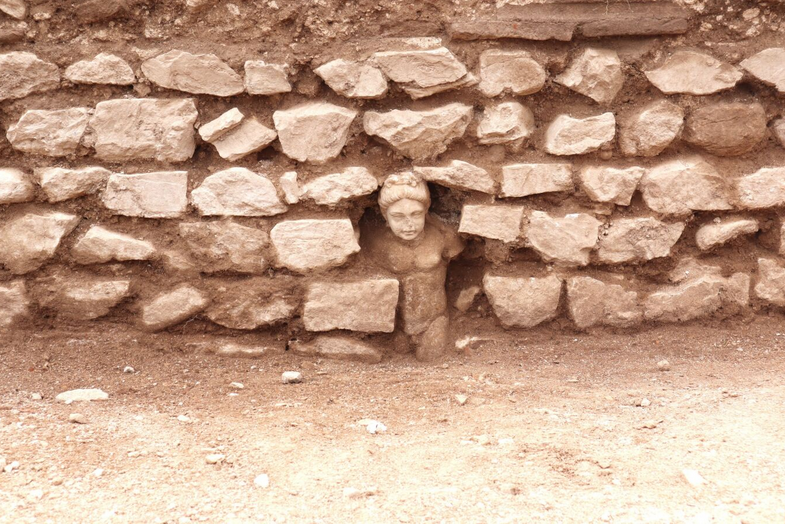
A large public building, where there is a statue of a young male figure embedded on the base of a wall, parts of the city streets, baths (public baths) with a Roman and early Christian phase, workshops and houses, are just some of what the archaeologists saw and recorded during the demanding works for the installation of the water supply and fire safety network.
“This project enabled us to confirm the results of the geophysical survey carried out in the framework of another project, under the supervision of Prof. Gr. Tsokas, but also earlier explorations. This method, which locates buried walls, gave us impressive results at Philippi and helped us a lot in the routing of the pipeline, so that antiquities were not damaged. At the same time, the fire-proofing project provided us with new evidence of the city’s rich history after the 6th century AD, invalidating the hitherto held assumption that Philippi was abandoned in this period. During the work we found structures dating from the 9th to the 11th century AD, which reveal that the city was inhabited even then,” says the director of the Ephorate of Antiquities of Kavala – Thassos, Stavroula Dadaki, speaking to APE-MPE.
Stara Stav Stavros Dastas, the director of the Archaeological Museum of Thassos, said in a statement at the Stavropol site of Staraja Thassos.
What is included in the fire safety plan
“The construction of the fire safety network was not an easy task, it required a lot of study, systematic work and painstaking work by the curatorial staff. There had to be the possibility to provide alternatives when the works encountered archaeological finds”, Ms. Dadaki notes and continues: “every time the contractor, in the path where the trench had been cut for the pipes to pass, encountered sites of archaeological interest, a new marking had to be made for the route of the pipelines. In one case, the pipelines with a special construction passed over an ancient wall, so that it would not be destroyed, while only in two cases in a pipeline network, about 2 km long, it was necessary to partially deconstruct four walls, partially already destroyed.”
The fire protection of the famous ancient city of Philippi, which includes iconic monuments such as the theatre, Basilica II and the ancient marketplace, has been a priority for the culture ministry. The project, with a total budget of more than 2.5 million euros, was included in the Recovery Fund and is expected to be delivered by autumn 2025. It aims to enhance the fire safety of the visited archaeological site (60 acres in size, compared to the 700 acres of the entire walled city), while respecting its archaeological value, as the works include modern technologies without affecting the sensitive monuments.
According to the study, two reservoirs were constructed on the outskirts of the visited archaeological site to supply water to the network, while fire hydrants will be placed around the perimeter without altering the aesthetics of the surrounding area. Also, with the proposal of Stavroula Dadaki, along with the fire safety pipelines, a water supply pipeline and an additional pipeline for the routing of electricity cables were installed, so that there is the possibility of providing drinking water and electricity to the entire archaeological site.
Increase in visitor numbers in 2024
The archaeological site of Philippi, included since 2016 in UNESCO’s list of World Heritage Sites, is among those monuments that have seen a significant increase in visitor numbers since the coronavirus pandemic.
“In 2024”, Ms. Dadaki points out, “the visitation of Philippi reached 100,000 people and this number is significant as until the coronavirus (in the years 2015 – 2019) the visitation was around 40,000 people per year. I appreciate that the important projects that started in 2019 for the consolidation of the archaeological site have significantly changed the image of the site. During this period, the fire safety works provided us with new data on the layout of the ancient city and at the same time highlighted key locations for future new excavations to reveal even more monuments.”
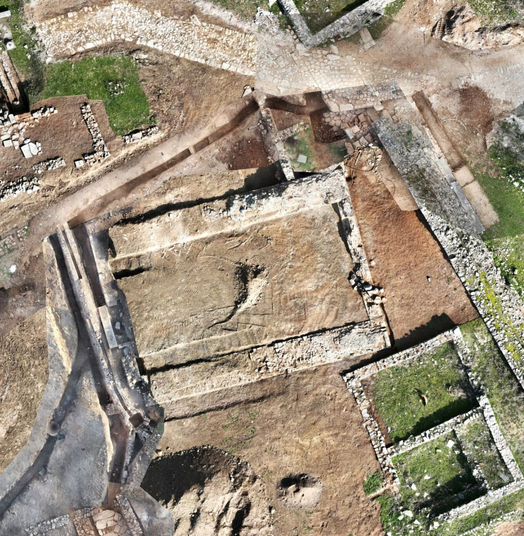
“For example, one of the first buildings worth excavating is the one found near the ancient theatre,” the Curator of Antiquities of Kavala points out and continues: “it is a large building, so we assume that it had a public character, on the north side of which a statuette of Neania is embedded as a decorative element. The Romans were accustomed to form niches and to place statues in them. The work has revealed the upper part of the trunk, but the excavation must be completed to see the whole picture. Also, it is to be investigated whether this building is related to the ancient theater in the 2nd century AD, whether it is a reservoir for collecting water, or a granary, or a warehouse for grain, or heaters.”
“Another interesting building, found during the work of the fire safety network,” notes Ms. Dadaki, “is located southwest of the palace, which we believe was a thermae (public baths). A section of a hall with a semi-circular configuration and floors made of orthomarble was revealed. Interestingly, it also has an early Christian phase, encroaching on a Roman road, and gives us evidence of the layout of the city in the 6th century AD.”
“Equally interesting is the wall that defines the northern side of the so-called Egnatia. It was uncovered over a considerable length. It bears recesses in the form of niches, which were probably decorated with statues. A section of a similar wall was excavated by the French School of Archaeology in the 1930s to the north of the ancient market place, but it was not interpreted. If the research, which is certainly worth continuing, reveals that this is the continuation of the same wall, then we are talking about a monumental configuration that separated the two levels of the city”, concludes the Curator of Antiquities of Kavala – Thassos.
Ask me anything
Explore related questions