

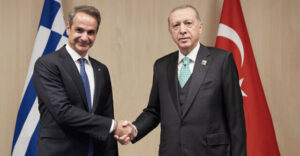
A new postponement of the High Cooperation Council Greece–Turkey, which was due to take place in early 2025 in Angara with Turkey.
According to reports, at the meeting in Doha, the Foreign Ministers of the two countries discussed the scheduling and exchanged dates, but it appears that the meeting will be postponed to after March and after the expanded conference on the Cyprus problem in Switzerland has been convened and the Ramadan (April 1) has been completed.
Although the two ministers discussed the usefulness of continuing the Political Dialogue and the meetings on Confidence Building Measures (CBMs), they did not set dates for these two mechanisms of the Greek-Turkish dialogue. The reality, of course, is that the process has reached its limits, and the main objective of the two sides is simply to maintain “calm waters” in the Aegean, knowing that it is extremely difficult to make progress on the major issue of the delimitation of the shelf and the EEZ.
But this pursuit is running into difficulties, as Turkey continues to arbitrarily say that the issue is directly linked to what Turkey wants, which is Greece’s self-limitation in the exercise of its sovereign rights.
Mr. Gerapetritis raised with his Turkish counterpart the issues related to the investigations being conducted on the electrical interconnection. The optimistic assessment of a senior diplomatic source is that “there will be no problem.”
In any case, the continuation of the surveys for laying the Greece-Cyprus electrical interconnection cable is emerging as a key test for Greek-Turkish relations. After three months of continuous surveys in areas within Greek territorial waters, the surveys should now be extended to the sensitive area east of the Kasos, in the direction of Cyprus.
At this point, last July, the well-known incident occurred where the dispatch of Turkish warships prevented the continuation of exploration in areas of international waters, but within the Greek EEZ delimited with Egypt. These are areas overlapping the illegal Turkish-Libyan memorandum and where Turkey has unilaterally declared to the UN that they belong to the Turkish continental shelf.
At the time, Turkey, taking advantage of the disclosure of the coordinates of the Ievoli Relume research vessel to the Turkish authorities, had issued its own NAVTEX for the searches, even referring to “Turkish continental shelf” although no permission from the coastal state is required for such searches.
Last week, the Greek authorities issued two NAVTEX concerning the searches by the two ships Ievoli Relume and NG Worker north of Agios Nikolaos in the Cretan Sea in international waters, a few miles outside Greek territorial waters. Turkey sent a corvette to the area, which is monitoring the work of the two ships from a distance of 10 nautical miles in international waters, while reportedly claiming by radio that the area of the searches is outside “Greek jurisdiction” in an undefined continental shelf.
This message, which in diplomatic language it means that Turkey believes that Greece cannot exercise its own sovereign rights, even in an area of international waters where the continental shelf would clearly belong to Greece with any delimitation. The two research vessels continued their work as normal, while a Hellenic Navy frigate had also rushed to the area.
Turkey, with this move, declares its presence in the Aegean Sea, even in areas of international waters and the potential Greek continental shelf, and mainly sends the message that it will have a say in the issue of the investigations for the laying of the cable. The presence of the Turkish corvette is essentially a warning of the expected continuation of work east of Kasos, where it was halted last July.
The question now is whether the two research vessels will continue to the same perpetual areas within Greek territorial waters or in the international waters west of Kasos, where there are no direct Turkish claims, or whether the research will proceed east of Kasos, in the area of the defined Greek EEZ, and later on towards Cyprus.
Although in the previous period an understanding with Turkey at a higher level had been sought to find a formula for the smooth continuation of the investigations, the latest incident probably shows that no such formula has been found. Thus, either the investigations will be restricted, with negative consequences for the smooth implementation of the important project of the electrical interconnection, or there will be a risk of a new confrontation on the field , which will de facto disturb the “calm waters” and add another big weight to the next summit meeting between the two countries.
Ask me anything
Explore related questions