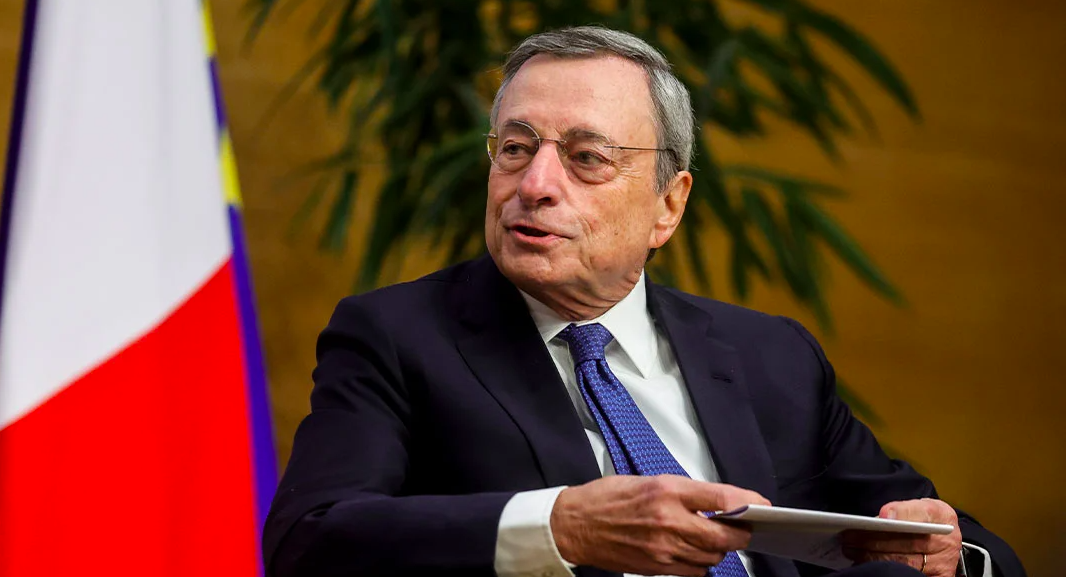
The need for radical changes in order to break down the barriers that are bringing the competitiveness of the European economy to its knees is highlighted by Mario Draghi in an article in the Financial Times, under the headline “Forget the US, Europe has successfully imposed tariffs on itself.”.
The former ECB president and prime minister of Italy, who has edited the landmark 2024 report on the future of European competitiveness, points in his article to the fragile recovery of the eurozone and the prospect of the US imposing tariffs, a possibility that creates further uncertainty.
Draghi points to two important factors that have led Europe to this predicament. “The first is the EU’s long-standing inability to address supply constraints, in particular high internal barriers and regulatory hurdles. These are far more damaging to growth than any tariffs the US could impose.”
“The IMF estimates that Europe’s internal barriers are equivalent to tariffs of 45% for manufacturing and 110% for services,” Super Mario underlines, while in the more innovative arm of services, digital, regulatory rules hinder the growth of European tech companies. “GDPR compliance costs, for example, are estimated to have reduced profits for small European tech companies by up to 12%.”
The second factor holding Europe back “is its tolerance of persistently weak demand“. “This has exacerbated all the issues caused by supply constraints. Until the crisis, domestic demand as a percentage of GDP in the eurozone was close to the mid-range of advanced economies. Then it hit rock bottom and stayed there.”
“Both of these shortages – supply and demand – largely stem from Europe itself. It is therefore within its power to change them, with an “unrelenting effort to remove supply constraints” and “redirecting demand back to the domestic market.”
Draghi is simultaneously calling for “a more farsighted use of fiscal policy in the form of higher productive investment” but, as he points out, “this path requires a fundamental change of mindset. Until now, Europe has focused on either individual or national targets without considering their collective costs.”
“Internal barriers are a legacy of times when the nation-state was the natural framework for action. But it is now clear that acting in this way has delivered neither prosperity for Europeans, nor sound public finances, nor even national autonomy, which is threatened by external pressure. That’s why we need radical change,” he concludes.
Ask me anything
Explore related questions