





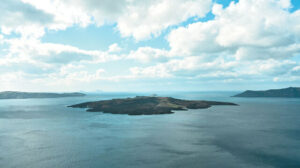
The mystery surrounding the swarm of seismic tremors in Santorini turned into a nerve-wracking thriller on Friday night. That was when the Euro-Mediterranean Seismological Center confirmed that increased activity, including harmonic tremors and a deep rumbling sound, had been detected on the island. According to scientists, and especially based on the presence of harmonic tremors, this typically indicates that magma is moving upward—an unmistakable sign of volcanic unrest.
For three hours, this intense movement of magmatic fluids persisted—long enough to concern scientists: Has Santorini’s volcano awakened, and what could it mean?
Seismographic Readings Under Scrutiny
Chilean geophysics professor Luis Donoso analyzed the readings from the “Thira” seismic station monitored by the EMSC. “The signal detected is a vibration registered by the instrument. Its origin is not tectonic but is linked to fluid movement within a fault system—fluid that carves its own path through the rock it moves in,” he explained.
Speaking to Proto Thema, Donoso stated that while this activity could mean many things, thorough study is needed before drawing conclusions. However, after about three hours, activity levels returned to normal. This, he clarified, does not mean the volcano has gone back to sleep—rather, it suggests a transition into a new phase.
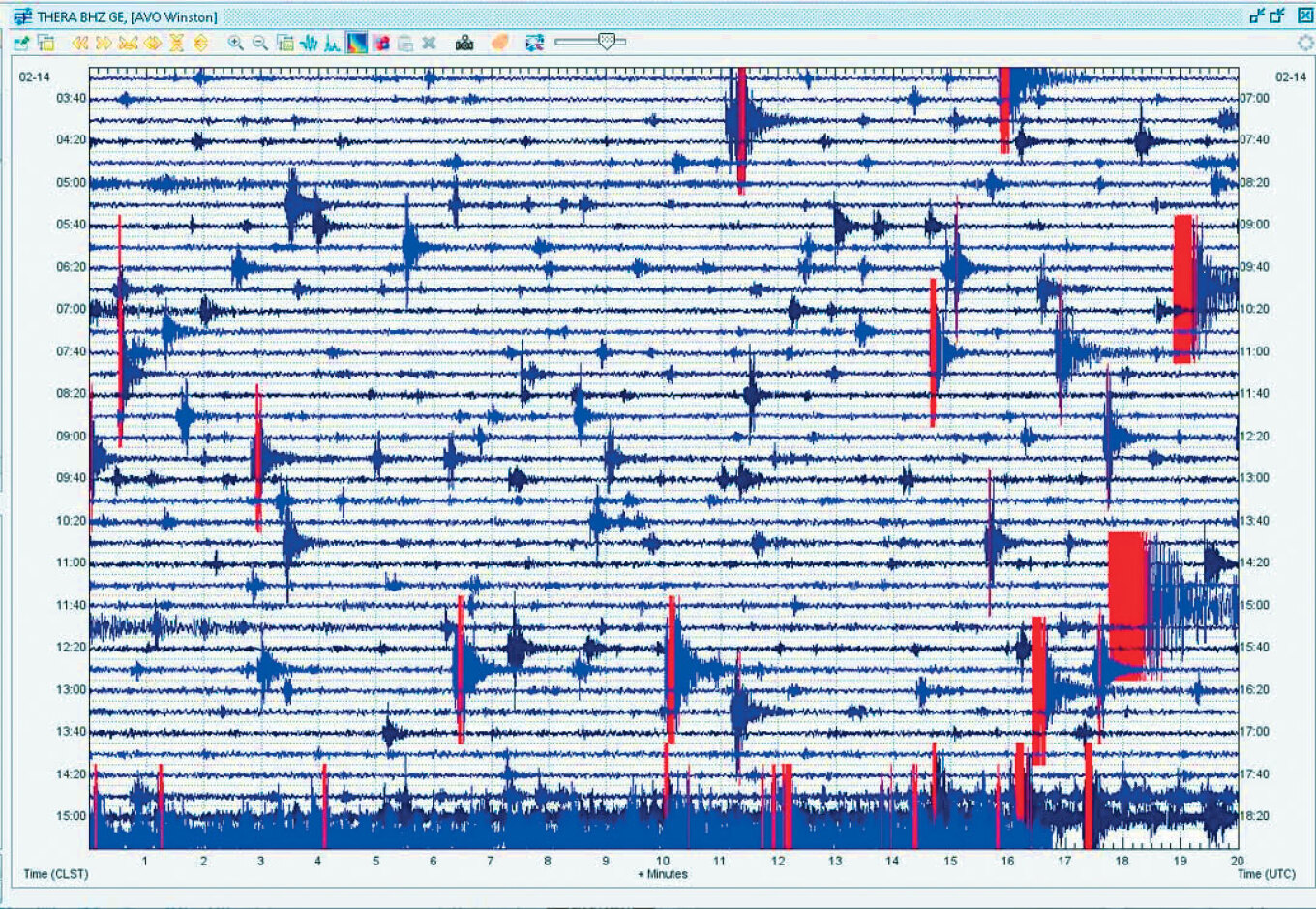
The seismic recordings from the “Thira” station at Santorini’s volcano set scientists on high alert on Friday night.
What’s Happening in Santorini?
“So, what’s really going on in Santorini?” Proto Thema asked Mike Burton, a volcanology professor at the University of Manchester. “Honestly,” he said, “when we’re dealing with a situation like this, predicting what will happen is not easy. Volcanic signals can be significant and lead to nothing, or they can be subtle and precede a major eruption after a long period of unrest. We just have to wait and see. The deformation and seismic signals suggest a magmatic process rather than a tectonic one, but a submarine eruption is by no means a certainty.”
A “Spectacular” Eruption?
The movement of these magmatic fluids, according to scientists, could mean a range of things—from the volcano slowly waking up to the possibility of increased activity that eventually subsides, much like in 2011.
“Since late July last year, we’ve been recording unrest at Kameni,” said volcanologist Giorgos Vougioukalakis, a member of Greece’s National Committee for Monitoring and Assessing Active Volcanoes in the Aegean. “By the end of November, we were sure of the trend. We informed the authorities and the relevant minister, and on January 5, the official update was issued: Santorini’s volcano was in a state of concern. The northern section of the caldera, between Kameni, Fira, and Oia, has risen by 4.5 cm, at a rate of about 1 cm per month.”
While Vougioukalakis stated that recent seismic activity in the area is not directly linked to volcanic activity, he believes we are seeing a repetition of the 2011 phenomenon. “Back then, we recorded a 13 cm uplift, the activity lasted 14 months, and the volcano went back to sleep. Now, we’re waiting to see how this plays out and whether it will settle again.”
Both at Kameni and Kolumbo, the State Geological Institute is analyzing data from seismographs, ground deformation monitoring networks, gas composition measurements, temperature readings, and dozens of other monitoring stations. This week, an on-site investigation by scientists at Kameni is also expected.
Vougioukalakis explained that the amount of magma currently gathered beneath the volcano is only about 10% of what was accumulated in 2011 (140 million cubic meters). He also pointed out that a scenario similar to the 1925 eruption is plausible. “If this unrest continues and the volcano reactivates, we could see a spectacular yet harmless eruption—similar to the one in Santorini in 1925, which was the first volcanic eruption ever captured on film. Back then, there were no casualties. Of course, today we’d have to deal with new challenges, such as managing volcanic ash—fine-grained pulverized rock that could occasionally reach Fira or the airport—as well as some gas emissions that might, at times, have slightly higher concentrations. But these are challenges that have been addressed worldwide. The contingency plan describes in great detail what needs to be done and how. With proper management, I don’t foresee any issues for Santorini.”
A Seismic Paradox?
The surge in magma movement followed roughly 12 hours of relative seismic quiet in Santorini and Amorgos. According to some scientists, this activity might indicate not just volcanic or seismic fault agitation but potentially the exact opposite—that the energy in the area is being released.
The most probable explanation for the increased activity, according to Professor Evi Nomikou from the National and Kapodistrian University of Athens, is the passage of fluids from deeper magma chambers, causing shifts on the seafloor as they ascend.
However, Vougioukalakis clarifies: “Not a single tremor has had an epicenter within 5 kilometers of the caldera’s magma chamber, nor has any evidence emerged pointing to Kolumbo.”
Could a Major Earthquake Follow?
As seismic activity over the past weeks shifts northeast toward the more dangerous Amorgos Fault—the one responsible for the massive 1956 earthquake—and as Santorini’s caldera continues rising at 1 cm per month, concerns grow: Will this unrest culminate in a major earthquake and tsunami? Will the volcano erupt? Or will everything subside through a series of minor quakes?
The National and Kapodistrian University of Athens, which recorded over 15,300 tremors between January 26 and last Monday (including a 5.2-magnitude quake), observes that the seismicity is migrating northeast—toward a different fault segment, with epicenters east of Anidros, and the strongest quakes occurring north of Anidros. “That’s not something we want,” Nomikou noted.
Seismologists have deployed monitoring stations on Santorini, Ios, Amorgos, Anidros, Astypalaia, and Anafi. According to Nomikou, the primary concern is that “this entire seismogenic zone is adjacent to major active fault lines, including the large Amorgos Fault (which caused the 7.7-magnitude quake in 1956). We do not want the seismic epicenters shifting northeast. Nor do we want any influence on the Kolumbo submarine volcano, which is located northeast of Santorini and borders these fault zones.”
When Will It Stop?
There’s no definitive answer on when this seismic activity will subside, but early estimates vary.
Professor Dimitris Papanikolaou predicts that the quakes in Santorini will persist “until Easter,” saying, “I’m fairly certain we’ll still be dealing with this by then, and possibly beyond.”
Seismologist Akis Tselentis believes the phenomenon will last for months, as we are still in the foreshock phase, awaiting the main event and subsequent aftershocks. “This depends on when the main quake occurs and its magnitude. Until then, the current foreshock activity will continue (as it did for months in Arkalochori). Even after the main quake, the aftershock sequence may last a while. Unfortunately, this will impact the island’s tourism for several months.”
Nomikou, however, emphasizes that predicting the duration of seismic activity is no easy feat: “In other areas, similar phenomena lasted 1 to 1.5 years…”
Ask me anything
Explore related questions




