The announcement by Marko Rubio in Saudi Arabia of Ukraine‘s agreement to a 30-day ceasefire is by no means a simple affair and is no small step towards peace. A week ago at the White House Volodymyr Zelensky failed to articulate a word and both the President and the Vice President of the United States sent a message to all that things will either be done the “Trump way” or not at all.
In just a couple of days Kyiv has taken a series of steps backwards, but the truth is that these are quite measured in terms of diplomatic maneuvers and do not seem like unconditional surrender. Ukraine has been and will continue to be pressured, as the US after the White House incident not only froze arms shipments but also “took the phone down” from its intelligence agencies. Without sophisticated US systems, not only are medium and long-range weapons systems “blind” but the air defenses of major urban centers and the country’s critical energy infrastructure are certainly less protected.
Kiev and Zelensky of Saudi Arabia yesterday also made a larger step back. Ukraine, which was in no way discussing a general ceasefire but only a halt to the use of drones, long-range missiles and calm at sea, has also agreed to halt any movement on the battlefields for at least a month. Ukraine has in fact accepted this ceasefire without practically receiving any American guarantee, at least not officially. A commitment that weapons will start arriving in Ukraine again and that systems will start transmitting critical information again can in no way be – and practically is – considered to be – that.
Kiev is taking a data risk with this move as Russia especially in the first two years of the war – especially after its troops retreated from Kherson – has made the most of any Ukrainian weakness in the field. But Ukraine’s tactics have also provided something extra and show that Kyiv has significant diplomatic capital, at least such that it can stand its ground and reap benefits under extremely adverse conditions. The reference to precious earths and the agreement with Washington has no Ukrainian signature whatsoever and this is a “card” that the country still holds. With the conditions as they are shaped, it is not unlikely that it will be able to “play it” at the moment when it considers that it will have the greatest possible benefits for itself and this is not a “little” at all.
Trump and the challenge with Putin
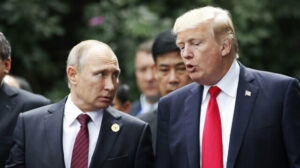
Shortly after the announcements from Saudi Arabia, Donald Trump noted to reporters that now the US will go to Moscow. The US President has repeatedly and in all tones noted that he respects the Russian President and has not hesitated lately to make moves that have made him identify more with Russian than Ukrainian positions. Now, in addition to Moscow, the “ball of responsibility” is in the hands of the US President himself, who will have to convince the Russian side to accept the Ukrainian agreement, which will be a difficult and demanding process.
Russia has carried over from the Lavrov-Rubio meeting and again from Saudi Arabia its terms and it will be difficult for the Russian President to back down for the first time since the start of the war. Trump claims to have a way of persuading the Kremlin to come to the table and if he is to be credited with anything it is that in 50 days he has managed to change the focus regarding the war. From “when will the war end?” which was the main question during the Biden administration, today the question that needs to be answered is “how will it end?”
Trump has brought the two sides as close as possible to the negotiating table with great speed and even in unorthodox ways. It should be taken for granted that from tomorrow if Russia raises objections and refuses to agree to what the US is proposing Trump will without second thoughts put Putin in his crosshairs.
The way the 47th US President interprets “Peace through strength” that Reagan said 40 years ago in his own way but that doesn’t mean it won’t work… Putin is by no means Zelensky in manners or even dynamics but that won’t stop the US President from carrying out his plan or going on a surprise attack with whatever “weapon” he has in his hands to achieve his goal. Besides, Trump has already activated the man who has brought tangible results in the Middle East, Stiv Whitkov. Whitkov, who was present at the first meetings in Saudi Arabia but has already gone to Russia once, cannot be ruled out that he has already informed the Kremlin of what the US President will ask for. Russia is an unstable factor which is also under pressure and the fact that for the first time he is being asked to “contribute” by choosing another direction may test the balance…
Saudi Arabia emerging as a strategic ally and partner
Saudi Arabia has once again in the last three years played a pivotal role in diplomatic developments. In addition to the two top-level conferences last month on the war in Ukraine, Saudi Arabia has hosted similar albeit informal conferences on the Middle East crisis. The country with its vast energy resources and the corresponding liquidity systematically attempts to be a partner of all sides. It is a given that relations with the US and Russia are mutually good, while Saudi Arabia has managed to maintain them at an excellent level, having also given at least $400 million in the form of humanitarian aid to Ukraine.
For Donald Trump, Saudi Arabia is one of the key also investment partners in his effort to bring the US economy back to the “froth” with the US President making no secret that he has openly requested $1 trillion in investment… In a world that is changing dramatically and with dramatic speed, the heir to the throne of Saudi Arabia is attempting with the pile of money he is managing to transform his country and his profile into that of a “virtuous power” what the Americans call “soft power”. Saudi Arabia has already “frozen” the war with the Yemeni Houthis and bin Salman, after the murder of Jamal Khashoggi in Turkey and what Ankara’s intelligence services accused him of, has radically changed both “ways” and practices. Saudi Arabia’s methods, its huge economic and energy potential and above all its willingness to engage with all the world’s big players are not unlikely to bring the Arabian Peninsula country soon into the limelight as one of the leading mediators.
Ask me anything
Explore related questions