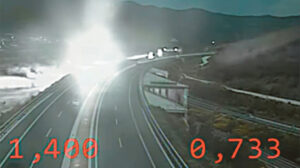
On February 27, the report by EODASAAM experts on the Tempi tragedy was made public, a report that launched the latest conspiracy theory regarding the fireball that formed immediately after the train collision. Suggesting the “possible presence of an unknown fuel” that caused the explosion, the committee pointed to the second locomotive of the freight train, as videos released two years later confirmed that there was no “clandestine tank” in its first wagons.
On page 40 of the EODASAAM report, it was stated that the driver’s cabin of the second locomotive had not been fully located anywhere among the wreckage, except for a small part of the roof and the upper headlight. The insinuation was clear—some unknown entity had placed flammable material in that space, causing the massive explosion upon collision. Today, we now know that no flammable material was present.
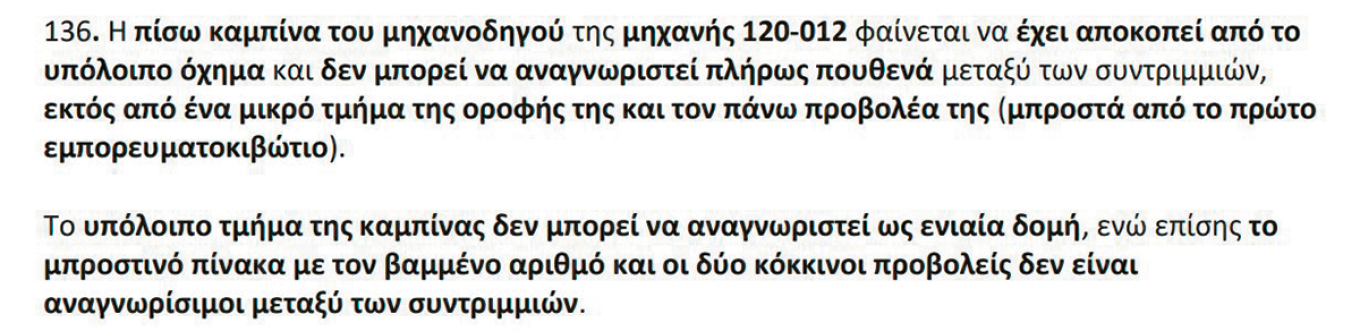
The EODASAAM report stated that the driver’s cabin of the second locomotive was not fully located, leaving an implication that there was flammable material there.
How do we know this? One week after the report’s publication, firefighters from the Arson Crimes Investigation Directorate (DAEE) of the Fire Department and forensic experts discovered the “missing” parts of the specific locomotive in Koulouri, 10 kilometers from the center of Larissa, where the wreckage from the deadly collision had been stored. They even found the driver’s seat of the cabin. Since even that was not burned, an explosion inside the cockpit of the electric locomotive is ruled out. Case closed.
Since Friday, DAEE Fire Department personnel have been in the process of reconstructing the second locomotive of the freight train. It consists of three or four large pieces, about the size of half a car. These pieces were found 40-50 meters away from the wreckage of the specific electric locomotive. The initial assessment indicates that there are no signs of fire anywhere.
EODASAAM states in its report that the missing piece from the second electric locomotive detached while on fire and caused a blaze. However, a photographic document of the rear section of the freight train’s cockpit, published by THEMA, clearly shows significant material deformation due to the collision, but no signs of fire. Additionally, it is well known that the ill-fated engineers of the freight train died in the collision—they were not burned.
By Friday afternoon, the “roof” along with the two sides, the front (cockpit) with its curtain, the locomotive door, and one seat had been found. There are no burn marks on either the recovered pieces or the rest of the locomotive wreckage.
Further Investigation into the Passenger Train
A DAEE investigation will follow into the passenger train. A free examination will be conducted on the electric locomotive of the passenger train, the first-class section, the dining car, and the first second-class wagon. This area suffered the most fire damage. The order for new investigations was given by Sotiris Bakaïmis, the appellate judge assigned by the Larissa Court of Appeals to investigate the Tempi tragedy on March 10, 2023.
After two years of investigations, Judge Bakaïmis has had to contend with every kind of conspiracy theory—from the claim that three wagons were “vaporized” by the fireball to the alleged transport of NATO ammunition destined for Ukraine, and the supposed hidden fuel tank in the first wagon of the freight train, as suggested in the EODASAAM report.
Legal Challenges and Missing Evidence
He has also had to endure a flood of lawsuits filed by the victims’ families—most accusing him of concealing evidence from the case files. Lawyer and politician Zoe Konstantopoulou, who represents some of the grieving families, has publicly stated that 649,000 files were deleted from the case.
However, the judge must also provide a definitive answer to what caused the fire after the collision of the two trains just before entering the Tempi tunnel. As various theories about the presence of flammable materials weaken—and are not confirmed by the evidence from the locomotives and wagons—it is becoming increasingly clear that the truth must be sought elsewhere.
It is obvious that the investigation must look into this “elsewhere.” The trial for Tempi cannot devolve into a debate over where flammable material was placed and which victims it burned, feeding conspiracy theories that have been cultivated in the two years since the disaster.
Justice must be served in this trial. That means assigning responsibility where it belongs, based on factual evidence, not theories that are debunked one after another—yet still linger as “truth” in the public’s perception.
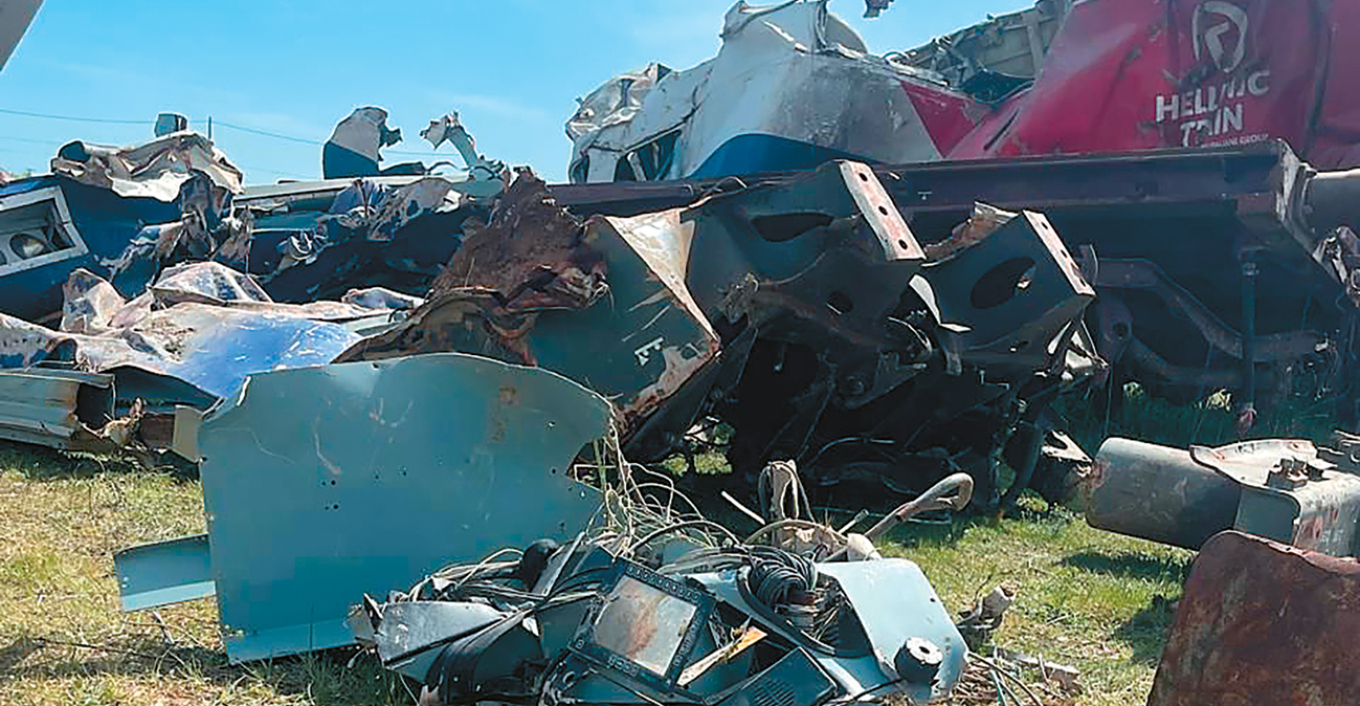
The “tail” of the freight train’s cockpit, as found by DAEE. The material shows signs of impact damage but no burn marks, indicating the absence of flammable material in the cabin. Notably, the EODASAAM report claimed that this piece detached while on fire and caused a blaze.
The Report That Was Overlooked
The public debate on the fire’s cause after the explosion began when the victims’ families’ technical advisors challenged the forensic experts’ theory—appointed by the investigating judge—that silicone oils were responsible. That theory was dismissed by several experts, leading to alternative theories that involved the freight train in smuggling flammable materials.
As mentioned earlier, EODASAAM, in its own report presented one day before the second anniversary of the tragedy, considered the possibility of flammable material on the freight train likely due to its investigators’ inability to locate the second locomotive’s missing parts. However, the investigators clarified that during their visits to Koulouri, they did not have access to a crane—meaning their investigation was limited to what they could see with the naked eye.
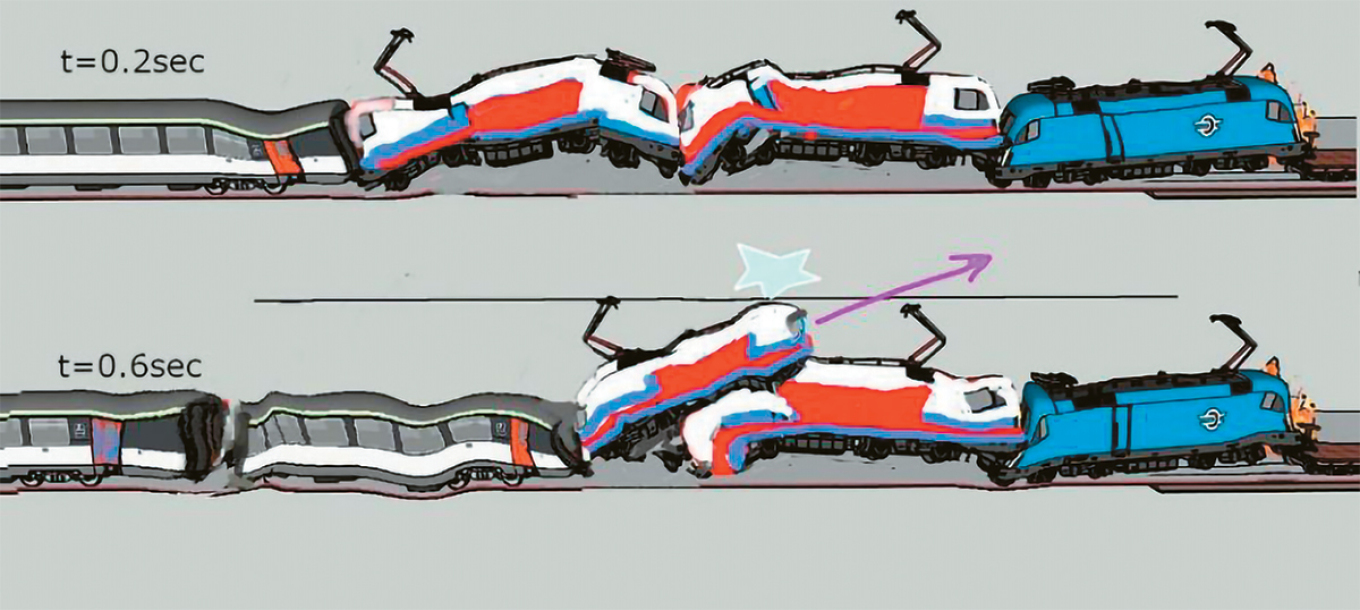
Three days before EODASAAM’s report—broadcasted live across Greece—the findings of an independent investigation initiated by Hellenic Train were published. Unlike the EODASAAM report, this one went largely unnoticed—unsurprising, given that the company was implicated in the disaster, despite the railway network being under the jurisdiction of OSE (Hellenic Railways Organization).
Yet now, with all other theories debunked, the Hellenic Train report is back in the spotlight—especially since EODASAAM did not acknowledge its findings at all.
The Hellenic Train report attributes the explosion and fire after the collision to electrical arcs and a short circuit in the overhead power line that occurred near or directly above the passenger train’s transformer. Additional capacitor short circuits resulted in the ignition and explosion of the cooling fluid, which then burned completely.
Belgian railway accident expert Yves Carton, with 25 years of experience, conducted the investigation for Hellenic Train. Unsurprisingly, Twitter (now X) commentators dismissed him as a “New Democracy troll” and “clueless.”
Who Were the Burned Victims?
From the first days after the disaster, forensic examiners determined that seven victims did not die from the impact of the collision but were burned in the fire that consumed almost the entire first wagon of the passenger train.
At one point, as conspiracy theories ran rampant, some of the victims’ families’ technical advisors estimated that the number of those who perished in the fireball was much higher. According to forensic investigator Vasilis Kokotsakis, 27 passengers survived the crash but were later burned to death in the fire that engulfed the first wagon of IC 62.
The public release—two years later—of distress calls from some victims to 112, with the chilling phrase “I have almost no oxygen left,” shook Greek society to its core. The grief and anger of the victims’ families—and the broader public, who already believed in the presence of flammable material and a government cover-up—intensified even further.
The Burden of Truth
The belief that victims might have survived if no flammable material had been present has fueled public outrage. But it is irresponsible to feed such a narrative when there is no evidence to support it—especially when the trains collided head-on, one traveling north to Thessaloniki at 160 km/h and the other south to Larissa at 105 km/h.
Justice must be based on facts, not myths that refuse to die.
Government Responsibilities
The Mitsotakis government is accused of covering up the Tempi disaster, but what has become undeniable after the latest findings in Koulouri—as well as the videos that surfaced with a two-year delay—is the negligence that fuels conspiracy theories.
Why was the cockpit of the freight train’s electric locomotive discovered two years after the tragedy? Why were the loading videos of that specific train never found? Why did the security company recover the footage of the doomed train only after two years?
How could the EODASAAM officials produce a meaningful report when they were forced to admit that they visited Koulouri without crane support and a full year after the disaster?
Ask me anything
Explore related questions