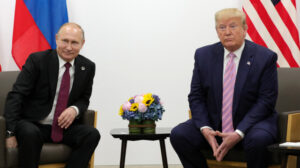
At 15:00 (local time) today at noon, Donald Trump will begin a phone call with Vladimir Putin with the Kremlin press secretary specifying that the two leaders have agreed to have two hours (until 17:00) available for their conversation.
“There were negotiations in Moscow, in Constantinople, earlier there was a first telephone conversation between the two presidents. So there is an understanding,” Peskov said, adding that the Trump-Putin conversation will last as long as the two of them deem necessary.
As he noted, “there are a number of major issues regarding further normalization of our bilateral relations and Ukraine. All these should be discussed by the two presidents.”
Peskov also said there would be no statements from Putin after the phone call with Trump.
It will be recalled that the first telephone contact between the US-Russian presidents took place on February 12 and lasted 1.5 hours.
What they will discuss
Russia has set the US a clear framework and conditions for how it will sit at the diplomatic table to end the war that has raged for more than three years. These terms are being presented by Russia as the “main body” of a plan not just for a ceasefire but for a “long and stable peace”, according to the Russian Foreign Ministry. Given Putin to ask his US counterpart for the three main pillars of the Russian proposal to form the basis for the next steps.
If Putin receives assurances from Washington that Ukraine will not be and will not become a member of NATO, that Russia will keep the territories it has occupied not only from 2022 but also from 2014 (Crimea), and that Zelensky will not be at the table in the next phase then he will say a big “yes” to the next US initiatives and will not hesitate to issue a statement talking about “Russian immediate ceasefire initiative”. The Russian President will also insist that even if Zelensky is a thing of the past that he does not want any foreign and specifically European forces in the remaining Ukrainian territories…
For his part, Donald Trump, with the way he has managed both Kiev and the President of Ukraine, should not be considered unlikely to acquiesce on the NATO issue – going as far as a US veto – and this is not something that his entourage in particular has not openly talked about. Trump, who did not hesitate to publicly call the Ukrainian President a “dictator” and a few twenty-four hours later to launch an unprecedented attack on Zelensky in front of open cameras, is clearly not going to have any issue agreeing with Putin that the leader of Ukraine must be “sacrificed” in order to achieve peace. The big issue for Trump seems to be how to divide the Russian-occupied lands of Ukraine between Washington and the Kremlin.
The way the US President produces policy at home and abroad has only one basis, profit. If there is a deal with dozens of digits for the US Trump will accept that Russia, which he is in his way anyway touting as the winner today, will make the smallest concessions and the Ukrainians will be asked not just to agree but to do so under new pressure from the US.
The only way there can be steps back from Washington and ask Moscow for an alternative plan is for Europe, which is now on alert but also facing a realistic threat to use both its diplomatic and military capital. On the one hand, Europe will have to impose its presence on whatever Putin and Trump decide is the next step, and on the other hand, it will have to “run” a plan that will put Washington in a more difficult position than Ukraine alone can. Trump has proven that he has no problem cutting off arms and critical information shipments with a signature, and the Union will have to find leverage that will “cost” the US more than it pays off.
The European war industry is not currently in a position to produce the advanced weapons systems that Ukraine needs for its defence but can, with the right manipulations, procure them itself on behalf of Kiev. The Union will also press Washington to sign the rare earths agreement in its current form in order to have a practical American commitment, even if only to a minimal extent. Finally, it is an exclusively European issue that the leaders – Macro, Starmer and Merz – of the continent manage to get parallel and accurate information from the White House on what will be said between Trump and Putin. Time is always an ally in crises and what will come out of today’s phone call between the two poles of the world will be the beginning of a new one…
Ask me anything
Explore related questions