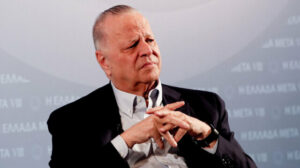
Evangelos Mytilineos launched a scathing attack on Europe’s defense policy doctrine, criticizing the possibility of Turkey’s inclusion in the €800 billion ReArm Europe initiative, which aims to increase Europe’s strategic autonomy from the U.S.—a move he described as a major geopolitical challenge.
The Metlen CEO expressed particular concern over the prospect of Turkey’s involvement in European defense policy, warning that it would cause serious disruptions for Greece and Cyprus, both of which frequently face Ankara’s intransigence and threats. The most recent example of this was Turkey’s interference with the Crete-Cyprus-Israel power cable project, deploying naval frigates in the Aegean to block research efforts.
Turkey has emerged as a formidable competitor, having developed a massive defense industry in recent years, with exports estimated at $8 billion in 2023.
During his 40-minute speech at the Circle of Ideas event hosted by Evangelos Venizelos, Mytilineos posed some critical questions:
“What will we do? Will we join a European ‘coalition of the willing’ alongside Turkey—against Turkey?” He also questioned Europe’s stance on Greece’s security, stating:
“Today, Europeans are rushing to aid Ukraine. Would they do the same for Greece? They are spending hundreds of billions on Ukraine, but I don’t believe they would do the same for us. Luxembourg doesn’t care what happens in the Aegean.”
For Mytilineos, only the U.S. has real deterrent power when it comes to defending Greece, emphasizing that Washington is the only reliable ally in facing these threats.
Full Throttle on Defense
One thing that became abundantly clear yesterday is that Metlen’s defense operations are a vital part of the company, and they are expanding rapidly. This growth trajectory positions the company strategically ahead of the massive ReArm Europe defense program.
At its Volos facilities, Metlen is running triple shifts, with exports of defense equipment accelerating. As Mytilineos pointed out, the Greek defense industry took off after the Imia crisis, leading to the creation of several domestic defense manufacturers.
The defense sector is now a hotbed of activity, with Metlen and other companies pushing hard for Greece to receive 30% in industrial offsets from its defense procurement programs. Mytilineos himself highlighted this issue in a recent LinkedIn post.
Last week, a meeting was convened by SEV (Hellenic Federation of Enterprises) president Spiros Theodoropoulos, bringing together 250 smaller companies, including 50 SEV members and additional members from the Hellenic Manufacturers of Defense Materiel Association (SEKPY).
The sector has attracted increasing interest from diverse Greek business groups, including Infoquest and GEK TERNA, with intensified visits to Brussels aimed at strategic preparation and recruitment for future contracts.
Criticism Over the Belharra Frigates
Mytilineos did not hold back his frustration, openly criticizing how Greece handled the €3 billion deal for three French Belharra frigates, all of which are being built in France with zero industrial benefit for Greece.
“This should never happen again. We built the German Type 214 submarines 20 years ago. Are we saying we don’t know how to build frigates today?” he asked.
The Need for a Defense Strategy
While the Metlen CEO was voicing his concerns to economic and political leaders, a separate defense-related event was taking place under the Hellenic Manufacturers of Defense Materiel Association (SEKPY).
Through discussions and presentations, it became evident that Greece already has a robust defense ecosystem, comprising 400 entities—companies, research centers, startups, and universities—that contribute to the sector.
The industry’s annual turnover is estimated at €1.5 billion, supporting 15,000 jobs. Among these businesses, 100 companies are actively participating in the European Defence Fund programs. Despite being a small country, Greece ranks first in program participation and contract awards, with a 57% participation rate in 2024 alone.
SEKPY President Tasos Rozolis (CEO of Akmon) stressed the significance of this moment:
“What is happening in Europe today happens once every 50 years. This is a massive opportunity.”
Rozolis emphasized that the €800 billion earmarked for European defense is not free money:
“€650 billion will be funded through debt overruns—meaning citizens will pay for it—while €150 billion is loans.”
Despite this, he insisted that Greece must seize the opportunity.
“Out of the €13 billion we’ve spent on defense procurement so far, our local participation has not exceeded 2-3%. This needs a strategy.”
Rozolis also pointed out that Greece lags in defense negotiations, citing the upcoming purchase of F-35s from Lockheed Martin as an example:
“If you agree on the price first and then ask for something extra, the seller will either refuse or give it to you on terms that make it worthless. All other countries negotiate before signing deals.”
He highlighted a rare success story—the 30% local offset agreement for Leopard tanks, which secured significant contracts for Greek companies, including Metka in Volos, which was responsible for manufacturing key components of the tank turrets.
Ask me anything
Explore related questions