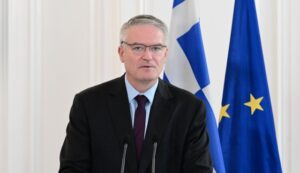
The Greek economy will continue to show economic growth above the eurozone average, says Matias Corman, secretary general of the Organisation for Economic Co-operation and Development (OECD), in an interview given to the 10th Delphi Economic Forum. At the same time, he praised Greece’s efforts to reduce its public debt.
In particular, the OECD will undertake a downward revision of its forecasts for global economic growth as a result of the imposition of tariffs by the US, says the organization’s secretary-general Mathias Corman.
“Our next forecasts will be announced in early June, at the same time as our cabinet meeting in Paris, but if everything remains as it is and there is no change in the other direction by then, we would say that this (tariffs) will lead to lower growth and higher costs and indeed it is not a positive development for the global economy. What we are saying to everybody is that there are better ways to deal with unfair trade practices. Both bilaterally and in multilateral organisations, including the OECD, and to find possible ways to avoid tariffs and keep markets open.”
As Corman said, “This is our message to all governments around the world. If you identify problems, issues, with the way international markets work, talk to each other bilaterally and multilaterally, through organizations like the OECD, to address these problems constructively and in the common interest. Unilateral tariffs will lead to lower growth, at higher costs, for everyone and certainly for US citizens.
In March we already revised downward the global growth outlook by 0.2% for this year and 0.3% for next year, to 3.1% and 3%, respectively, and the imposition of additional tariffs will no doubt also lead to new impacts on global economic growth and put upward pressure on inflation.”
At the same time, Corman praised Greece regarding its efforts to reduce its public debt, noting that “Greece has done an excellent job in recent years in terms of reducing its debt as a percentage of GDP. Greece is one of the countries that continues to move in the right direction to reduce a very high level of debt to GDP. It is still high but it is heading in the right direction. Now, if everything stays as it is and if tariffs lead to lower growth, then that means less revenue for governments and leads to more challenging fiscal conditions. And to the extent that tariffs also put upward pressure on inflation, central banks will have to raise interest rates to deal with inflation and that will increase the cost of servicing debt. So, the sustainability of debt, in general, is also negatively affected.”
Regarding the performance of the Greek economy, Corman noted that “the Greek economy has been performing very well in recent years. Unemployment is at its lowest level since November 2008, and of course it has come down drastically from the high levels it had reached, and we forecast that Greece’s growth will remain above the euro area average. Greece is an open economy, of course, and the latest developments on the tariffs are expected to have an impact on all trading partners, which creates challenges for Greece as well.
Ask me anything
Explore related questions