May be Beijing and Washington have taken up their battle positions and are firing at each other, but we should be clear that in such an extended war the consequences will affect everyone and there is a very serious possibility that the changes will not only be economic…
If someone three months ago presented as realistic the scenario of the White House deciding to re-draw the global “deck” at the risk of bringing decades-old enemies to the same table to discuss how to deal with their until recently most important ally, it would have caused the least smirk. Yet the fact that Japan and South Korea on their own initiative are in discussions on a new joint engagement project in Asia with China shows the extent not of the theoretical concern but the real dimension of the problem.
When the world’s largest fund manager – BlackRock – officially and especially publicly declares that the US is currently the main agent of instability in the world with the policies it chooses, then the issue is much deeper and more serious than announcements and tariff rates. The markets in the US have decided to send a clear message to the Administration immediately and that is why we are also seeing significant changes in US bond yields which are at 5% for the first time since 2020 and the serious consequences – and economic – that the pandemic has brought with it. Behind these particular moves, in fact, it seems that China, which is the world’s second largest holder of US debt, is not – at least not yet – behind them.
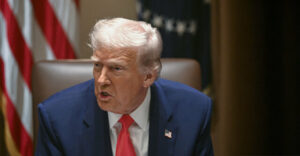
Donald Trump may not have made a public appearance yesterday as he was in hospital for hours for his scheduled annual health check that every President goes through but through the White House spokeswoman he indicated that even now what he is waiting for is for Beijing to pick up the phone to negotiate. What is expressed as a wish from the oval office is unlikely to happen, at least not immediately, as China for its part appears ready to bear the costs – at least to some extent – that will result from US economic “fire”. Beijing also appears to have prepared an initial contingency plan to deal with possible consequences of factory closures or shutdowns in the country, and it is not out of the question for China to turn to more significant measures against the US if Trump insists on increasing pressure.
Outside of China, however, there is significant – unprecedented for this century, analysts note – mobility around the world at the political and diplomatic level. The visit of the Prime Minister of Spain to Beijing may not have been “over-analysed”, but it is indicative that in the Union member states, beyond the common line, have chosen to move individually in order to reduce as quickly as possible the risks of recession that are visible to all. China, which seems to be taking a wait-and-see attitude, stating that “we will not continue the tariff game”, seems to have a clear plan to cover – or at least attempt to do so – the gaps that the US has diplomatically and politically chosen to leave, especially in Europe. What is produced in the first year from these meetings may be “small” or even unworthy of political analysis, but in the big picture of the future it is the beginning of discussions with a country that the US has traditionally isolated with the political and long-standing solid alliances it has built over 8 decades… Today Beijing has the opportunity again by paying a heavy price to find itself in a different diplomatic and political position. A position that may in the long run also require significant structural changes from Beijing itself, but ultimately a position that brings the country officially into the limelight as the second major pole of the world. With Trump’s manipulations, China gains – by losing – its official position and recognition at the “table” of the world’s greats.
Ask me anything
Explore related questions