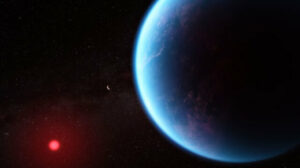
A giant exoplanet, 124 light-years from Earth, has detected the strongest signs yet of possible biological activity beyond our solar system, according to observations by the James Webb Space Telescope.
Astronomers have detected on the exoplanet K2-18 b traces of two chemical compounds – dimethylsulfide (DMS) and dimethyldisulfide (DMDS) – which, on Earth, are produced exclusively by life forms such as marine phytoplankton.
“Perhaps the turning point in the search for life”
“This is the strongest indication to date of possible biological activity beyond our solar system,” Professor Nikku Madhusudhan, an astrophysicist at the University of Cambridge who led the research team, told the Guardian.
“We are very sceptical. We have to question both the validity of the signal and what it might mean,” he added.
According to him, “maybe in the future we will look back on this moment and recognize that it was the turning point – where the question ‘are we alone?’ could be answered.”
The doubters and the open possibilities
Although the detection of the compounds is statistically significant (with only a 0.3% chance of it being a chance event), it is not sufficient on its own to prove the existence of life.
Dr. Nora Hänni, a chemist at the University of Bern, pointed out that DMS has also been detected on comets with no signs of life, while other researchers stress that the conditions on K2-18 b remain controversial: it could be a planet with oceans, but it could also be a gaseous planet, or even a world made of magma.
A planet with a history of promise
K2-18 b, located in the constellation Leo, is nearly nine times the mass of Earth and about 2.6 times larger, and orbits within the habitable zone of its star – a red dwarf half the mass of the Sun.
In 2019, the Hubble Space Telescope appeared to detect water vapor in its atmosphere, with scientists at the time calling it “the most habitable world known”. But later analyses in 2023 showed that the signal was likely coming from methane, which sparked new questions and the theory of a deep ocean.
James Webb’s signal: Clear and strong
As the planet passed in front of its star, James Webb detected precipitation at specific wavelengths consistent with absorption by DMS and DMDS.
The presence of the molecules can also be explained by extremely rare cosmic impacts, volcanic activity, or chemical reactions in hydrothermal vents, but all of these alternatives remain speculative.
Despite the disagreements, scientists agree that this is a major leap in the search for extraterrestrial life, even if it does not constitute proof. If this discovery proves reliable and is confirmed by future observations, then we may be closer than ever to answering the age-old question: “Are we alone in the universe?”
Ask me anything
Explore related questions