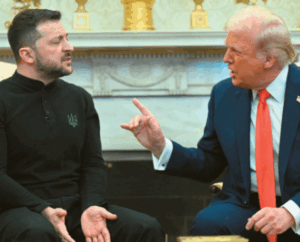
The US Secretary of State – and, yesterday, President Trump himself, noting that no one is playing with him-after the conclusion of yesterday’s meeting with both the Ukrainian and European delegation in Paris regarding the war in Ukraine chose to send tensions into the red again with an “ambiguous” position.
The American statement “I’m leaving” the peace effort in the region if there are no immediate significant developments “reads” variously, but the problem remains that once again Washington chooses to prioritize its own effort rather than the outcome.
Behind the US threat of withdrawal is a given discomfort on the part of Donald Trump about the stagnation on this issue, which is the only thing that, according to him, exposes him to what he has committed to do. The American President may have gone from “end the war in one day” to “end the war in the first 100 days”, but April 30 is now very close and there is so much that needs to be done to meet that timetable.
The scenarios behind the US strategy largely boil down to two. But in both cases there are unpredictable – even today – important factors.
Scenario One: Change of posture and pressure on Russia
Ukraine has received within 90 days asymmetrical American pressure. Ukraine’s president has been turned into a punching bag between President Trump and Vice President Vance in the Oval Office, the US has frozen arms and intelligence shipments to Kiev for a few days, and Volodymyr Zelensky was labeled everything from “dictator” and “little” to “the main reason the war started.”
On the flip side, the Kremlin, for the first time in more than three years, “enjoyed” distancing itself from the tension. Donald Trump contacted Vladimir Putin, by phone, with the US President as a first step of “goodwill” to take aggressive rhetoric and isolation – even if diplomatically for the time being – from Moscow off the table. Trump’s chief of staff Witkoff has already been to Russia several times where he has met with the Russian President, while US Secretary of State Marco Rubio – has also spent hours listening to Russian positions – has talked for hours with his Russian counterpart Lavrov in Saudi Arabia.
In the first scenario, there is the possibility that the US will again turn to Kiev. Donald Trump has left the window open to put pressure on Moscow if its efforts and proposals continue to be met with diplomatic “dribbles” and constant “nietzsche” in order to take a first significant step. The US President knows and has already left on the table in plain sight, the “pistol” of further sanctions on Russian oil.
Trump has the ability to put new sanctions not only on Russia, but on those who still buy Russian oil. This will severely hit the only source from which the Kremlin continues to fund the fighting in Ukraine. Such a data move will put a lot of pressure and hurt not only Russia, but also China, with whom Trump is officially at open trade and economic war. The scenario, though on the table is unlikely to proceed. With such a move, Russia data will again significantly increase its aggression on the ground and the US will have no other way to respond than to once again massively reinforce Kiev and Volodymyr Zelensky… If this scenario is ultimately chosen, it will be a 180 degree turn by the White House of the kind that Donald Trump rarely chooses to make.
Scenario Two: Ukraine a purely European issue
The second scenario is the most likely of the American options. Trump has stressed in all ways and in all tones that the war in Ukraine is not an American problem, but a European problem.
If he puts his second option in place, he will do just that: leave Kiev and its European partners trying to cut their losses from a Russia that will – in this case too – further increase its aggression. If this is ultimately Washington’s choice, in addition to Ukraine, Europe will find itself in an even more difficult position.
The Union’s mobility and reflexes may have “woken up” after decades of “hypnosis” and inaction, but today it will be very difficult to find a way in which the war will end with European intervention. European arms will increase as will the funds to meet the enormous needs of the Ukrainians, but no real solution to the problem will be found.
Washington’s withdrawal and Europe’s “all in” involvement may be “sold” as a victory at home for Russia , but it will not be such … The French – British and German plan will be the only plan on the table. This will mean that the Russian condition to “abstain” European troops from Ukrainian territories will never be “respected”. At the same time, a purely European management of the crisis will again put Russia in a “occupied line” status. The Kremlin will communicate with Washington, but this aspect will no longer be as influential and crucial as it is today. The actual withdrawal of Washington from the events in Ukraine will be a major “headache” for the Old Continent. But sooner or later it will produce results from Europe for Europe. Indeed, if the Union ultimately succeeds in promoting a peace plan in the medium term, the Kremlin and Washington will both be losers, the former because the conditions that the US seems to be listening to at least today will not be accepted under any circumstances and, in the second year, because the European road map for a solution will be followed and not the American one.
Whatever the eventual outcome of the “roll of the dice” that the US is currently choosing for the war in Ukraine, those who said, even before the US election that brought Trump to a second term in Washington, that the war in Eastern Europe is too complex to end in one, 100 or even 500 days, seem to be vindicated…
Ask me anything
Explore related questions