The successive years of drought, losses from the aging water network, and increased consumption — driven by tourism and a growing population — have sounded the alarm at the management of the Athens Water Supply and Sewerage Company (EYDAP).
These factors are considered the main causes of the water scarcity threatening Attica. Before the capital returns to conditions like those of the 1980s, when water was scarce and precious, EYDAP is preparing to deploy a series of measures ranging from investments to water transportation by tanker, aiming to keep water rates as stable as possible.
First Comes Pricing
As the water reserves in the Attica Basin decrease to alarming levels, and recent rainfall has been insufficient to replenish the losses of recent years, consumers are at risk of bearing the burden through new pricing schemes, with expected increases likely to align with inflation (at least for now).
It’s worth noting the issuance of the Joint Ministerial Decision (JMD), which sets the general framework for pricing and charging for water services. This framework is a prerequisite for EYDAP, the Thessaloniki Water Supply and Sewerage Company (EYATH), and the Municipal Water and Sewerage Companies (DEYA) to develop and submit proposals for potential tariff adjustments to the Regulatory Authority for Waste, Energy, and Water (RAAEY) for evaluation and approval.
The JMD mandates tiered pricing structures that will vary depending on location and consumption levels. The pricing formulation will also consider social, environmental, and hydrogeological criteria and will be subject to review every five years.
In the meantime, annual inflation adjustments will be possible, and additional increases may be allowed through emergency revisions if certain conditions are met. The introduction of seasonally adjusted tariffs is also foreseen.
How Much Water Are We Missing?
The harsh truth is that this year is one of the worst in terms of water scarcity risk since 1985, the earliest year with available EYDAP measurements.
According to the latest available data from EYDAP, on Holy Tuesday, April 15, the daily available water reserves in the reservoirs supplying the Attica Basin were at 648.57 million cubic meters — significantly lower than the 915.34 million cubic meters of the same day last year, and far below the 1.42 billion cubic meters recorded on April 15, 2006 (a year of maximum reserves). While we’re still above the emergency levels of 1993, when reserves dropped to 180.19 million cubic meters, both the population and its water demands have increased significantly since then.
The Bill and the Projects
EYDAP’s strategy, as recently presented by its CEO Haris Sachinis, focuses on efforts to keep water rates low, although adjustments are not ruled out and will be determined by RAAEY. A major highlight is the ambitious project exceeding half a billion euros to transfer water from Lake Kremasta. Simultaneously, efforts are being made to reduce leaks and water losses, with a total budget of 400 million euros, along with the installation of smart water meters, for which a tender will soon be announced.
Additionally, in case of urgent need — instead of the emergency measures of the past (older residents may remember the severe drought in Athens during the late ’80s to mid-’90s, when washing cars, gardens, and sidewalks with hoses was banned, and placing a brick in the toilet tank was recommended) — tankers will be deployed to transport water to the capital from the mouth of the Acheloos River.
Overall, the investments being launched or undertaken by EYDAP approach €3 billion, focusing on increasing water availability, reducing losses, and, if necessary, adopting consumption restriction measures in cooperation with the state. The cost of interventions to address water scarcity will be covered by the government, with EYDAP acting as an advisor and implementing body.
At the same time, the group is implementing an investment program worth €2.1 billion, which is further reinforced with additional spending of nearly €300 million for the modernization of the Psytalleia plant. It is also undergoing corporate restructuring by separating its activities into two distinct entities: one for regulated services and one for non-regulated services.
The pumping stations in Yliki have already started operating, while restoration and upgrading works are being carried out on the boreholes in Mavrosouvala, to ensure continuous water supply to Attica through natural flow, without the need for pumping.
Additionally, the immediate implementation of critical projects is beginning, aiming to connect the Krikeliotis and Karpenisiotis rivers to the Evinos reservoir. This will help maintain water adequacy even under particularly adverse conditions. This, in terms of cost to the end consumer, is of great significance. Since the water supply system will operate by gravity (e.g., with the water transfer project from the Kremasta Lake, costing €170 million), Attica will be supplied with water for the next half-century with minimal energy cost for water transport.
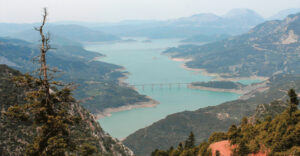
Kremasta Lake
As for the implementation of the solution concerning Kremasta Lake, which constitutes the central axis of the plan — the main scenario or “Plan A” — the investment has a total value of €535 million, with the first phase of the project estimated at €365 million and the second at €170 million. According to Mr. Sachinis, the necessary studies and preparatory procedures are underway, though it is not yet possible to determine a precise start date for the tender process.
Once construction begins, it is estimated that approximately two years will be required for the project’s completion, which includes the construction of a 20-kilometer tunnel, provided there are no delays from objections or legal appeals to the Council of State.
The Kremasta project appears to be the solution with the most advantages, not only because it offers a long-term resolution to Attica’s water supply needs with high-quality water through river connections, but also because it creates the potential for a pumped-storage project at the eastern edge of the reservoir, with a capacity of about 50 MW.
In terms of the financial aspect, to cover the needs for approximately 200 million cubic meters—a quantity currently lacking—the cost is estimated at €0.10–€0.15 per cubic meter. Given that 3.5 billion cubic meters flow into the lake annually, only 5% of that amount is needed to meet the needs of the Attica region.
Nevertheless, EYDAP (the Athens Water Supply and Sewerage Company) is also considering the worst-case scenario, conducting studies on the potential use of brackish water from available aquifers in the area around the Mornos aqueduct, such as in Kirra. At the same time, the use of seawater through desalination units is being examined, with the necessary technical approaches being promoted.
Additionally, the possible utilization of underground water reserves along the route of the Mornos aqueduct is being considered, with particular focus on the Boeotian Kifisos river, aiming to reduce pumping from the main reservoirs of Mornos and Evinos.
By Ship
With EYDAP officials emphasizing that under no circumstances will they allow Athens to go without water—whether due to delays in scheduled projects or if climate change leads to droughts beyond expected levels—other, more extreme solutions are also on the table, such as the transport of water from the Acheloos River by sea!
The emergency solution included in the planning foresees the transport of water from the Acheloos River estuaries during drought periods using large-capacity tankers. According to the plan, three tankers capable of carrying 100,000 cubic meters each will be chartered from the port of Astakos, destined for facilities either in Aspropyrgos or Thisvi in Boeotia. From there, the water will be offloaded from the tankers and directed into the EYDAP network.
However, the administration has clarified that this option is a temporary and short-term solution, which will be activated exclusively under conditions of increased risk, and only if there is no rainfall and the planned infrastructure projects are significantly delayed. The goal is to maintain the water supply of the capital.
Of course, the plan also includes the construction of desalination units, although their installation in Attica is difficult due to issues with site selection and their connection to the network. A more suitable alternative being proposed is the area of Itea, where a unit is planned that will process 100,000–200,000 cubic meters of brackish water daily, at a cost approximately 30% lower compared to seawater desalination. As officially clarified, the project is at an early stage, as a feasibility study must first be conducted.
Two additional areas are also being considered: Aspropyrgos and Thisvi, where advantages include the ease of integrating the quantities into the existing network, offering a mix of water resources that also includes supplies from mountainous Nafpaktia.
Why thirst is coming
Scientists, despite the fact that this winter was rainy, point out that the water that fell was not enough to make up for the previous two years of prolonged drought. If the pattern of low rainfall and high temperatures continues, they say, then the strategy may need to change.
This is because high temperatures cause evaporation of water, which is already being recorded at worrying levels in the four main reservoirs of Attica (Mornos, Yliki, Marathon, Evinos).
Regardless of the amount of rainfall during the winter and the extent to which underground aquifers are replenished in various parts of Greece, the explosive rise in tourism over the past 3–4 years — a trend expected to continue or even intensify — makes any replenishment of water resources impossible. Even in potentially favorable hydrological periods, the sharp rise in consumption cannot be met.
Especially in coastal and island areas, the increased demand exceeds any possibility of natural replenishment. It is worth noting that Greece receives around 35 million visitors annually, a number that corresponds to about 3.5 times its permanent population. The majority of these arrivals occur during the warmer months — the 4–5 driest months of the year — which further exacerbates pressure on the water supply system.
Add to that the growing needs resulting from the expansion of the capital to the east, as well as the (very) high demands expected with the completion of the mega project in Elliniko, where a new city will be built within the city.
Another major issue is the large leaks recorded in the network, estimated at about 23% for non-revenue water and 15% in terms of water actually lost. EYDAP (the Athens Water Supply and Sewerage Company) has received consulting expertise from Israeli companies, which deal with water scarcity and adopt high-tech solutions. These companies report that losses in their cities do not exceed 8%–9%.
Smart meters
To tackle leaks, among other things, it is planned to replace networks and pipelines, with a cost of €169.8 million and a completion horizon by the end of 2029; to install smart water meters, costing €122.6 million, also by the end of 2029; to carry out maintenance and restorations at a cost of €9.7 million by the end of the current year; and to make interventions at the Mornos system, costing €54.6 million by the end of 2028.
Finally, the smart meter project, which is underway, along with studies and contacts with specialized companies, could help prevent sharp increases in water bills.
Ask me anything
Explore related questions