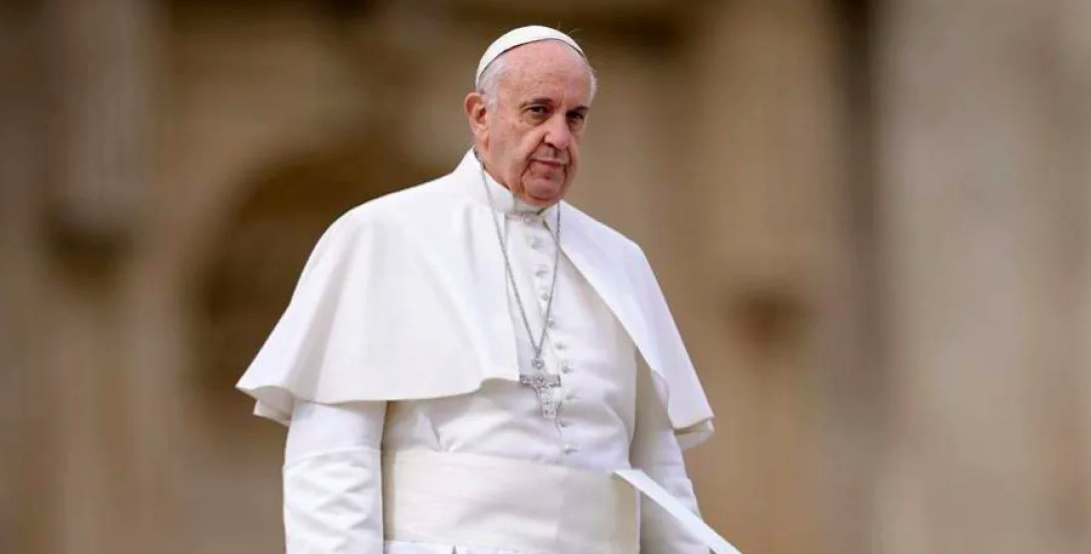
“I am a sinner. That is the most accurate definition. And this is not just a way of speaking, a verbal construct, a literary device, or a theatrical line. I am like Matthew in Caravaggio’s painting: a sinner upon whom the Lord turned His gaze. And that is precisely what I said when I was asked if I accepted my election to the papal throne: ‘Peccator sum, sed super misericordia et infinita patientia Domini nostri Jesu Christi confisus et in spiritu penitentiae accepto’ (I am a sinner, yet I trust in the boundless mercy and patience of our Lord Jesus Christ, and I accept it in a spirit of repentance).”
These are the characteristic words of a man who, in theory, is without sin—according to doctrine—Jorge Mario Bergoglio, who was born in 1936 in Flores, with roots from Piedmont, a place he always identified with since his ancestors migrated there to Buenos Aires in 1922.
“My family started as workers paving roads from the port to the fields, and soon they established a paving and asphalt business that flourished,” he describes in his autobiography “Hope,” translated by Anna Papastavrou. Since then, his family, his ancestors, and himself never ceased working, especially after the crisis of ’29: from cleaning workers to working for a Greek-Jewish man in a hosiery factory, and even as a bartender, having jobs ranging from porter to supervisor. They lived in a poor neighborhood, eating almost exclusively Italian dishes, like capelletti—tiny dough pieces pinched with their fingers—along with pizzas that he has always declared to love. From his family, he learned to appreciate music, especially opera.
He admits to loving carnival, costumes, and celebrations, and that, apart from his deep devotion to religion, he lived like a normal teenager. In his autobiography, he describes the girls he liked, the fights he had with his classmates while studying chemistry, which even led to him injuring someone seriously in the head, as well as his love for opera, music, and… soccer. During his internship, he even had to work hard not to think about a girl who had become an obsession, but as he confesses in his autobiography, “it was something normal; I would be abnormal if I hadn’t gone through these situations. Even today, I think if a boy or a girl hears the special call of God and doesn’t feel a little uncertainty, a little fear… something is missing. In such cases, I become a bit suspicious. The Lord calls us for great things, and it is healthy and beneficial for the excitement about that call to be accompanied by a little fear.”
Indeed, great things followed as Pope Francis became close to people, especially the poor and the marginalized, by washing the feet of prisoners, migrants, and Muslims, embracing diversity, including gay and transgender individuals, effectively granting them informal rights to marry. He also preferred not to stay in papal palaces, choosing instead to sleep in a modest room at Casa Santa Marta and eat with the staff—he even invited garbage collectors to Mass!
In his autobiography, he names things as they are, revealing that many representatives of the Papal Church were involved in sexual abuses and that he had to suspend a priest who had sexually exploited a disabled child. He is not afraid to speak about the gang rape of a girl in Africa, a story that was shared with him by the girl herself. He also never forgets to advocate for migrants, as he says he never forgot being a migrant child himself. For him, civilization means never forgetting your origins and your roots, which was in his mind when he took migrant families with him on the airplane after his visit to Lesbos, forever changing their destinies.
He proudly states that these children thrived, noting that a young woman from Syria, who followed him on the papal plane, is now a renowned biologist doing remarkable work. Even in the way he worships, he is unique: while he hasn’t changed many elements of papal doctrine, he remembers that his guiding figure—unlike other leaders of the Papal Church who invoke only Jesus—is the Virgin Mary, whom he appeals to in difficult moments of his life. For this reason, he formed a deep connection with Santa Maria Maggiore, his beloved church where he prayed on the day he became Pope and where he decided to reside after his death. It is, after all, the church that houses the statue of the Virgin Mary commissioned by Pope Benedict XV in 1918, asking her to end World War I.
Pizza and Soccer: What He Says About His Two Loves
“It’s as if I can smell the aroma of that pizza: perhaps for me, it’s somewhat like Proust’s madeleine. And to tell the truth, one of the little things I miss is going out to eat pizza,” is how Pope Francis describes his great weakness for pizza, as well as soccer. “As a cardinal, I loved walking the streets and taking the subway. Some found it strange and insisted on accompanying me to take the car, but sometimes reality is very simple: I’ve always loved walking. The street tells me a lot; I learn many things on the way. And I love the city, both above ground and underground, the streets, the squares, the taverns, a pizza at a little table outside, which has an entirely different taste than the one you order and have delivered: deep in my soul, I am a city dweller.”
It’s no coincidence that he has never stopped supporting his team, San Lorenzo—indeed, the Buenos Aires club wanted to rename the stadium “Pope Francis,” a suggestion he did not think was a good idea. “I watched almost all the home games of the 1946 championship, which we won just a few months before my 10th birthday, and over 70 years later, I still have that team before my eyes as if it were today: Blasina, Vancini, Basso, Zubieta, Greco, Colombo, Imbeloni, Faro, Martino, Silva… And all ten were wonderful. Then… there was also Pontoni. He was Rene Alejandro Pontoni, the center forward, the goal-scorer, the soul of Ciclón, as we called San Lorenzo, my favorite. He certainly didn’t have two left feet. He kicked equally well with both legs and was skilled at dribbling, inventive, strong in headers, acrobatics in backward scissors kicks. He could score in all sorts of ways, and I saw him score them all. ‘Let’s see if any of you has the courage to score a goal like Pontoni…,’ I said when I met the national soccer teams of Argentina and Italy, captained by Messi and Buffon respectively, for a charity match shortly after my election as Pope. Those young men smiled at me a bit awkwardly, likely not understanding what I meant, but that goal— that quick, quick, quick goal—was imprinted in my mind like so many things that captivate the gaze of a small child when their eyes are sponges, and the images remain forever. October 1946, the championship is nearing its end, and San Lorenzo is playing against Racing de Avellaneda: a shot from the left, Pontoni, with his back to the goal, controls with his chest and, without the ball even touching the ground, kicks it backward, evading the defender coming at him with a lobbed pass. Then, from the six-yard box, he launches a tremendous shot and the ball rockets to the right of the goalkeeper. Gooooal! Because if every goal in South America has more ‘o’s than in Europe, and every goal, even a small one, is a golazo, imagine that one. I hugged my father, I hugged my brothers, everyone embraced. Pontoni was for me the emblematic figure of that sport, soccer; he represented companionship, a love for a sport that wasn’t just about a bank account, because he, instead of listening to the sirens of millions calling him to Europe, preferred his team, chose to stay close to family, to friends, to those who loved him. He was great, and he remained so, even after the serious accident in a game that, two years later, dealt a heavy blow to his career. He wandered a bit around South America, Colombia, Brazil, then returned to San Lorenzo before hanging up his boots and opening a tavern. He lived a good life. His son, named Rene after his father, came to see me at the Vatican two years after my election.”
The Greek-Jewish Employer Where He Worked With His Family
“I had already done a few jobs in my grandparents’ store since I was 10, but I mostly liked to wander around the warehouse and sneak some candy. The store was based on trust: we delivered the goods, noted everything in a ledger, and people only paid at the end of the month. That was my grandparents’ job, and for me, it was fundamentally a game,” Pope Francis confesses about this “sinful” childhood condition, later revealing the Greek origin of one of their employers. “Now things were getting serious. My father found me a job in a hosiery factory with one of his clients, a Greek-Jewish man named Moze Nahmias, a decent man who even came to my ordination in the seminary. At the factory, I was responsible for cleaning. I worked there during my holidays for three years: cleaning the floors and toilets with a team of women and children, and occasionally taking on some administrative tasks entrusted to me.
Upon finishing high school, I considered becoming a doctor. I had even pre-registered at a college close to home, on Carrabombo street, right across from the apartment building where a soccer player lived, who, as a young man, enjoyed challenging the kids from Flores to matches where it was everyone against everyone until dusk, and later became one of the greatest soccer players of all time: his name was Alfredo Di Stefano. In short, I thought I would spend five years at General Urquiza High School, and then go to university. However, one Sunday at the table with my maternal grandparents, Uncle Luigi and Uncle Vicente said to me: ‘And then? You’ll come out of there and be a half encyclopedia, knowing a little about everything and nothing; it’s better to choose a technical school. You’ll spend an extra year, six instead of five, but you’ll graduate with a future ahead of you; you’ll be a chemist, an engineer; you’ll build houses, you’ll be able to sign plans.’ Whoever graduated from those schools could sign plans for constructing buildings up to two stories.
I was convinced. Meanwhile, just a few months earlier, classes had begun at a state Chemistry school specializing in Nutrition, an experimental, model school that selected a handful of students each year who could then attend any university, even in Chicago, which was already known as one of the finest centers for study and research in the world. So I enrolled there.”
How Cardinals Reach the Final Vote—How He Became Pope of the Catholic Church
The account of how he was elected Pope is also revealing, as it was something he, as he admits, never expected. In the corresponding chapter, he reveals that the smoke comes from the ballots that the cardinals burn and how they use chemicals to alter the smoke’s color, making the difference between black and white clear. “The next day, Tuesday, March 12, the conclave began. I arrived in the morning at Santa Marta with a suitcase where I had put two cassocks I had kept in Rome and very few other things. I had left everything in Buenos Aires, the books I had just started reading, the speeches I had prepared for Palm Sunday and Holy Thursday, along with some clutter. I had already purchased my return ticket for Saturday the 23rd; no one was going to be declared Pope during Holy Week, I thought: I’ll take the plane on Saturday and leave. I’ll return home. Period. At Santa Marta, the cardinals lined up at the entrance waiting to be checked and have their briefcases recorded, which were not permitted to contain phones, computers, or any other devices. No newspapers. Strict confidentiality prevails throughout the conclave. The windows are closed, and mobile phones are turned off. They let me through: “Do come in, Your Eminence; we’ll give you your little bag inside.” Everything was armored, at Santa Marta just like in the Sistine Chapel. At the moment the messenger came to hand me the bag and shouted, “Cardinal Bergoglio?” someone behind him, as I later learned, commented, “He might accept it after all.” Perhaps some cardinals were already discussing it, in some way. However, I heard nothing; of course, at no point did such a thought enter my mind. When I reflected on it later, I also remembered that in the preceding days, on Via della Scrofa, an archbishop had come to ask me what I thought about the situation. More or less, however, everyone was asking us that. I had vaguely responded, ‘I don’t know, these are names we all know…’ ‘What if it’s you?’ he had asked me. Well, come on, let’s drop the jokes. ‘But would you accept?’ I shot back: ‘Look, today, at the point the Church is at, no cardinal can say no… Period. The only thing I wanted was to get out of that awkward exchange. At 10 AM on Tuesday, the Mass pro eligendo Romano Pontifice (for the election of the Roman Pontiff) was celebrated at St. Peter’s, which inaugurated the ceremony. In the afternoon, the procession, which led us from the Pauline Chapel to the Sistine Chapel for the official swearing-in, took place. That evening, the conclave reached its first vote, which usually has a somewhat courteous character. You vote for your friend, for someone you appreciate… A mechanism begins that is fairly known and established: when there are several strong candidates, anyone still undecided, like I was, casts their vote for someone they know won’t be elected. Essentially, they’re parking votes, waiting for the situation to evolve and for clarity to emerge. That’s why I received votes, but I was fully aware they were “parked” votes. I felt completely relaxed. The next morning, Wednesday the 13th, in the second ballot, I still had “parked” votes. And in the third, one or two more. It was clear it was a fluid situation; nothing had been decided, so there was nothing particularly surprising for me. I was focused on doing everything as well as possible to catch my flight to Buenos Aires and celebrate Palm Sunday and Easter there. Once the black smoke came out, I moved to the dining room for lunch, but first, I went to find the Archbishop of Havana, Jaime Lucas Ortega, who had asked me to bring him, if I could, the text of the speech I had made in the general meetings. I had no written text, so I tried to summarize what I had said into four main points. ‘Ah, thank you; this way I’ll have a memory of the Pope,’ he said. Once again, I found that funny. Ortega asked me if he could share the text, and I said yes. In the elevator, I met another cardinal, also from Latin America: “Did you prepare your speech? Make it well, okay?” “What speech?” I said. “Well, the one you have to give from the balcony!” Another joke? Or something he said out of politeness? Perhaps it was simply a wish of his.
Ask me anything
Explore related questions