





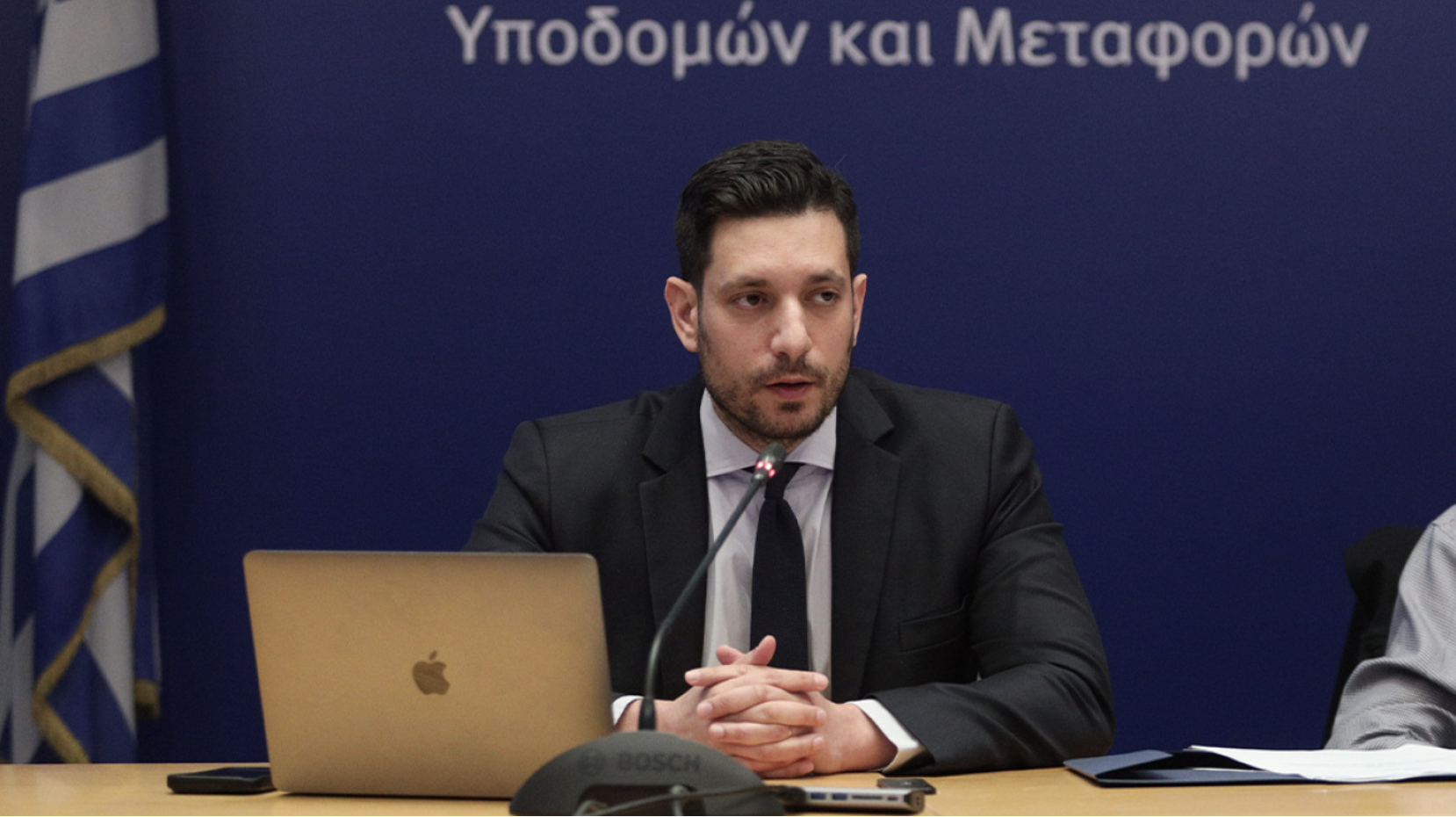
Kyranakis is holding a live press conference regarding the bill aimed at the modernization of the railways.
According to Mr. Kyranakis, the platform railway.gov.gr will be created so that citizens can track the real-time location of trains. The system is expected to be ready in three months. “An important aspect of the application is that the executed routes will not be declared manually or on paper; they will be derived from digital data,” Mr. Kyranakis said.
“With the new application for recording orders and violations, every individual performing critical tasks will have their activity recorded daily,” he added, announcing that violations of the regulations will be classified into three levels, depending on their severity (high, medium, and low risk). “We will see in real time who is doing their job properly,” he emphasized.
Regarding penalties for regulation violations, they will range from mandatory retraining to dismissal, according to Kyranakis.
A train supervisor will now be appointed, trained both as a stationmaster and a driver, effectively acting as the “train manager.”
He outlined the additional applications:
- Digital Railway Data Register
- Precise train geolocation system
- Application for recording orders and violations
He stated that the new Railway Safety Structures will include the establishment and operation of the OSE Unified Supervision Center, with capabilities for supervising trains, collecting traffic data, monitoring risk assessments, providing preventive alerts, and immediate emergency intervention.
He also discussed the training and evaluation of railway personnel, with stricter penalties:
- Evaluation tests for critical task personnel before and after hiring
- Cooperation with the Armed Forces for the evaluation of security personnel
- Appointment of a Train Supervisor
- Establishment of a Special Railway Inspectors Unit
- Penalties for General Traffic Regulation Violations
- Access to facilities and training services for railway company and infrastructure manager personnel
- Expansion of certification for maintenance responsibility bodies
On the accelerated staffing of RAS (Railway Regulatory Authority) and EODASAAM (Special Service for the Certification of Railway Staff and Rolling Stock), he noted:
- Faster hiring processes for RAS
- Faster hiring processes for EODASAAM
- Independence in resource management for EODASAAM
The modern corporate structure of the new OSE (Hellenic Railways Organization) focuses on strengthening efficiency and speeding up processes, emphasizing:
- Staffing with private-sector economic terms
- Attracting executives from abroad
- Faster hiring for critical safety tasks
- Faster tendering and implementation processes for key railway projects
According to Kyranakis, OSE’s training center will also be upgraded, and talks have already begun with international organizations.
“Our central philosophy is to make safety visible. We believe this is the best way to restore the trust gap between society and the railways. We are determined to succeed with OSE,” he stated.
He also mentioned that “we are in renegotiations with Hellenic Train on all issues.”
The Deputy Minister referred to contracts concerning, among others, the restoration of the Thessaly network, underground works at Sepolia, and contracts in the Peloponnese and Domokos.
“We want all employees to show the professionalism and high readiness that many already have, and good performance will be rewarded,” he said.
“We wanted a system that would allow us to see, with centimeter accuracy, where the trains are in real-time. This system provides an additional safety layer,” Kyranakis explained.
He also emphasized that to attract investors, the railway projects must be completed to meet European standards.
“The strategy chosen is to hire a technical consultant of international stature for the new OSE. Practically, this means that any company awarded the contract must bring in executives for five years (…). One of the organizations we are in talks with is French, but not the only one. We will negotiate with several countries that have reliable rail systems and make our decision based on availability, willingness to collaborate, and cost,” said the Deputy Minister of Transport.
Ask me anything
Explore related questions




