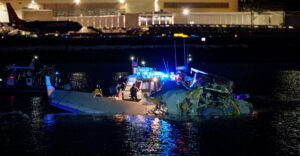
Shocking new evidence of the Black Hawk helicopter crash with an American Airlines passenger jet over the Potomac River in Washington, D.C., brings to light a recent report revealing that the pilot of the military helicopter failed to obey critical course change instructions just seconds before the crash.
On the evening of January 29, Captain Rebecca Lobach was conducting her annual flight evaluation with her co-pilot and instructor, Lt. Andrew Lloyd Eaves. Three months later, The New York Times revealed that Lobach made multiple errors, leading to one of the worst tragedies in aviation history.
Ignored commands to change course
According to the evidence, Lobach was flying the Black Hawk at excessive altitude and, in the last critical seconds, neglected to comply with both control tower commands and her co-pilot’s exhortations to turn left. About 15 seconds before the collision, air traffic controllers gave a change of course order, which Lobach acknowledged but did not execute.
Sergeant Eaves, realizing the danger, verbally reminded her of the instruction, however, again there was no reaction. The result was fatal: the helicopter and the American Airlines passenger jet collided, resulting in 67 deaths – all on board both aircraft.
All 67 passengers were killed in the crash, including all of the passengers on board and all the passengers on board.
Investigators may never know why Lobach did not react. She and her co-pilot had previously requested to continue the flight with “visual separation,” a procedure that allows pilots to avoid other aircraft based on visual contact rather than tower commands.
But, as experts have pointed out, when visual separation is not performed properly, it poses deadly risks. According to the finding, if Lobach had turned to the left, she would have opened critical distance from the passenger aircraft operating Flight 5342.
Technical difficulties and lost communication
Another significant finding was that communications suffered severe interference that night. Investigators found that at the time the command to “pass behind the aircraft” was given, the Black Hawk crew was likely pressing the transmit key, resulting in them not hearing the key phrase.
In addition, the helicopter’s ADS-B automatic tracking system – which provides accurate position and altitude data to controllers and crews – was turned off for no apparent reason.
National Transportation Safety Board (NTSB) chief Jennifer Homedy said the Black Hawk was recording incomplete radio communications and that the crew wore night vision goggles throughout the flight, with no evidence they were removed.
The tragic losses
The passenger plane, which had taken off from Wichita, Kansas, and was preparing to land, was flying at an altitude of 313 feet just two seconds before the crash. Its captain, Jonathan Campos, 34, had dreamed of becoming a pilot since he was a boy.
The aircraft was carrying students and parents from Northern Virginia schools, as well as members of the Boston Skating Club, who were returning from a training program following the USA Figure Skating Championships 2025.
Lobach, a native of Durham, North Carolina, was an Army Air Force officer with about 500 flight hours and had also served as a military social worker at the White House during the Biden administration.
Ask me anything
Explore related questions